
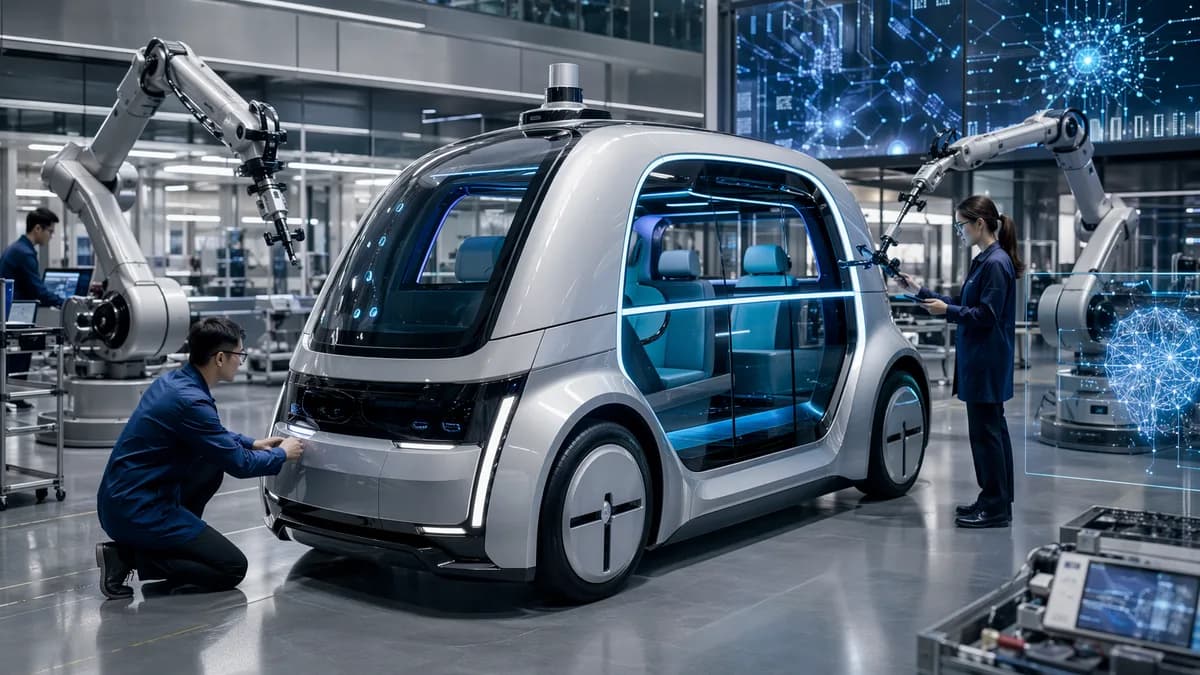
The refreshed Zoox robotaxi signals that Amazon’s autonomous vehicle unit thinks its steering-wheel-free vehicle is no longer just a test machine, it’s a product headed for production. Zoox unveiled an updated version of its boxy, bidirectional robotaxi and called it the “next evolution” of the vehicle it wants to mass-produce.
TechnologyJune 24, 2026· 6 min read· By XOOMAR Insights Team
No-Wheel Zoox Robotaxi Sharpens Its Paid Ride Pitch
Updated on June 26, 2026
XOOMAR Intelligence
Analyst Take
73/ 100
4 sources analyzedMedium confidenceTrend10Freshness100Source Trust88Factual Grounding94Signal Cluster20
The update centers on rider comfort, clearer vehicle communication, and production readiness, according to The Verge. The timing matters because Zoox is already running free robotaxi service in San Francisco, Las Vegas, Austin, and Miami, but it still needs federal approval before it can charge riders in a vehicle with no steering wheel or pedals.
Zoox refreshes its steering-wheel-free robotaxi for mass production
Zoox’s core bet is unchanged: the robotaxi should be built around passengers, not drivers. The updated Zoox robotaxi keeps the same purpose-built shape that separates it from fleets based on modified consumer cars. It has no traditional driving controls, no steering wheel, and no pedals. Its cabin uses two bench seats facing each other, and its symmetrical body lets it drive in either direction without making a 180-degree turn.
The refresh doesn’t reinvent the vehicle’s concept. It polishes the parts riders actually touch. Zoox brightened the interior with “monochrome aloe green seating and stone-grey flooring and trim,” a choice the company says should create a calmer cabin and make it easier to spot darker personal items such as phones and keys. The seats now get more padding and ergonomic curves, a direct answer to rider complaints.
That counterpoint matters. A skeptic could look at this update and see small changes: color, cushioning, cupholders, a sharper screen. But those are exactly the details that separate a technology demo from a robotaxi ride service people will use repeatedly. The Verge previously reported that contributor Abigail Bassett found the earlier seats too firm, with road bumps that could “travel directly through your seat and into your body.”
Zoox also revised the touchscreen, added fluting to the wireless phone charging pad for stability, and made the cupholders bigger. The exterior gains bidirectional reflectors that can rotate colors to show which direction the vehicle is traveling. Sliding, elevator-like doors now include a new speaker and microphone, with expanded two-way audio.
Zoox says the door and audio changes will “ensure clearer communication to our riders and other road users, as well as between Zoox Support and first responders.”
The strongest evidence that Zoox sees this as more than a cosmetic pass is the production plan. The new iteration is set to enter production at Zoox’s Hayward, Calif. facility, where the company says it has capacity to scale up to 100 vehicles a week.
Amazon’s Zoox keeps betting on a custom robotaxi as rivals use regular cars
Zoox is taking the harder route because it wants control over the whole ride experience. Other robotaxi operators have typically used vehicles with familiar nameplates and added autonomous systems. Zoox is sticking with a vehicle designed from day one for autonomy, ride-hailing, and passenger flow.
That choice gives Zoox a cleaner product story. There’s no driver’s seat to repurpose, no steering wheel to ignore, and no front-facing cabin layout inherited from a human-driven car. The carriage-style seating makes the ride feel more social, and the bidirectional design removes the need for some turns that a conventional vehicle would need to make.
| Design choice | Zoox robotaxi | Typical modified robotaxi approach |
|---|---|---|
| Vehicle base | Purpose-built for autonomy | Based on familiar consumer vehicle models |
| Controls | No steering wheel or pedals | Traditional controls usually remain |
| Cabin layout | Facing bench seats for passengers | Conventional forward-facing layout |
| Directionality | Drives either direction | Built around a front and rear |
The risk is just as clear. A custom vehicle gives Zoox fewer fallback options if regulators slow approval or if production proves harder than expected. A modified consumer car can still resemble the rules and assumptions built around ordinary vehicles. The Zoox robotaxi challenges those assumptions directly.
Amazon’s ownership raises the stakes. This is a long-horizon hardware and service bet, far from the retail battles XOOMAR tracks in Flipkart Quick Commerce Puts Amazon India on the Clock or consumer deal coverage such as LG C5 OLED Crashes to $899 in Rare Prime Day Deal at Amazon. Zoox is Amazon playing in transportation infrastructure, not just selling devices or moving packages.
The thesis still holds because Zoox’s design advantages are inseparable from the regulatory problem. The same missing steering wheel that makes the cabin feel purpose-built is the feature that requires federal permission. What would prove this strategy wrong is not a bad color palette or an uncomfortable seat. It would be a regulatory or production bottleneck that keeps the vehicle from turning its design into paid service.
Federal safety exemption remains the key hurdle for Zoox’s robotaxi rollout
The refreshed vehicle can look production-ready, but regulators still decide whether Zoox can turn free rides into a commercial service. The company is waiting for a federal exemption from safety rules that assume production vehicles include traditional controls such as steering wheels and pedals. Forbes has described that pathway as a “Part 555” exemption from the National Highway Traffic Safety Administration, covering vehicles that don’t comply with federally mandated features.
Zoox already has free service operating in San Francisco, Las Vegas, Austin, and Miami. That puts real riders inside the vehicle, and it gives Zoox feedback on comfort, communication, and usability. The new cabin changes show the company is responding to that feedback before scaling.
The harder question is whether the federal government is ready to approve a vehicle that breaks the old car template. The Verge reports that Zoox is waiting for approval before it can collect fares from passengers. Until that happens, mass production capacity in Hayward is a signal of readiness, not proof of commercial launch.
There’s a practical reading here. Zoox is reducing the reasons riders might reject the service once regulators clear it: hard seats, unclear direction indicators, unstable phone charging, small cupholders, and limited audio communication. Those aren’t minor annoyances in a driverless vehicle. In a cabin with no human driver, every interface has to carry more weight.
The next test is not whether the Zoox robotaxi looks more finished. It does. The watch item is whether federal approval arrives in a form broad enough for Zoox to charge riders and scale production beyond limited service areas. If that happens, the refreshed robotaxi becomes Amazon’s first real shot at a paid autonomous ride product. If it doesn’t, the new design remains a sharper prototype waiting on permission to become a business.
The Bottom Line
- Zoox is moving its robotaxi from a test vehicle toward a production service.
- The refresh focuses on rider comfort, which could affect whether passengers use robotaxis repeatedly.
- Federal approval remains the key hurdle before Zoox can charge for rides in vehicles without steering wheels or pedals.
Zoox Robotaxi Refresh vs. Original Concept
| Area | Original/Existing Approach | Refreshed Version |
|---|---|---|
| Vehicle concept | Purpose-built robotaxi with no steering wheel or pedals | Same steering-wheel-free, pedal-free design aimed at mass production |
| Cabin layout | Two bench seats facing each other | Same passenger-focused layout with improved comfort |
| Interior design | Earlier rider-facing finishes | Monochrome aloe green seating with stone-grey flooring and trim |
| Seat comfort | Rider complaints about comfort | More padding and ergonomic curves |
| Service status | Free robotaxi service in select cities | Updated vehicle positioned as production-ready, pending federal approval to charge riders |
Sources

Written by
XOOMAR Insights Team
Research and Editorial Desk
The XOOMAR Insights Team pairs automated research with human editorial judgment. We track hundreds of sources across technology, fintech, trading, SaaS, and cybersecurity, cross-check the facts, and explain what happened, why it matters, and what to watch next. We do not just rewrite headlines. Every article is fact-checked and scored for reliability before it goes live, and we link back to the original sources so you can verify anything yourself.
Explore More Topics
Related Articles
 Technology
Amazon's Gas Plant Permits 33 Million Tons of CO2
Amazon's planned Texas data center, powered by a dedicated natural gas plant, has a permit to emit 33 million tons of CO2 annually, potentially making it the la
Aug 8, 20267 min
 Technology
Robotaxis Need a Backbone — Moove Just Raised $250M to Build It
Moove raised $250M, pivoting from ride-hailing financing to become the physical backbone for scaling robotaxi fleets, aiming to own the depots and maintenance f
Aug 5, 20265 min
 Technology
Ninja Slashes Kitchen Appliance Prices Up to 40%
Ninja is discounting its entire line of premium kitchen appliances on Amazon by up to 40%, a surprising move that trades margin for sales volume.
Aug 9, 20265 min
 Technology
Amazon's Texas Gas Power Plant Betrays Climate Pledge
Amazon's investment in a private gas-fired power plant to run its Texas AI data centers makes a mockery of the company's Climate Pledge, prioritizing power reli
Aug 8, 20267 min
 Technology
Amazon's Luxury Kindle Costs Four Times the Paperwhite
Amazon's new Kindle Scribe Colorsoft costs $630, roughly four times a Paperwhite, pushing e-readers into the luxury accessory category with color features more
Aug 8, 20267 min
 Trading
Strait of Hormuz Shutdown Lifts Oil Prices 6%
WTI crude oil jumped over 6% after Iran confirmed talks on shipping routes don't mean the Strait of Hormuz will reopen, setting the stage for a prolonged geopol
Aug 10, 20268 min
 Trading
Stocks Ignore Record Job Losses as Fed Pledge Trumps Payrolls
The Dow Jones Industrial Average showed no fear after July's shocking job losses, as investors bet weak labor data will keep the Federal Reserve from raising ra
Aug 10, 20266 min
 Fintech
CPI Print Holds Key to Crypto Rally or Ruin
Crypto's fate this week balances on a knife edge, with the July CPI report poised to dictate Fed policy and market risk appetite, while earnings reveal which co
Aug 10, 20266 min
 Global Trends
Court Cancels Russia's Only Anti-War Party on 'Extremism'
A Moscow court disqualified Russia's only registered anti-war political party from parliamentary elections, using allegations of extremism and copyright infring
Aug 10, 20266 min
 Fintech
Banks Invade Earned Wage Access, Force Fintechs Out
Major banks and credit unions are launching earned wage access to retain customers and gather data, forcing original fintech providers into a defensive scramble
Aug 10, 20264 min
Don't miss the signal
Get our weekly roundup of the stories that matter across tech, fintech, and trading. No noise, just signal.
Free forever. No spam. Unsubscribe anytime.