
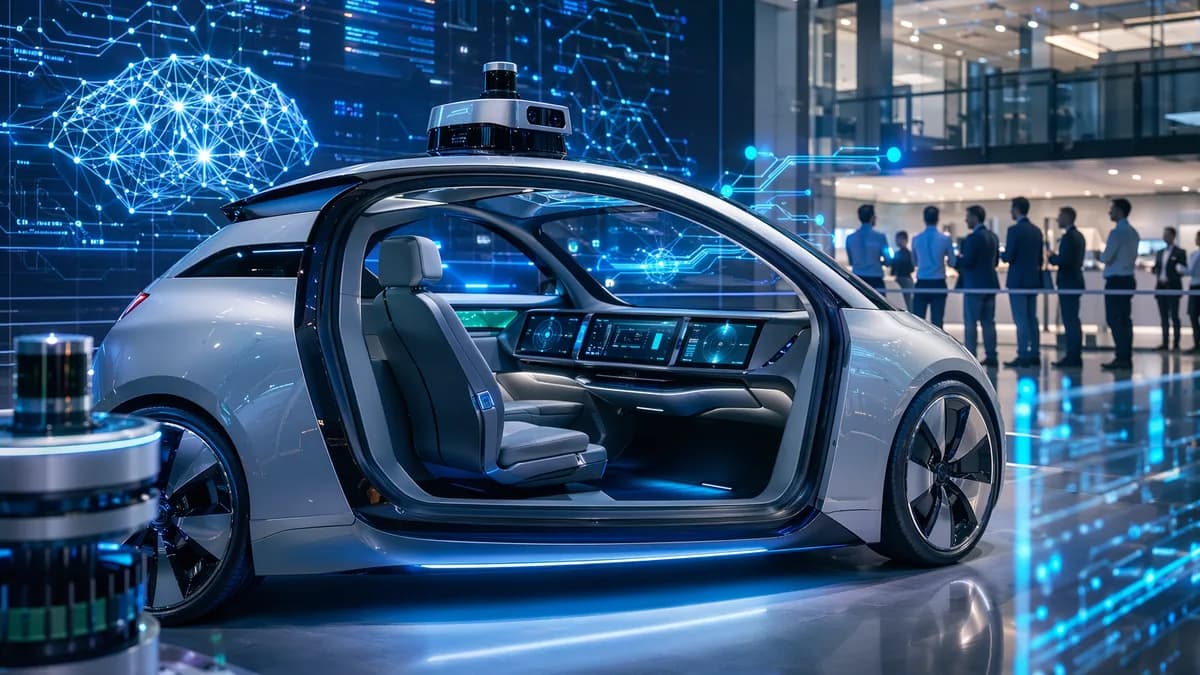
Washington is signaling that purpose-built robotaxis may no longer have to pretend they were built for human drivers. The Trump administration’s proposed change to the brake pedal requirement for AVs would let companies omit manual brake pedals in vehicles “designed to be driven exclusively by automated driving systems,” according to TechCrunch.
TechnologyJune 26, 2026· 8 min read· By XOOMAR Insights Team
Tesla Wins as Trump Targets Robotaxi Brake Pedal Rule
Updated on June 26, 2026
XOOMAR Intelligence
Analyst Take
58/ 100
4 sources analyzedLow confidenceTrend10Freshness99Source Trust90Factual Grounding90Signal Cluster20
That is a clear policy boost for Tesla, Zoox, and any company designing vehicles around autonomy rather than retrofitting conventional cars. It doesn’t approve robotaxis by itself. It does something narrower but still important: it starts moving federal vehicle rules away from the assumption that a human, a steering wheel, and a pedal box sit at the center of every car.
Trump’s brake pedal rollback gives robotaxi developers a cleaner design path
The Department of Transportation proposal targets a specific mismatch. Federal Motor Vehicle Safety Standards were built around vehicles with human controls. Fully autonomous vehicle developers want to build vehicles where those controls are absent by design.
Under current rules, a company developing an autonomous vehicle that lacks required FMVSS equipment has to request an exemption from the federal government. Even if granted, that exemption comes with limits on how many vehicles can operate on U.S. roads. Reuters, via U.S. News, reported that NHTSA has authority to allow up to 2,500 vehicles per manufacturer yearly without required human controls.
That cap matters. A test fleet can fit inside it. A scaled robotaxi business cannot.
NHTSA Administrator Jonathan Morrison framed the proposal as part of a broader push under Secretary Sean Duffy’s AV Framework:
“We are at the cusp of the greatest technological revolution in vehicle technology since the innovation of the Model T,” Morrison said. “If we want America to lead the way, we have to reimagine our regulatory framework.”
XOOMAR analysis: the brake pedal proposal is less about one component than about who gets trusted. Removing the pedal shifts more confidence from mechanical human override to automated driving systems, software validation, remote assistance, and federal safety performance rules.
The DOT proposal is aimed at vehicles built only for automated driving systems
The proposed rule would apply to vehicles “designed to be driven exclusively by automated driving systems.” That distinction is central. This is not about cars with driver-assistance features where a human is still expected to intervene. It is about vehicles where no human control is part of the operating model.
Reuters reported that the proposal would not apply to vehicles with human driver controls. NHTSA also said it would not drop braking performance requirements, including stopping distance standards for self-driving vehicles. In other words, the agency is not saying brakes no longer matter. It is saying the physical interface for braking may not need to be a foot pedal if no human is meant to use it.
That creates a sharper regulatory line between two categories:
| Vehicle type | Human controls | Regulatory implication from the proposal |
|---|---|---|
| Conventional or modified vehicles | Yes | Brake pedal rules remain relevant |
| Purpose-built AVs | No | Manual brake pedal requirement could be removed |
| Robotaxis with no steering wheel or pedals | No | Could avoid some exemption bottlenecks if final rule is adopted |
The public now has 30 days to comment before DOT decides whether to approve the changes. That comment period is where safety advocates, automakers, AV developers, and state officials can press for tighter reporting, clearer testing standards, or limits on how no-pedal vehicles enter service.
The numbers that actually matter are regulatory, not market forecasts
The supplied sources do not provide reliable AV market-size estimates, so the useful numbers here are procedural and operational: 30 days for public comment, 2,500 vehicles per manufacturer yearly under exemption authority, and NHTSA’s existing stopping distance requirements.
Those numbers explain why the brake pedal requirement for AVs is a commercial issue. A company can absorb a slow exemption process while demonstrating a limited fleet. It cannot build a national robotaxi strategy around case-by-case approvals and annual caps.
Tesla is the clearest beneficiary in the source material. The company has spent years developing the Cybercab, a two-seater vehicle intended to operate without a steering wheel or pedals. TechCrunch reports that Tesla has never applied for an exemption from FMVSS standards requiring those controls. Elon Musk has instead said the company would deploy the vehicles nationwide once regulatory approval was granted.
Tesla’s current bridge is smaller. TechCrunch says the company has been operating a small robotaxi service in Austin, Texas, initially with safety drivers in the front seats, then steadily removing them and leaving cars to operate “unsupervised.” Tesla has also admitted to NHTSA that it uses teleoperators to monitor and, in rare cases, move vehicles remotely at low speeds after crashes or to avoid obstacles.
That last detail matters more than the missing pedal. If the human fallback is not in the car, regulators will care how intervention happens, who triggers it, what data is retained, and what failures require a remote move.
For related Tesla safety context, readers can see Doorbell Cam Catches Tesla Autopilot Crash Killing Woman.
Tesla, Zoox, and Waymo sit on different sides of the same rule
Tesla benefits strategically because its proposed robotaxi design depends on removing traditional controls. A final rule would reduce one major design barrier for Cybercab. It would not prove that Tesla’s system is safe enough for broad deployment.
Zoox is in a different position. The Amazon-owned company applied for and received an exemption last year so it could demonstrate its purpose-built robotaxi. It has since applied for another exemption to operate that robotaxi commercially, according to TechCrunch. A rule change could make that path less dependent on special permission.
Waymo shows the opposite model. TechCrunch notes that companies using retrofitted or modified versions of regular vehicles, such as the Jaguar I-Pace, have been able to deploy as many robotaxis as they want because those vehicles already include manual controls.
That creates a strategic split:
- Tesla: Wants purpose-built autonomy, but has not applied for the relevant FMVSS exemption.
- Zoox: Built around no-wheel, no-pedal design and has used the exemption process.
- Waymo: Avoids this specific hardware fight by keeping conventional controls in modified vehicles.
Readers tracking Amazon’s AV unit can pair this policy shift with No-Wheel Zoox Robotaxi Sharpens Its Paid Ride Pitch.
From steering wheels to no-pedal pods, the federal framework is catching up slowly
This proposal did not appear from nowhere. TechCrunch reports that NHTSA, under President Biden, proposed and finalized a rule allowing autonomous vehicles to operate without steering wheels. The Trump DOT has since proposed additional changes, including earlier NHTSA proposals around windshield wiping and defogging systems, and tire placards.
Reuters also reported that NHTSA withdrew a Biden-era proposal to adopt a voluntary national framework for evaluation and oversight of self-driving vehicles. The agency said automakers viewed some requirements as too stringent, while some safety advocates said the framework would not give NHTSA enough oversight to ensure an appropriate safety level.
That tension is the core fight. AV developers want rules that recognize vehicles without drivers. Safety advocates want proof that removing human controls does not remove accountability.
XOOMAR analysis: the strongest argument for the DOT proposal is consistency. If a vehicle is legally and technically designed never to be driven by a human, requiring a foot-operated brake pedal becomes a legacy artifact. The strongest counterargument is that regulators are removing familiar physical safeguards before the public has clear, comparable evidence on how these systems perform across edge cases.
Robotaxis may lose pedals before they gain public trust
A final rule would likely accelerate no-pedal prototype and fleet designs before it delivers mass-market robotaxis. Design permission is not the same as deployment permission. Companies still need to satisfy safety rules, operate within state and city constraints, and prove their vehicles can handle real roads without an onboard human fallback.
The practical risk calculus changes for riders, cities, and insurers. If there is no driver and no brake pedal, responsibility shifts further toward the automaker, software developer, fleet operator, teleoperation process, and maintenance chain. The sources do not spell out liability rules, but the design change makes that allocation harder to ignore.
Tesla will likely treat the proposal as validation for its Cybercab strategy. Investors should be more disciplined. The evidence to watch is not whether the cabin has pedals. It is whether Tesla, Zoox, and others can show safe performance, transparent incident handling, workable remote assistance, and scalable operations under whatever final rule DOT adopts.
Washington may remove the brake pedal requirement for AVs from the rulebook. The industry still has to prove the software is safer than the human foot it wants to replace.
Impact Analysis
- The proposal could reduce a key federal barrier for purpose-built robotaxis without brake pedals.
- Tesla, Zoox, and other AV developers may gain more flexibility to design vehicles around autonomy instead of human drivers.
- The change does not approve robotaxis outright, but it could make scaling beyond limited test fleets easier.
Current AV Rules vs Proposed Brake Pedal Rollback
| Issue | Current Rules | Proposed Change |
|---|---|---|
| Human controls | Federal standards assume vehicles include required human controls such as brake pedals. | Vehicles designed exclusively for automated driving systems could omit manual brake pedals. |
| Approval path | Companies without required equipment must seek federal exemptions. | Purpose-built AVs would face a cleaner regulatory path for compliant design. |
| Scale impact | NHTSA exemptions allow up to 2,500 vehicles per manufacturer yearly. | The proposal could make larger robotaxi deployments easier if finalized. |
Current NHTSA Exemption Cap for AVs Without Required Human Controls
Vehicles per manufacturer yearly
vehicles2,500
Sources

Written by
XOOMAR Insights Team
Research and Editorial Desk
The XOOMAR Insights Team pairs automated research with human editorial judgment. We track hundreds of sources across technology, fintech, trading, SaaS, and cybersecurity, cross-check the facts, and explain what happened, why it matters, and what to watch next. We do not just rewrite headlines. Every article is fact-checked and scored for reliability before it goes live, and we link back to the original sources so you can verify anything yourself.
Explore More Topics
Related Articles
 Technology
49ers Coach Blames Tesla Autopilot for Bone-Breaking Crash
San Francisco 49ers head coach Kyle Shanahan suffered broken bones in a crash where his Tesla was on Autopilot, revealing deep confusion over whether the system
Aug 9, 202610 min
 Technology
Robotaxis Need a Backbone — Moove Just Raised $250M to Build It
Moove raised $250M, pivoting from ride-hailing financing to become the physical backbone for scaling robotaxi fleets, aiming to own the depots and maintenance f
Aug 5, 20265 min
 Technology
Honda's Profit Doubles After Worst Annual Loss Ever
Honda's quarterly profit more than doubled to $2.9 billion in a dramatic recovery, just months after posting its first-ever annual loss, driven by vehicle sales
Aug 9, 20264 min
 Technology
Amazon's Gas Plant Permits 33 Million Tons of CO2
Amazon's planned Texas data center, powered by a dedicated natural gas plant, has a permit to emit 33 million tons of CO2 annually, potentially making it the la
Aug 8, 20267 min
 Technology
Ford's Fathom EV Model T Claim Masks Deep Sales Crisis
Ford CEO Jim Farley's pitch of the Fathom EV as a 'Model T moment' reveals a desperate company struggling for relevance as its sales sit at less than half their
Aug 8, 20266 min
 Trading
Strait of Hormuz Shutdown Lifts Oil Prices 6%
WTI crude oil jumped over 6% after Iran confirmed talks on shipping routes don't mean the Strait of Hormuz will reopen, setting the stage for a prolonged geopol
Aug 10, 20268 min
 Trading
Stocks Ignore Record Job Losses as Fed Pledge Trumps Payrolls
The Dow Jones Industrial Average showed no fear after July's shocking job losses, as investors bet weak labor data will keep the Federal Reserve from raising ra
Aug 10, 20266 min
 Fintech
CPI Print Holds Key to Crypto Rally or Ruin
Crypto's fate this week balances on a knife edge, with the July CPI report poised to dictate Fed policy and market risk appetite, while earnings reveal which co
Aug 10, 20266 min
 Fintech
Banks Invade Earned Wage Access, Force Fintechs Out
Major banks and credit unions are launching earned wage access to retain customers and gather data, forcing original fintech providers into a defensive scramble
Aug 10, 20264 min
 Fintech
Brazil Aims Pix Payments at Global Payment Giants
Brazil's central bank is pushing its dominant Pix instant payment system onto the global stage, aiming to reshape cross-border payments and challenge establishe
Aug 10, 20267 min
Don't miss the signal
Get our weekly roundup of the stories that matter across tech, fintech, and trading. No noise, just signal.
Free forever. No spam. Unsubscribe anytime.