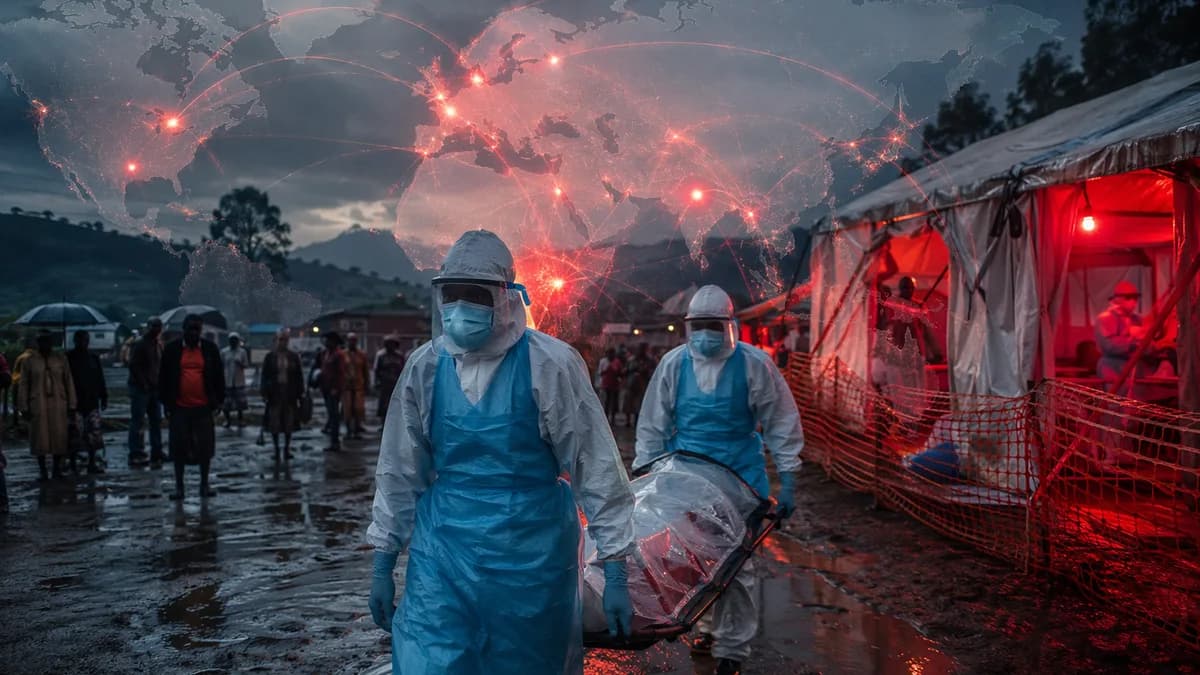
The Congo Ebola outbreak has already killed at least 930 people, and the deeper warning is that violence, staff walkouts, and a virus with no approved vaccine or treatment are now colliding inside the same emergency.
XOOMAR Intelligence
Analyst Take
Congo’s Ministry of Health said the deaths came from 2,344 confirmed cases as of Saturday, with 37 new deaths recorded in the previous 24 hours, according to ABC International. The outbreak was declared in eastern Congo on May 15 and is described in the source as the fastest-growing Ebola outbreak on record.
Congo's 930 Ebola deaths expose a public health failure bigger than the virus
The headline number is brutal. The operating conditions behind it are worse.
The source material points to a response squeezed from several directions at once: safety fears have restricted work in Ituri, at least 12 attacks have been recorded against health facilities and teams since mid-May, and many health workers have walked off their jobs over lack of payment. At least 36 health workers infected with the virus have died.
That changes how to read “at least 930.” It’s not just a death toll. It’s a minimum count from a system trying to track a fast-moving outbreak while parts of the response are being attacked, interrupted, or understaffed.
“The Bundibugyo virus responsible for the outbreak is less common than others that cause Ebola disease, and there is no approved vaccine or treatment.”
XOOMAR analysis: this outbreak is not only an epidemiological problem. It’s an access problem. If responders can’t safely reach patients, if health workers are unpaid, and if clinics become targets, the virus gets time. Ebola control depends on speed: find cases, isolate patients, trace contacts, protect staff. Every broken link gives transmission another opening.
The numbers behind the Congo Ebola outbreak show severe strain
The confirmed figures already imply a high fatality burden:
| Indicator | Source-grounded figure |
|---|---|
| Confirmed cases | 2,344 |
| Deaths | At least 930 |
| Deaths in previous 24 hours | 37 |
| Patients in isolation and hospitals | 724 |
| Health workers infected and dead | At least 36 |
| Attacks on health facilities and teams | At least 12 |
Based on the confirmed cases and deaths reported by the ministry, the apparent fatality rate is about 39.7%. That is a simple calculation from the published figures, not a final epidemiological estimate. It can shift as cases are confirmed, patients recover, or delayed deaths are added.
The source gives confirmed cases only. It does not provide a current count of suspected or probable cases for this outbreak. That matters because surveillance quality shapes the apparent scale of any Ebola emergency. If testing, transport, or reporting breaks down, the official number can lag the reality on the ground.
Daily spikes also need careful handling. 37 deaths in 24 hours is one of the highest single-day totals, according to the source, but the larger question is whether response teams are finding transmission chains fast enough. A single day can reflect reporting delays. A sustained rise signals that isolation, contact tracing, and care are not catching up.
Ituri's security crisis is turning Ebola response into a security operation
The most important operational detail in the source is not only the death count. It is the line about safety fears restricting the response in Ituri, the worst-affected province.
Standard Ebola control assumes that health workers can move, clinics can stay open, patients can be transported, and teams can trace contacts without being attacked. The source says at least 12 attacks have hit health facilities and teams since the outbreak was declared. That turns a medical response into something closer to a protected logistics campaign.
The payment dispute compounds the risk. Many health workers have walked off their jobs over lack of payment, while 724 patients are currently in isolation and hospitals. That combination threatens both capacity and morale.
XOOMAR analysis: armed protection can keep some operations running, but it also risks making health work look political or coercive in communities already under stress. The source does not document community sentiment, so mistrust should not be asserted as fact here. But the structural risk is clear: when treatment centers and response teams become unsafe, patients may arrive later, contacts may be missed, and health workers may face higher exposure.
This Ebola toll is historically serious, but the supplied record limits direct comparisons
The source says this is the fastest-growing Ebola outbreak on record. That is the strongest historical comparison available in the supplied material.
The additional WHO material provided by the prompt concerns a separate 2025 Ebola event in the Democratic Republic of the Congo. It gives useful general context about Ebola disease: transmission can occur through direct contact with bodily fluids, contaminated materials, or burial-related exposure, and WHO notes that people are not infectious during incubation but become contagious with early symptoms.
That helps explain why speed matters. Once symptoms appear, each delay in isolation or contact tracing can widen the circle of exposure.
What the supplied sources do not provide is a verified side-by-side comparison with West Africa’s 2014 to 2016 epidemic or Congo’s full Ebola history since 1976. Adding those figures without source support would overstate the record. The safer conclusion is narrower and still severe: Congo is facing a record-fast Ebola outbreak driven by Bundibugyo virus, with no approved vaccine or treatment, under security and labor pressures that directly interfere with containment.
Families, doctors, aid groups, and officials are not fighting the same battle
For patients and families, the official facts point to fear and disruption: hundreds are in isolation or hospitals, and the disease has already killed at least 930 people. The source does not detail family testimony, stigma, or burial rules in this outbreak, but WHO’s general Ebola guidance makes clear that close contact with the deceased can be risky.
For doctors and nurses, the risk is explicit. At least 36 health workers infected with the virus have died. That figure is not just a casualty count. It signals danger inside the response itself.
Aid groups and officials face a different problem: they need speed, but speed collapses without access, pay, and safety. The health ministry says it is intensifying response efforts in affected health zones. The source does not say whether those efforts are enough.
Separate XOOMAR coverage has shown how outbreak responses can become political or civic flashpoints even when the pathogen is different, including US Aid Workers Turn Kenya Ebola Quarantine Into Flashpoint and NYC Legionnaires' Outbreak Kills One as Cases Hit 67. The lesson for Congo is not that these events are the same. It’s that public health operations fail when the social system around them breaks faster than the medical system can respond.
Global health security depends on trust before the next case count
The source does not report international spread from this outbreak. That matters. The current evidence supports urgency, not panic.
Still, the Congo Ebola outbreak is a warning for outbreak funding and preparedness. A response cannot wait until deaths become politically impossible to ignore. It needs paid local staff, safe access to treatment zones, reliable isolation capacity, and fast confirmation of cases before transmission chains multiply.
Medical tools matter. In this outbreak, the problem is sharper because the source says there is no approved vaccine or treatment for the Bundibugyo virus responsible. That leaves classic containment measures carrying more weight: isolation, infection control, surveillance, and safe care.
XOOMAR analysis: when those measures depend on workers who are unpaid or exposed to attack, the effective response capacity is lower than the official plan suggests.
Three paths for Congo's Ebola outbreak over the next six months
The best-case path is visible but difficult: attacks decline, health workers return, isolation capacity holds, and response teams identify transmission chains faster than the virus creates new ones.
The middle path is a grinding outbreak. Deaths continue, but unevenly. Some zones improve while others flare because contacts are missed, patients arrive late, or response teams lose access.
The worst-case path is a security breakdown that forces wider suspension of field work in affected health zones. The source already says safety fears have restricted the response in Ituri. More disruption would make the outbreak harder to count and harder to stop.
The evidence to watch is concrete: fewer attacks on health teams, restored payment for workers, falling daily deaths, fewer health worker infections, and a decline in patients needing isolation and hospital care. Without improvement on access and workforce stability, Congo’s outbreak will remain harder to end than the science alone would suggest.
Impact Analysis
- The outbreak has already killed at least 930 people and is described as the fastest-growing Ebola outbreak on record.
- Violence, unpaid health workers, and clinic attacks are weakening the response when speed is critical.
- The Bundibugyo virus has no approved vaccine or treatment, making containment and health system access even more important.
Key Figures in Congo's Ebola Outbreak
Primary Sources & Disclosures

Written by
XOOMAR Insights Team
Research and Editorial Desk
The XOOMAR Insights Team pairs automated research with human editorial judgment. We track hundreds of sources across technology, fintech, trading, SaaS, and cybersecurity, cross-check the facts, and explain what happened, why it matters, and what to watch next. We do not just rewrite headlines. Every article is fact-checked and scored for reliability before it goes live, and we link back to the original sources so you can verify anything yourself.