
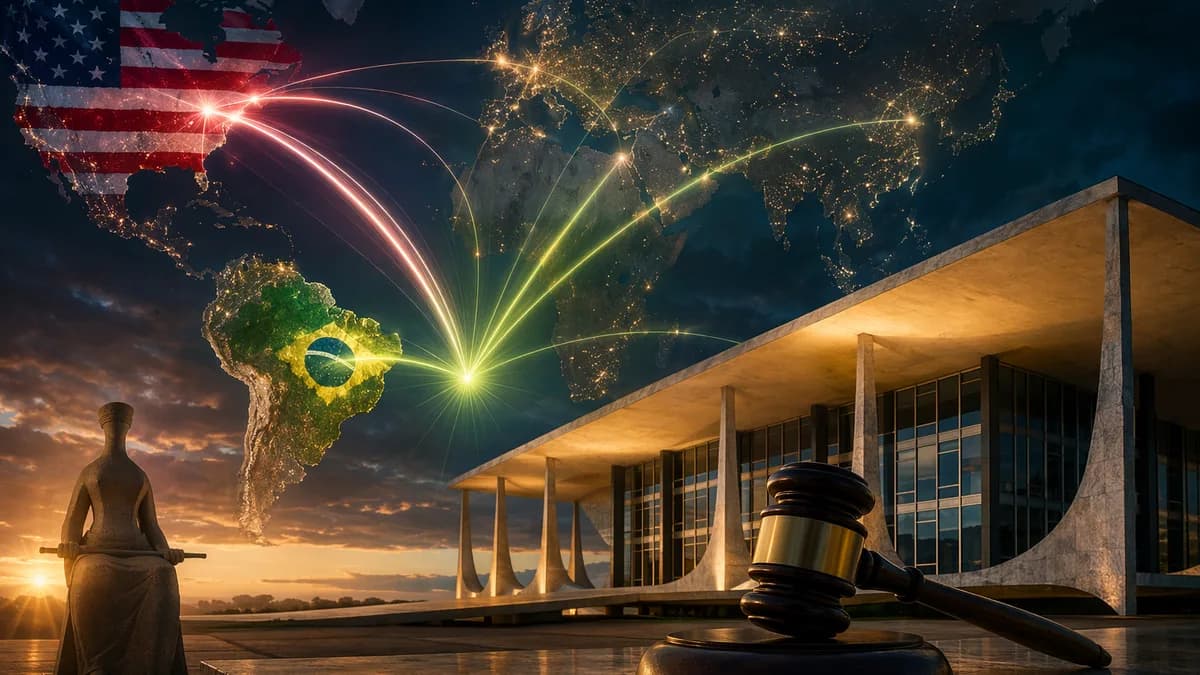
The Eduardo Bolsonaro conviction signals that Brazil’s supreme court now treats foreign pressure on judges as part of the country’s post-2022 coup reckoning, not as routine political advocacy. A four-justice panel sentenced Eduardo Bolsonaro to four years and two months in prison after finding that he courted US interference in his father’s coup plot trial, according to Guardian World.
Global TrendsJune 17, 2026· 7 min read· By XOOMAR Insights Team
US Pressure Backfires in Eduardo Bolsonaro Conviction
Updated on June 17, 2026
XOOMAR Intelligence
Analyst Take
66/ 100
4 sources analyzedMedium confidenceTrend10Freshness95Source Trust90Factual Grounding94Signal Cluster20
That matters because the case reaches beyond Jair Bolsonaro, who is serving a 27-year sentence for plotting a coup after losing Brazil’s 2022 election to Luiz Inacio Lula da Silva. The court is drawing a bright line: lobbying abroad may be politics, but seeking foreign sanctions against judges during an active criminal case can become legal exposure.
Eduardo Bolsonaro conviction turns a family defense into an institutional test
Eduardo Bolsonaro’s conviction reframes the Bolsonaro family’s legal fight as a test of judicial independence. Prosecutors accused the former lawmaker, who lives in the US, of courting help from the Trump administration to aid Jair Bolsonaro’s case by pushing sanctions on supreme court justices and tariffs on Brazilian goods.
That is not a small procedural point. Sanctions are coercive state tools. When they are aimed at judges handling a domestic criminal case, the pressure shifts from legal argument to geopolitical force.
Eduardo Bolsonaro’s counterargument is clear. He has said he was not properly notified about the court’s legal process. He also previously told Reuters that his work in the US was not aimed at getting his father acquitted, but at forcing Brazil’s supreme court to punish officials who, in his view, were not complying with Brazil’s constitution.
The court’s answer was equally clear. It treated the conduct as an attempt to pressure Brazil’s justice system, not merely as speech or foreign outreach. That is the core signal of the Eduardo Bolsonaro conviction.
Four justices, one sentence, and a harder line on US pressure
The vote gave the Bolsonaro camp little room to argue that the panel itself was divided. Guardian World reports that the panel’s four justices backed conviction. Reuters, carried by The Straits Times, reported that the ruling also makes Eduardo Bolsonaro ineligible for eight years to run for public office in Brazil.
The known case mechanics are direct:
| Issue | Source-backed detail | XOOMAR analysis |
|---|---|---|
| Sentence | Four years and two months in prison | The penalty turns the case from symbolic rebuke into personal legal risk. |
| Court vote | Four justices backed conviction | Unanimity narrows the political space for calling the ruling shaky. |
| Alleged conduct | Courting US sanctions on justices and tariffs on Brazilian goods | The court appears to distinguish foreign lobbying from foreign pressure on judges. |
| Defense position | Eduardo says he was not properly notified and denies seeking acquittal | The procedural objection may shape appeals or future legal steps. |
A Brazilian supreme court judge had already ordered Eduardo Bolsonaro’s bank accounts and assets frozen in July last year over allegations that money sent by Jair Bolsonaro was funding lobbying efforts in the US. That earlier asset freeze now reads less like an isolated enforcement move and more like part of a wider judicial effort to cut off external pressure campaigns around the coup case.
For readers tracking how legal disputes can become political weapons, XOOMAR has examined similar message-making patterns in Gavin Newsom DOJ Claim Puts Trump Rivalry on Trial. Outside electoral politics, questions about process and control also run through Data Broker Removal Tools Put Paid Privacy on Trial, where accountability turns on who gets to police sensitive systems.
US lobbying collided with Brazil’s rule-of-law guardrails
The sharpest distinction in the case is between persuasion and punishment. Politicians routinely speak abroad, meet allies, and seek sympathetic audiences. Eduardo Bolsonaro moved to the US in 2025, months before the trial that convicted his father, and worked to build support there, especially from the Trump administration.
The prosecution’s claim went further. It said he courted US authorities to help Jair Bolsonaro by imposing sanctions on court justices and tariffs on Brazilian goods. That is why the case became explosive.
Justice Cristiano Zanin, according to Al Jazeera’s report, described the conduct this way:
“It wasn’t merely an expression of opinion or a political stance, but rather conduct that clearly threatened Brazilian authorities and Brazilian citizens themselves.”
That quote captures the court’s legal theory. The issue was not that Eduardo Bolsonaro criticized the judiciary. The issue was that prosecutors said he sought punitive foreign action against the judges trying his father.
The strongest defense-friendly reading is that Eduardo saw himself as petitioning foreign officials against what he considered judicial abuse. But the court appears to have rejected that frame because the pressure targeted officials inside an active criminal proceeding. In XOOMAR’s analysis, that is the boundary Brazil’s supreme court is trying to make visible.
Brazil’s post-2022 reckoning now reaches Bolsonaro’s inner circle
The conviction shows that Brazil’s accountability drive is no longer limited to Jair Bolsonaro himself. Jair Bolsonaro served as president from 2019 to 2022. He later received a 27-year sentence for plotting a coup after losing to Lula.
Eduardo Bolsonaro’s case extends that reckoning to family members and political operators around the former president. The court is not only punishing the alleged coup plot. It is also policing attempts to shield that case from domestic adjudication through foreign power.
The US connection adds force. Trump publicly aligned with Bolsonaro, and Al Jazeera reported that Trump cited Jair Bolsonaro’s trial when announcing 50 percent tariffs on certain Brazilian products in July 2025. The Trump administration also sanctioned supreme court justice Alexandre de Moraes, later relaxing tariffs and repealing sanctions against de Moraes and his family in December, according to the same reporting.
That timeline matters. It gives the court’s ruling a factual backdrop: the pressure campaign was not abstract. US measures did follow, even if later scaled back.
Bolsonaro allies, judges, Washington, and voters will read the ruling differently
Brazil’s judiciary will read the verdict as a defense of court authority. The message to politicians is blunt: if you ask a foreign government to punish judges during a domestic trial, you may become part of the legal problem.
The Bolsonaro camp is likely to frame the same ruling as persecution. That is already visible in Eduardo Bolsonaro’s claim that he was not properly notified and in his broader argument that his family faces unfair treatment by the supreme court. Reuters also reported that he said the real motive of the trial was to bar him from public office.
Washington sits in the uncomfortable middle. Any perception that US political actors can be used inside Brazilian legal disputes risks straining trust with Brasilia, especially when the targeted officials are judges handling a coup case.
For voters, the split is just as stark. Bolsonaro loyalists may see another proof point for grievance politics. Critics may see evidence that the movement’s pressure campaign did not stop at speeches, rallies, or court filings.
The sentence now becomes a test of escalation, not just punishment
The practical effect of the Eduardo Bolsonaro conviction is to warn Brazilian politicians that overseas advocacy can cross into criminal exposure when it targets judges and trial outcomes. That warning will travel beyond this one family.
The ruling strengthens judicial authority in the short term. It also hands Bolsonaro-aligned forces a fresh grievance to organize around, especially as Eduardo’s brother, Senator Flavio Bolsonaro, has moved into the national political frame and reportedly met Trump at the White House last month.
The next evidence to watch is procedural. Appeals, enforcement questions tied to Eduardo Bolsonaro’s residence in the US, and any further court reasoning will show how durable the conviction is. Evidence that weakens the court’s position would include a successful procedural challenge over notification or due process. Evidence that strengthens it would be a higher-court affirmation that seeking foreign sanctions against judges during an active trial is coercion, not protected politics.
The sentence matters. But the larger signal has already landed: Brazil’s supreme court is treating the invitation of foreign pressure into a domestic coup trial as a direct threat to its authority.
Impact Analysis
- Brazil’s supreme court is treating foreign pressure on judges as a threat to judicial independence.
- The conviction expands the legal fallout from the alleged post-2022 coup plot beyond Jair Bolsonaro himself.
- The case sets a warning that lobbying foreign governments to sanction judges during active trials can carry criminal consequences.
Bolsonaro-Related Prison Sentences
Eduardo Bolsonaro
months50
Jair Bolsonaro
months324
Sources

Written by
XOOMAR Insights Team
Research and Editorial Desk
The XOOMAR Insights Team pairs automated research with human editorial judgment. We track hundreds of sources across technology, fintech, trading, SaaS, and cybersecurity, cross-check the facts, and explain what happened, why it matters, and what to watch next. We do not just rewrite headlines. Every article is fact-checked and scored for reliability before it goes live, and we link back to the original sources so you can verify anything yourself.
Explore More Topics
Related Articles
 Global Trends
US Pressure Crushes Cuba Tourism as Visits Plunge 58%
Cuba’s visitor collapse shows US pressure is hitting Havana’s cash lifeline, but ordinary Cubans are absorbing the shock.
Jun 16, 20268 min
 Global Trends
Revoked Iran World Cup Tickets Strand Fans Before Kickoff
Iran fans lost official World Cup tickets days before kickoff, forcing FIFA to clean up a mess tied to U.S. restrictions.
Jun 15, 202611 min
 Global Trends
Sharp Turn Shadows B-52 Bomber Crash Probe After 8 Die
Eight died in a B-52 crash at Edwards, and officials say the investigation could take six months.
Jun 16, 20265 min
 Global Trends
US-Iran Truce Traps Lebanon in Israel-Hezbollah Fire
The US-Iran truce quieted south Lebanon, but Israel and Hezbollah still control the danger civilians face when they return.
Jun 16, 202612 min
 Global Trends
Iran's Lebanon Demand Jolts US-Iran Peace Deal Talks
Iran is tying any US peace deal to Israel leaving Lebanon, testing whether Trump can force Netanyahu into a wider regional bargain.
Jun 16, 20268 min
 Fintech
Coinbase Advisor Blurs the Line Between App and Adviser
Coinbase Advisor puts AI advice inside the trading app, turning Coinbase One into a bigger test of trust, regulation, and control.
Jun 17, 20268 min
 Technology
Commerce Threatens Anthropic Over Foreign AI Model Access
Commerce reportedly threatened Anthropic with penalties unless it cut foreign nationals off from Fable 5 and Mythos 5.
Jun 17, 20267 min
 Technology
Mobileye Robotaxi Bet Puts Its Own Tech Buyers on Edge
Mobileye's 2027 U.S. robotaxi plan turns an AV supplier into a fleet operator, putting automaker buyers in a tougher spot.
Jun 16, 20267 min
 Cybersecurity
Noisy SIEM Tools Could Sink Small Security Teams in 2026
Lean teams need low-noise SIEMs with fast setup, clear pricing, and enough automation to avoid running a full-time SOC.
Jun 17, 202619 min
 Cybersecurity
VPN Split Tunneling Can Leak More Than You Expect Online
Split tunneling can speed up your VPN and fix app conflicts, but any bypassed traffic exposes your real IP.
Jun 17, 202622 min
Don't miss the signal
Get our weekly roundup of the stories that matter across tech, fintech, and trading. No noise, just signal.
Free forever. No spam. Unsubscribe anytime.