
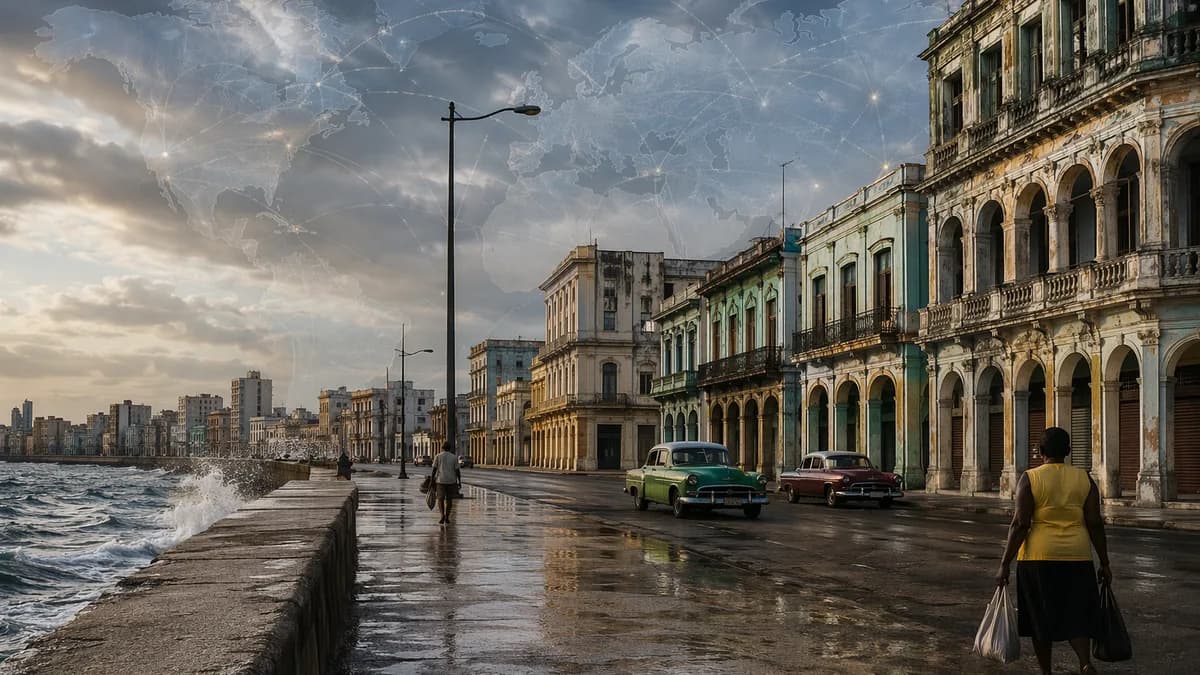
Cuba tourism has collapsed by 58.4% in the first five months of 2026, turning Washington’s pressure campaign into a direct hit on Havana’s most important hard-currency engine.
Global TrendsJune 16, 2026· 8 min read· By XOOMAR Insights Team
US Pressure Crushes Cuba Tourism as Visits Plunge 58%
Updated on June 16, 2026
XOOMAR Intelligence
Analyst Take
59/ 100
4 sources analyzedLow confidenceTrend10Freshness96Source Trust92Factual Grounding94Signal Cluster20
Fewer than 360,000 foreign travelers visited the island over that period, compared with the same stretch last year, Cuban statistics agency Onei says, according to BBC World. That is not a normal bad season. It is a stress test for an economy already short of fuel, medicines, food, electricity, and foreign exchange.
Cuba tourism crash shows Washington can squeeze Havana without firing a shot
The Trump administration has targeted Cuba’s tourism sector because it feeds state revenue and foreign currency into a government already under severe pressure. The campaign is economic, but its effects are physical: fewer flights, shuttered hotel operations, fuel shortages, garbage piling up, and power cuts long enough to trigger rare protests.
XOOMAR analysis: The pressure campaign is working in narrow economic terms. It is making Cuba harder to visit, harder to supply, and harder to operate as a tourism destination. But the same pressure is also deepening the shortages faced by ordinary Cubans, especially those whose income depends on visitors reaching the island.
The most direct channel is fuel. BBC reports that US sanctions and an effective oil blockade have worsened shortages that were already affecting fuel, medicine, and food. Once fuel becomes unreliable, tourism stops being a marketing problem and becomes an operating problem.
Airlines and hotel groups are reacting accordingly. Air Canada has suspended flights to Cuba indefinitely, citing “ongoing political and economic uncertainty.” Spanish hotel chains Meliá and Iberostar halted operations at a significant number of hotels before a 5 June US deadline for companies to stop doing business with Gaesa, the Cuban conglomerate controlled by the armed forces.
Rubio said Gaesa “hoards the profits from its businesses for the benefit of a small elite” as well as “repressing anyone who dares to complain”.
That is the core of Washington’s case: pressure the military-linked revenue machine. Havana’s problem is that tourism workers, patients, families, and consumers are caught inside the same squeeze.
The 58.4% visitor slump punches a hole in Cuba’s hard-currency machine
The headline number is brutal: fewer than 360,000 visitors in five months. For a country that depends on tourism to bring in dollars, euros, and Canadian dollars, that drop matters far beyond hotel lobbies.
Tourism revenue helps pay for imported goods. It keeps transport moving. It supports state-owned hotels and the wider services attached to foreign arrivals. When visitors disappear, Cuba loses more than room bookings. It loses one of the few remaining channels for hard currency.
The scale looks worse against recent history. EL PAÍS reported that Cuba ended 2024 with an official estimate of $917 million in tourism revenue and 1.9 million visitors, 14% below the previous year and far under the government’s projected 2.6 million. The same report said Cuba had reached 4.6 million arrivals in 2018.
| Tourism marker | Reported figure |
|---|---|
| Foreign visitors, first five months of 2026 | Fewer than 360,000 |
| Drop versus same period last year | 58.4% |
| 2024 tourism revenue estimate | $917 million |
| 2024 visitors | 1.9 million |
| Government projection for 2024 | 2.6 million |
| 2018 arrivals | 4.6 million |
Canada is central to the damage. BBC says Onei figures show Canadian visitors were by far the largest foreign tourist group in Cuba this year. EL PAÍS reported that about 860,000 Canadians vacationed on the island in 2024. Losing major Canadian airlift cuts into the market Cuba could least afford to lose.
For comparison in energy-linked stress elsewhere, XOOMAR has tracked how oil risk can reshape political and economic calculations in Trump’s 60-Day Iran Deal Stakes Oil and Credibility and US-Iran Ceasefire Buys 60 Days as Gulf Peace Slips. Cuba is a different case, but the common thread is clear: fuel access can become a coercive tool.
Fuel shortages turn a Cuba vacation into a logistics problem
The tourism industry runs on systems travelers rarely notice until they break. Cuba is now showing what happens when they do.
Fuel shortages hit aviation first. BBC says Air Canada had already stopped flying to Cuba in February because of an aviation fuel shortage. CNN also reported that flights from Russia and Canada had been canceled because there was not enough jet fuel on the island for longer international flights.
Ground transport is exposed too. BBC notes that the lack of fuel has paralyzed large parts of the economy, including rubbish collection. That is not just a public services issue. It changes the experience of arriving in Havana, moving between cities, and staying in areas where garbage and outages become visible signs of breakdown.
Electricity is the second pressure point. AFP, cited by BBC, reported that nuns making communion wafers in Havana often had electricity restricted to two hours a day. That detail is small, but it captures the broader strain: if basic religious supplies are being rationed because power is unavailable, hotels and airports are facing the same national constraint.
CNN’s reporting put a human face on the tourism collapse through Mandy Pruna, a classic-car tour driver in Havana:
“I need gas to be able to work, I need tourists to be able to work,” he said.
That sentence explains the spiral. No fuel means fewer services. Fewer services mean fewer travelers. Fewer travelers mean less income to buy what the country needs.
Airlines, hotel chains, families, and Washington are reading the crisis differently
The same collapse looks different depending on where you stand.
For Washington, the target is political and institutional. US Secretary of State Marco Rubio has framed Gaesa as a military-controlled structure that captures tourism profits and shields the Cuban elite. From that view, reducing foreign operators’ exposure to Gaesa is not collateral damage. It is the point.
For Havana, the pressure campaign looks like a deliberate effort to choke an already weakened economy. BBC says US sanctions and the effective oil blockade have worsened shortages of fuel, medicines, and food. Cuban state-run site Cubadebate reported that the survival rate for children with cancer had fallen from 85% to 65% since January, when Trump threatened sanctions on any country or company providing Cuba with oil.
For foreign companies, the calculation is narrower but still severe:
- Airlines: Fuel reliability and political uncertainty are now route-level risks.
- Hotel operators: US deadlines tied to Gaesa change the cost of staying open.
- Travelers: Fewer flights, blackouts, shortages, and service disruption raise the chance that a trip goes wrong.
- Cuban workers tied to tourism: Income depends on decisions made in Washington, Ottawa, Madrid, and Havana.
This is where the policy becomes messy. The pressure may deny revenue to the Cuban state, but it also cuts into the daily earnings of people who have little control over the state’s decisions.
Cuba’s tourism model is being tested in a weaker economy
Cuba has long depended on tourism as a hard-currency source. The current shock is sharper because it lands after years of decline and incomplete recovery.
The island is not falling from a position of strength. EL PAÍS reported that tourism arrivals in 2024 were the lowest in almost two decades, excluding the pandemic period. BBC describes shortages across fuel, medicine, and food, while power cuts have become frequent, lengthy, and widespread.
The US pressure campaign has therefore hit a system with little spare capacity. When aviation fuel is unreliable, airlines pull back. When hotel partners face sanctions deadlines, they halt operations. When electricity fails, food storage, cleaning, transport, and basic services become harder to maintain.
Cuba tourism still has assets travelers want: Havana, beaches, heritage cities, music, cigars, and a cultural pull few destinations can copy. But assets are not enough when the operating base is unstable.
The next Cuba tourism season depends on oil, air routes, and confidence
The near-term path is simple to frame and hard to fix.
If fuel shortages worsen, the visitor slide can continue because airlines and hotel operators will not sell capacity they cannot support. If oil supply stabilizes and air routes return, Cuba could see a partial recovery from today’s depressed level. If US enforcement eases or companies find compliant ways to operate, the rebound could be stronger.
The evidence to watch is practical, not rhetorical: whether Air Canada resumes service, whether hotel chains reopen halted properties, whether power cuts ease, and whether Onei’s next visitor data show stabilization rather than another leg down.
XOOMAR analysis: Marketing alone will not repair Cuba tourism. Travelers need flights, fuel, electricity, food supply, and confidence that the trip can run as sold. Until those pieces improve, Cuba’s cultural appeal will keep losing to operational reality.
Impact Analysis
- Tourism is one of Cuba’s most important sources of hard currency, so the collapse directly strains state finances.
- US pressure is disrupting flights, hotels, fuel access, and the broader visitor economy without military action.
- Ordinary Cubans face deeper shortages as tourism-linked income and supplies become harder to sustain.
Tourism Sector Responses to Cuba Pressure Campaign
| Company | Sector | Action | Stated trigger or timing |
|---|---|---|---|
| Air Canada | Airline | Suspended flights to Cuba indefinitely | Cited ongoing political and economic uncertainty |
| Meliá | Hotels | Halted operations at a significant number of hotels | Before the 5 June US deadline to stop doing business with Gaesa |
| Iberostar | Hotels | Halted operations at a significant number of hotels | Before the 5 June US deadline to stop doing business with Gaesa |
Cuba Tourism Decline in First Five Months of 2026
Foreign traveler decline
%58.4
Sources

Written by
XOOMAR Insights Team
Research and Editorial Desk
The XOOMAR Insights Team pairs automated research with human editorial judgment. We track hundreds of sources across technology, fintech, trading, SaaS, and cybersecurity, cross-check the facts, and explain what happened, why it matters, and what to watch next. We do not just rewrite headlines. Every article is fact-checked and scored for reliability before it goes live, and we link back to the original sources so you can verify anything yourself.
Explore More Topics
Related Articles
 Global Trends
Revoked Iran World Cup Tickets Strand Fans Before Kickoff
Iran fans lost official World Cup tickets days before kickoff, forcing FIFA to clean up a mess tied to U.S. restrictions.
Jun 15, 202611 min
 Global Trends
Iran Hardliners Turn US Peace Deal Into Surrender Fight
Iran's US peace deal is stuck in a harder fight at home, where hardliners are branding compromise as surrender.
Jun 14, 20268 min
 Global Trends
Beirut Strikes Threaten to Blow Up Iran Peace Deal
Israeli strikes on Beirut could wreck a near-signed Iran peace deal by putting Lebanon back at the center.
Jun 14, 20265 min
 Global Trends
China Seizes Vanished US Academic in Espionage Case
China says Min Zin spied after he vanished at a Kunming conference, but it hasn't shown evidence or clarified charges.
Jun 12, 20266 min
 Global Trends
US Iran Strikes Pull Gulf Allies Into Trump’s Ultimatum
US strikes on Iran triggered retaliation against Bahrain, Kuwait and Jordan, widening the crisis as Trump pressures Tehran over talks.
Jun 11, 20266 min
 Technology
500M Users Force Threads Personalization Into the Open
Threads hit 500M monthly users as Meta rolls out private feed controls, turning personalization into its next big trust test.
Jun 16, 20268 min
 Trading
$59K Bitcoin Low Sparks Wall Street's Crypto Spring Call
Standard Chartered says bitcoin's $59K low likely ended the selloff after ETFs, Strategy buying and oil all turned in bulls' favor.
Jun 16, 20269 min
 Technology
White House Locks Down Claude Fable 5 in AI Safety Fight
The White House kept Claude Fable 5 restricted, turning one jailbreak fight into a test of who controls frontier AI releases.
Jun 16, 20268 min
 Trading
Tiny Portfolios Pit Micro-Investing Apps Against Brokers
Micro-investing apps lower the entry bar, but brokers give small portfolios more choice and room to grow.
Jun 16, 202620 min
 Trading
Forex Brokers Bury Guaranteed Stop Loss Costs in Fine Print
GSLOs can cap slippage, but broker fees, limits, platforms, and country rules decide if they’re protection or an expensive trap.
Jun 16, 202623 min
Don't miss the signal
Get our weekly roundup of the stories that matter across tech, fintech, and trading. No noise, just signal.
Free forever. No spam. Unsubscribe anytime.