
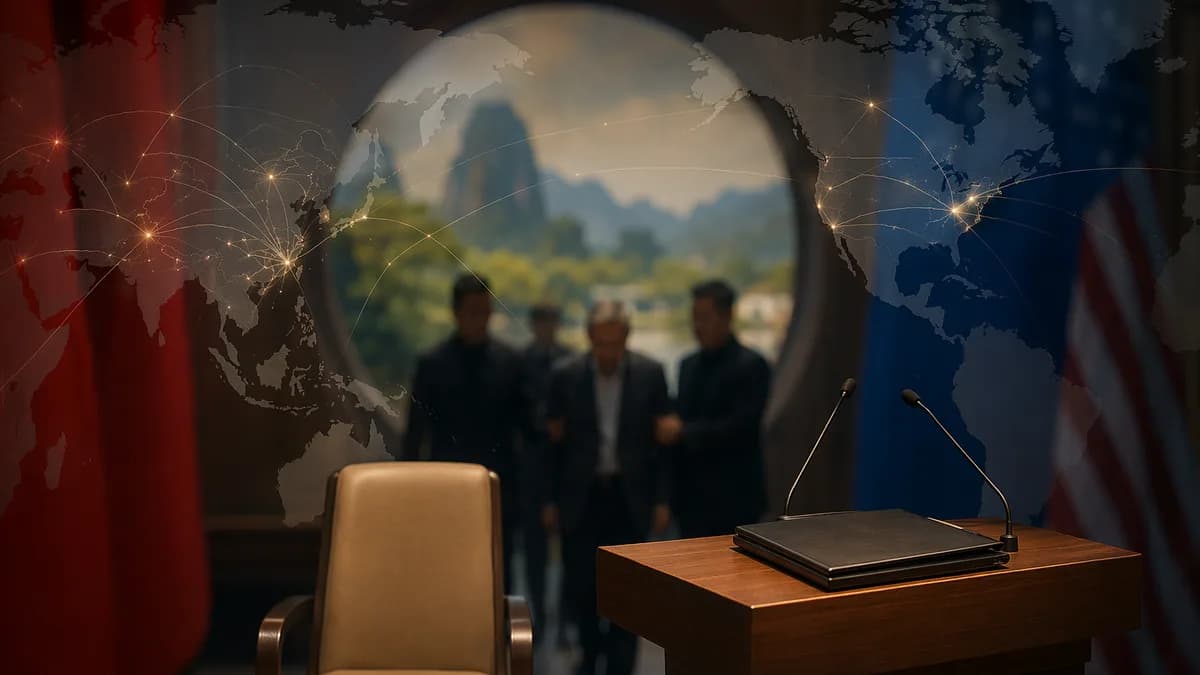
On Friday, nine days after Min Zin disappeared during a trip to Kunming, Beijing confirmed it had arrested the US scholar on suspicion of spying, a rare national security case involving an American citizen just weeks after Donald Trump met Xi Jinping in Beijing.
Global TrendsJune 12, 2026· 6 min read· By XOOMAR Insights Team
China Seizes Vanished US Academic in Espionage Case
Updated on June 12, 2026
XOOMAR Intelligence
Analyst Take
66/ 100
4 sources analyzedMedium confidenceTrend10Freshness96Source Trust90Factual Grounding91Signal Cluster20
China’s foreign ministry said Min Zin, who writes on Myanmar and Chinese foreign policy, was suspected of “engaging in espionage activities that endanger China’s national security,” according to Guardian World.
June 3 in Kunming: Min Zin disappears, then Beijing confirms an espionage case
Min Zin vanished on 3 June after traveling to Kunming, in Yunnan province, for a conference, according to a Burmese activist cited in the source material. The activist, who spoke anonymously for fear of arrest, said Min Zin had visited China many times before.
China’s Ministry of Foreign Affairs spokesperson Lin Jian confirmed the arrest on Friday. He said Min Zin was suspected of activity that endangered national security, but did not provide public evidence in the available source material.
Min Zin was suspected of “engaging in espionage activities that endanger China’s national security,” Lin Jian said.
Additional reporting cited in the source packet said Chinese authorities described Min Zin as having been placed under “criminal compulsory measures”, a Chinese legal phrase that can cover coercive steps during a criminal investigation. That wording does not, by itself, answer whether prosecutors have filed formal charges.
Several core facts remain undisclosed.
| Confirmed in source material | Still unclear |
|---|---|
| Min Zin has been arrested by China | Where he is being held |
| China alleges espionage activities | Whether formal charges have been filed |
| He disappeared after going to Kunming for a conference | Whether US consular officials have met him |
| China says the case involves national security | What evidence Beijing claims to have |
Chinese authorities said the US consulate in Guangzhou had been notified, according to the additional source material. Neither the supplied Guardian excerpt nor the related source material establishes whether Min Zin has had access to a lawyer or direct consular contact.
Myanmar research put Min Zin in a sensitive China policy channel
Min Zin’s public profile sits close to one of Beijing’s most sensitive regional files. He founded ISP Myanmar, a thinktank that has written in recent years about Chinese foreign policy and trade with Myanmar, which borders China’s south-west.
The organization has exchanged ideas with Chinese thinktanks and published on issues including Myanmar’s rare-earth exports to China, according to the Guardian source material. Min Zin is also a PhD candidate at the University of California, Berkeley.
His personal history adds another layer. Min Zin was a student activist during Myanmar’s 1988 uprising, a student-led movement met with military force by the government at the time. He later sought asylum in the US. The Burmese activist cited in the source material said Min Zin was not currently involved in direct activism work.
XOOMAR analysis: The sensitivity here is not just Min Zin’s US status. It’s the subject matter. Research on Myanmar can touch China’s border security, trade flows, resource access, and contacts with actors inside a country that has been in civil war since the 2021 coup, as noted in the related source material. Beijing’s allegation does not prove wrongdoing, but it shows how quickly policy research can be reframed as a national security issue when foreign citizenship, border politics, and data gathering intersect.
For readers tracking the conflict side of the Myanmar story, our earlier coverage on Forced Recruits Let Myanmar Junta Reverse Rebel Gains gives useful context on why Myanmar’s internal war remains central to regional security reporting.
One month after Trump met Xi, a rare US citizen arrest strains the reset script
The timing raises the diplomatic stakes. The arrest comes about a month after Trump met Xi in Beijing, where the two governments were seeking to reset what the source material describes as a tumultuous relationship.
The Guardian and AP source material both stress that it is uncommon for Beijing to arrest a US citizen on national security allegations. That rarity matters. Cases like this can quickly move from legal process to diplomatic bargaining, especially when details are withheld under national security language.
The immediate US response is not established in the supplied material. The practical next steps, though, are clear: Washington can seek consular access, ask for details on the allegation, and press for due process. Whether those requests happen publicly or privately is not yet known.
The case is also likely to rattle academics, thinktank staff, policy researchers, and conference organizers working on China-adjacent topics. That effect does not require a court ruling. The signal is already sharp: a scholar who had traveled to China before, and whose work involved exchanges with Chinese thinktanks, is now under an espionage allegation.
XOOMAR analysis: Beijing’s public line remains broad. “National security” gives Chinese authorities room to limit disclosure, while still framing the detention as a state security matter rather than an ordinary criminal case. For foreign institutions, that ambiguity is the risk. They may not know which meetings, documents, interviews, or research contacts Chinese authorities consider suspicious until a case has already begun.
This arrest also lands amid wider regional security tensions involving China’s neighbors. For more on how China-linked disputes can surface through courts and cross-border politics, see XOOMAR’s Death Sentences Drag Bangkok Bombing Back Into China Row.
The next decision points: consular access, charges, and Beijing’s evidence
The next public signals will determine whether this remains a tightly controlled national security case or becomes a larger US-China dispute.
Watch for:
- Consular access: Whether US officials confirm they have met or contacted Min Zin.
- Formal charges: Whether China moves beyond suspicion and files charges.
- Legal representation: Whether Min Zin has access to a lawyer.
- Evidence disclosure: Whether Beijing specifies what conduct it considers espionage.
- Institutional response: Whether ISP Myanmar, UC Berkeley, or Min Zin’s family issue public statements.
- Diplomatic escalation: Whether Washington folds the case into broader talks with Beijing.
The most important unknown is Beijing’s evidence. Without it, the case rests publicly on a sweeping national security claim. With it, the dispute could shift into a fight over whether academic research, thinktank contact, or conference activity crossed a legal line under Chinese law.
For now, Min Zin’s arrest has created a test case for scholars working near China’s security perimeter. The next move belongs to Beijing: disclose more, charge him, or keep the case inside the opaque machinery of national security enforcement.
Impact Analysis
- The arrest adds strain to US-China relations weeks after Trump met Xi in Beijing.
- The case highlights the risks academics and researchers face when working on sensitive China-related topics.
- Key details remain undisclosed, including Min Zin’s location, legal status, and access to US consular officials.
Sources

Written by
XOOMAR Insights Team
Research and Editorial Desk
The XOOMAR Insights Team pairs automated research with human editorial judgment. We track hundreds of sources across technology, fintech, trading, SaaS, and cybersecurity, cross-check the facts, and explain what happened, why it matters, and what to watch next. We do not just rewrite headlines. Every article is fact-checked and scored for reliability before it goes live, and we link back to the original sources so you can verify anything yourself.
Explore More Topics
Related Articles
 Global Trends
Tariff Detours Crush the US Manufacturing Jobs Pitch
Tariffs haven't sparked a US factory jobs boom. Chinese inputs are taking longer routes, with higher costs and more automation.
Jul 27, 20268 min
 Global Trends
Trump Tariffs Twist Court Loss into Checkout Tax Fight
Trump recast his tariffs after a court loss. Democrats see an opening, calling them a sales tax on squeezed Americans.
Jul 25, 20269 min
 Global Trends
Trump Tariffs Drag 80 Countries Into Legal Showdown
Trump's new tariffs hit 80-plus countries and set up a fresh fight over presidential power, import costs, and Congress's tax authority.
Jul 24, 20267 min
 Global Trends
China Snaps as Australia News Live Tracks Strike Threat
China rebuked Penny Wong as Victorian teachers prepared to strike, leaving Canberra and Melbourne fighting credibility battles.
Jul 23, 20268 min
 Global Trends
Typhoon Noul Rips Hong Kong Scaffolding Into Street
Typhoon Noul tore scaffolding off a Hong Kong building and cancelled 360 flights before China’s strongest 2026 landfall.
Jul 27, 20265 min
 Trading
GBP/USD Price Forecast Wobbles Before Fed-BoE Showdown
GBP/USD is stuck near 1.3300. Fed and BoE signals may decide whether sterling holds or slides toward 1.3000.
Jul 28, 202612 min
 Trading
War Risk Bet Unwinds as Brent Crude Crashes 8.7% in a Day
Brent crude’s 8.7% plunge shows traders dumping war-risk premium, not proof that Gulf energy flows are out of danger.
Jul 28, 20265 min
 Fintech
Upstart Bank Charter Throws AI Lending Into Hot Seat
Upstart won OCC conditional approval, but its bank charter still needs FDIC and Fed signoffs before its AI lending model faces the real test.
Jul 27, 202610 min
 Global Trends
Oil Shock Exposes Germany Energy Drag Behind Ifo Jump
Germany’s Ifo jump may be stale. Commerzbank sees oil costs capping 2026 growth at just 0.6%.
Jul 28, 20267 min
 Technology
$150 Price Cut Sends Nanoleaf Blocks to New Low for Dorms
Nanoleaf Blocks Combo XL just fell to $99.99, a new low for a smart light kit that also adds pegboard and shelf storage.
Jul 28, 20266 min
Don't miss the signal
Get our weekly roundup of the stories that matter across tech, fintech, and trading. No noise, just signal.
Free forever. No spam. Unsubscribe anytime.