
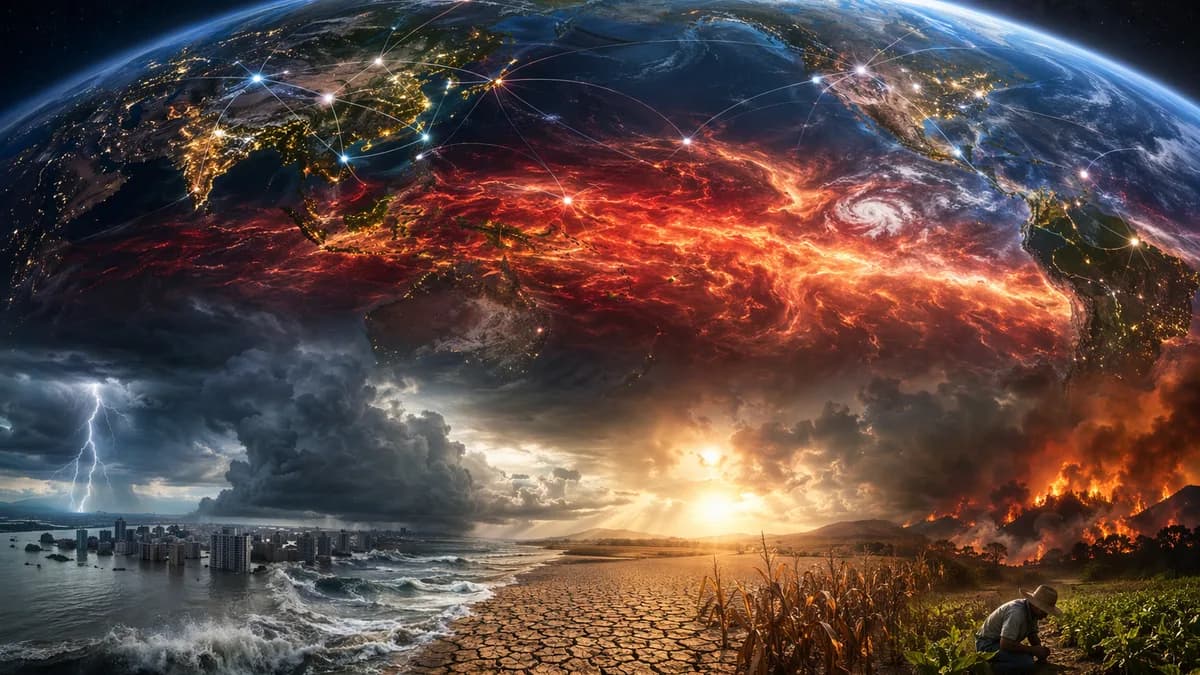
El Niño has officially begun in the tropical Pacific, and the real warning is not the ocean pattern itself. It’s that this warming pulse is landing on a planet already hot enough to turn ordinary climate variability into a harder test for food systems, disaster planning, and vulnerable communities.
Global TrendsJune 11, 2026· 9 min read· By XOOMAR Insights Team
63% Super El Niño Risk Throws Food Systems on Trial
Updated on June 12, 2026
XOOMAR Intelligence
Analyst Take
60/ 100
4 sources analyzedLow confidenceTrend10Freshness98Source Trust92Factual Grounding91Signal Cluster40
The US National Oceanic and Atmospheric Administration said El Niño conditions are now under way after sea surface temperatures rose sharply in recent months, according to BBC World. The agency’s declaration means the central and eastern equatorial Pacific has crossed the threshold US scientists use to call an El Niño event, with the atmosphere now responding to the warmer ocean.
That distinction matters. A warm patch of ocean alone is not enough. NOAA has also seen winds above the equatorial Pacific begin to shift, which suggests the ocean-atmosphere system is coupling in the way forecasters expect during El Niño.
"El Niño conditions developed over the past month, as shown by above-average sea surface temperatures (SSTs) across the central to eastern equatorial Pacific Ocean," NOAA said.
This is not a surprise event. Forecasters had expected the warming phase after La Niña faded at the end of last year. The surprise is the confidence models are already showing about potential strength.
El Niño Has Arrived on a Planet With Less Heat Margin
The core risk is simple: El Niño usually pushes global temperatures higher, and it’s now forming after decades of human-caused warming. That makes the next phase less like a routine weather cycle and more like a stress test.
The BBC report says many forecasts suggest this could become a so-called "super" El Niño, potentially among the strongest ever recorded. NOAA’s own June outlook puts a number on that risk: a 63% chance of a very strong El Niño during November-January, strong enough to rank among the largest events in the historical record going back to 1950.
A very strong El Niño typically lifts global air temperatures by around 0.2C, according to the BBC. That may look small on a chart. It doesn’t feel small when it arrives through drought, flooding, crop losses, wildfire risk, and heat records.
Prof Adam Scaife, head of monthly to decadal prediction at the UK Met Office, put the risk plainly.
"We do need to worry about the impacts," said Prof Adam Scaife. "The current El Niño is… riding on top of a substantial amount of global warming."
"This means that the actual temperatures in affected regions could well be unprecedented, as the warming from El Niño is being topped up by climate change."
XOOMAR analysis: that is the real signal beneath the headline. El Niño is natural. The baseline it now acts on is not. That changes the damage profile without requiring every regional outcome to be predictable.
The Ocean Thresholds Behind NOAA’s Alert
NOAA uses a 0.5C-above-average sea surface temperature threshold in the central and tropical Pacific to define an El Niño event. That threshold has now been passed.
Intensity is judged by how far temperatures rise above average in a key Pacific zone:
| El Niño category | Temperature marker cited in source |
|---|---|
| El Niño threshold used by US scientists | 0.5C above average |
| Strong El Niño | More than 1.5C above average |
| Very strong El Niño | Above 2C |
| Some latest US and European model scenarios | Potentially more than 3C above average by year-end |
The BBC says the three strongest El Niño events since 1950 occurred in 1982/83, 1997/98, and 2015/16. That comparison is why forecasters are treating this event seriously before its peak is confirmed.
NOAA also cautioned against reading strength as destiny.
"Even very strong El Niño events do not lead to the expected impact everywhere, but stronger events can more significantly tilt the odds in favour of expected outcomes."
That sentence should frame the whole forecast. El Niño shifts probabilities. It does not write a local weather script.
How Warmer Pacific Waters Shift Rainfall, Drought, and Hurricanes
El Niño changes global weather because warmer Pacific surface waters alter atmospheric circulation. The consequences travel far beyond the tropical Pacific, but they do so unevenly.
The BBC says disruption is felt most sharply in the tropics. Flooding is common in northern Peru and southern Ecuador, and can reach parts of East Africa, Central Asia, and the southern United States. At the same time, drought and wildfire risk rises across much of Australia, Indonesia, and northern South America, with consequences for agriculture and global food stocks.
El Niño also tends to suppress Atlantic hurricanes. That can sound benign, but the regional trade-off is harsher than the headline suggests.
"While that sounds like a good thing, for Central America that leads to a lot less rainfall and potentially drought conditions," said Liz Stephens, professor of climate risk and resilience at the University of Reading.
The UK is not immune, but the link is weaker. The BBC says El Niño can tilt the odds toward a mild start and cold end to winter, though those connections are loose.
XOOMAR analysis: for decision-makers, the useful takeaway is not “El Niño causes X in country Y.” It is that weather-sensitive regions should plan around wider probability bands, especially where flood and drought risks already strain food systems.
For readers tracking how climate risk shows up in everyday monitoring tools, XOOMAR has separately covered the 20% Off SwitchBot E Ink Weather Station Drops Days In. That consumer-tech story is not evidence about this El Niño, but it sits in the same broader reader interest: weather data is becoming harder to ignore.
Food Systems Face the Clearest Near-Term Pressure
The source material is strongest on agriculture and food. It links El Niño to drought, wildfire, flooding, disruption to food supplies, and pressure on economies running into 2027.
Mohamed Adow, director of campaign group Power Shift Africa, described the stakes for vulnerable communities in blunt terms.
"An El Niño declaration is not just another weather forecast - for millions of people it is a deadly siren to be feared," said Mohamed Adow.
"It means failed rains, dying crops, rising food prices, and families pushed to the edge yet again. In East Africa especially, this will land on communities already battered by droughts and floods in recent years."
The BBC also includes an image caption noting a farmer in Zambia with a small ear of corn grown in a field affected by drought during a previous El Niño event. That is anecdotal, not a forecast. But it shows the pathway: rainfall shifts, crops suffer, and food insecurity can deepen.
Some parts of the outline for this story would normally invite discussion of insurance exposure, power demand, and public health systems. The supplied sources do not provide specific evidence for those channels. So the grounded analysis stops short of claiming those effects here.
What is supported: agriculture, food supplies, weather extremes, drought, wildfire risk, flooding, and economies are all directly named in the source material.
The 1982, 1997, and 2015 Benchmarks Are Warnings, Not Templates
The historical comparisons are useful because they set scale. NOAA says a very strong event this November-January could rank among the largest El Niño events in the record going back to 1950. The BBC names 1982/83, 1997/98, and 2015/16 as the three strongest events since then.
But the past cannot be copied forward. No two El Niños are alike. Regional effects vary, and NOAA explicitly warns that even very strong events do not deliver expected impacts everywhere.
The stronger comparison is thermal, not geographic. The BBC reports that 2024 was the warmest year on record and was boosted by an El Niño that was not especially strong. It also says 2025 came in as the third warmest year on record despite the cooling drag of La Niña, hotter even than the super El Niño year of 2016.
That’s the escalation. A natural warming phase no longer needs to be record-breaking on its own to push global temperatures into record territory.
For readers following geopolitical risk alongside climate stress, XOOMAR’s A Near Iran Deal Cracks as Trump Threatens Payback covers a separate pressure point. It should not be read as part of the El Niño evidence base, but it reflects the same planning problem for governments and businesses: shocks rarely arrive one at a time.
The Next Test Is Whether Forecast Strength Becomes Real-World Damage
Japan’s Meteorological Agency has also judged that El Niño conditions are present and says it is all but certain to last into the autumn. Australia’s Bureau of Meteorology is more cautious because it uses a stricter 0.8C-above-average threshold. It says the tropical Pacific is "approaching El Niño conditions" and expects development later this year, potentially strong.
That split is not a contradiction so much as a measurement issue. Agencies use different criteria. NOAA has called it. Australia has not.
The forward watch is now specific:
- Ocean heat: whether tropical Pacific temperatures move toward the higher model scenarios cited by the BBC.
- Atmospheric coupling: whether wind shifts continue to reinforce the ocean pattern.
- Global temperatures: whether late-year heat sets up another record-hot year, most likely in 2027, as the BBC reports.
- Regional extremes: whether drought, flooding, and wildfire risks intensify in the regions most often affected by El Niño.
- Food stress: whether crop impacts translate into broader pressure on food supplies and prices, especially in already exposed communities.
Prof Scaife said, "At the end of this year and into 2027, we're likely to see very high temperatures globally."
That is the forecast to test. Evidence that would strengthen the thesis includes a very strong November-January peak, continued atmospheric response over the Pacific, and regional disruption matching known El Niño patterns. Evidence that would weaken it would be a weaker-than-expected peak or atmospheric signals failing to lock in.
Either way, the lesson is already visible: El Niño is a recurring cycle, but it now operates inside a warmer climate system. That makes the odds matter more, even before the worst outcomes arrive.
Impact Analysis
- El Niño is forming on top of long-term human-caused warming, raising the risk of more severe extremes.
- A stronger event could strain food systems, disaster planning, and vulnerable communities.
- NOAA sees a 63% chance of a very strong El Niño during November-January.
El Niño vs. La Niña Context
| Climate Pattern | Status in Article | Why It Matters |
|---|---|---|
| El Niño | Now under way in the tropical Pacific | Can push global temperatures higher and increase weather extremes |
| La Niña | Faded at the end of last year | Its end cleared the way for the current warming phase |
NOAA Outlook for Very Strong El Niño
Chance during November-January
%63
Sources

Written by
XOOMAR Insights Team
Research and Editorial Desk
The XOOMAR Insights Team pairs automated research with human editorial judgment. We track hundreds of sources across technology, fintech, trading, SaaS, and cybersecurity, cross-check the facts, and explain what happened, why it matters, and what to watch next. We do not just rewrite headlines. Every article is fact-checked and scored for reliability before it goes live, and we link back to the original sources so you can verify anything yourself.
Explore More Topics
Related Articles
 Global Trends
Wildfire Smoke Kills 1.5 Million as Fire Plans Fail
Wildfire smoke kills far more people than flames, and hotter, drier weather is making suppression-only playbooks dangerously obsolete.
Jul 25, 20268 min
 Global Trends
900 Canada Wildfires Send Smoke Across the Atlantic
More than 900 Canada wildfires have burned 3m hectares, spreading smoke abroad as other weather extremes intensify.
Jul 25, 20266 min
 Global Trends
Camel Heat Stress Breaks Africa's Desert Insurance
Camel heat stress is killing calves in Ethiopia, turning Africa's toughest dryland livestock into a warning sign for herders.
Jul 22, 20268 min
 Global Trends
$10 Trillion Threat Puts 2026 El Niño Off the Charts
Models put 2026 El Niño beyond recorded history, with potential losses near $10 trillion by 2032.
Jul 25, 20267 min
 Global Trends
9-8 Vote Throws Jay Clayton DNI Nomination Into Peril
Jay Clayton cleared committee 9-8, leaving Trump's DNI pick facing a tense Senate fight over loyalty and intelligence experience.
Jul 21, 20266 min
 Trading
War Risk Bet Unwinds as Brent Crude Crashes 8.7% in a Day
Brent crude’s 8.7% plunge shows traders dumping war-risk premium, not proof that Gulf energy flows are out of danger.
Jul 28, 20265 min
 Fintech
Upstart Bank Charter Throws AI Lending Into Hot Seat
Upstart won OCC conditional approval, but its bank charter still needs FDIC and Fed signoffs before its AI lending model faces the real test.
Jul 27, 202610 min
 Trading
$83 Oil Traps USD/CAD Before Pivotal Fed Rate Call
USD/CAD is boxed near 1.4093 as oil supports the loonie, but Fed risk keeps traders from calling a breakout.
Jul 29, 20265 min
 Technology
Fast Metals Mines Toxic Red Mud for Critical Minerals
Fast Metals raised $4.3M to mine critical minerals from red mud. Now it has to prove the leftover waste is safer.
Jul 29, 202612 min
 SaaS & Tools
Nearly 60 Webinar Tools Expose the Best Webinar Software
Webinar platforms are now judged by pipeline, not polish. Zapier’s 2026 picks show marketers which tools turn attendance into action.
Jul 29, 20268 min
Don't miss the signal
Get our weekly roundup of the stories that matter across tech, fintech, and trading. No noise, just signal.
Free forever. No spam. Unsubscribe anytime.