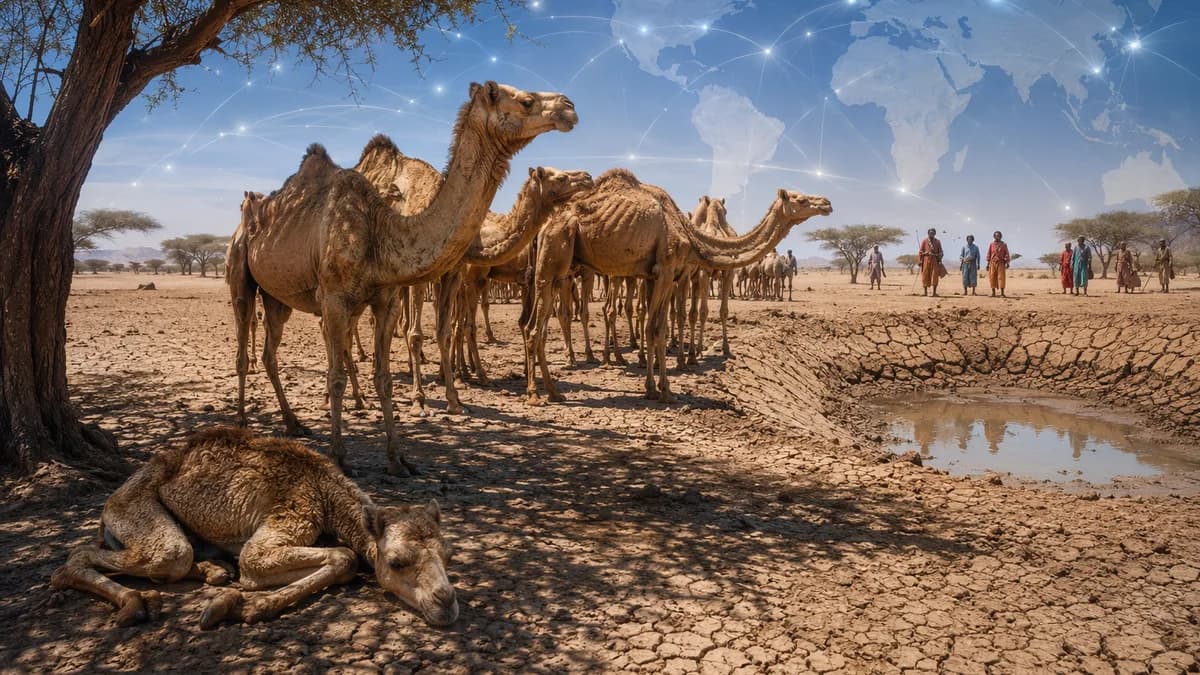
The animal African herders chose because cattle could not take the heat is now suffering from the heat itself, and camel heat stress is becoming a warning signal for dryland economies, not just an animal welfare story.
XOOMAR Intelligence
Analyst Take
In Ethiopia’s Afar region, camel herder Ali Umer told BBC World that he lost eight camel calves in one month as heat intensified. His animals, he said, are getting foot blisters, watery eyes, burned skin, and hair loss from hot sand. The contradiction is stark. Camels became the fallback for pastoralists facing heat and drought. Now the fallback is under pressure.
"Even the wind, which used to bring cool air, now carries heat," Umer told the BBC.
XOOMAR analysis: this is the deeper signal. When the most heat-adapted livestock starts showing visible biological failure, the stress has moved beyond normal seasonal hardship. It points to a dryland system where heat, water loss, disease, weak veterinary access, and pasture scarcity are arriving together.
For readers tracking resilience failures across very different systems, this sits far from XOOMAR’s coverage of Power Plants in Crosshairs as Trump Iran Threats Hit Hormuz, the U.K. heat wave economy, jade plant leaf drop, and Free England vs Argentina Live Stream Beats Scam Links, but the same analytical question applies: where does a system break when its backup layer fails?
Camel heat stress is exposing the limit of Africa’s desert insurance
North Africa and the Horn of Africa host around 80% of the world’s largest population of one-humped dromedary camels, according to the BBC. Herders shifted toward camels over the years because they endure harsh heat and drought better than many other livestock species.
That old assumption still holds, but only up to a point.
Camels can manage heat by letting their body temperature fluctuate through the day, reducing sweating and conserving water. They also concentrate urine, produce dry faeces, and use a thick coat to shield against solar radiation. Experts cited by the BBC said camels comfortably handle heat up to around 40C.
The problem is what happens beyond that range. In the Danakil Depression, temperatures can top 50C. In parts of the Sahara, summer temperatures now frequently exceed 50C, according to Dr Mohammed Bengoumi, a camel health specialist with the UN Food and Agriculture Organization.
"But camels can also experience heat stress when temperatures rise beyond their comfort range," Dr Bengoumi told the BBC.
The before-and-after is brutal:
- Before: Camels acted as the livestock option that could outlast cattle in hotter, drier conditions.
- Now: Extreme heat is linked to stress, fatigue, dehydration, disease prevalence, reduced milk yield, reproductive problems, and calf deaths.
- Before: Mobility helped herders track water and vegetation.
- Now: Water, vegetation, and shade are shrinking at the same time, making movement less reliable.
- Before: Heat adaptation bought pastoralists time.
- Now: hotter droughts are compressing that time.
The numbers show heat is hitting herds, milk, and mortality
The strongest data in the BBC report comes from herder surveys, veterinary observations, and regional studies. It doesn’t yet form a clean continent-wide dataset. That gap matters. Camel systems are often spread across remote rangelands, so mortality, disease, milk loss, and forced movement can show up first as local distress before national figures catch up.
Still, the available numbers are sharp.
A 2025 study based on camel herders’ perceptions in southern Ethiopia found that high temperatures and climate variability harmed camel herd health, productivity, and reproductive performance. In Somalia, research published in June found drought-related camel mortality affected nearly 46% of camel-owning households. The study covered nearly 6,000 pastoral households and found mortality concentrated in northern regions, with Sool reporting a rate of nearly 73%.
In north-eastern Kenya, veterinary officer Hassan Nuya Guyo told the BBC that Marsabit county has seen a more than 15% increase in camel deaths in the last two years due to extreme heat.
"We are seeing significant increase in cases of hyperthermia in camels as a result of which they get multiple infections," Guyo said.
WMO data adds the climate backdrop. Its State of the Climate in Africa 2025 report said North Africa recorded the fastest warming among Africa’s six subregions, at 0.43C per decade between 1991 and 2025. WMO also said several North African countries and Middle Eastern countries reported temperatures above 50C in 2024.
XOOMAR analysis: camel heat stress is not just a temperature problem. It is a compounding-risk problem. A single hot season can reduce milk, weaken calves, disrupt breeding, and raise disease exposure. That damage can outlast the heatwave.
The camel’s old advantage is being eroded by hotter drought
Drought is not new in Africa’s drylands. The difference described by the BBC’s sources is that drought under extreme heat drains the system faster.
An atmospheric science analysis cited by the BBC found that high temperatures were behind the 2021-22 drought in the region. Extreme heat turns water from soil and water bodies into vapour, while plants release water into the air. That means the same rainfall deficit can become more punishing when heat is higher.
This is where the camel’s biology starts to work against its own limits. Professor Abdelmadjid Chehma of the University of Ghardaia in Algeria told the BBC that prolonged day-and-night heat above 41 to 45C directly attacks camel cells.
"Their immune system suffers because such heat levels damage their white blood cells and other cells because of stress, they [the cells] struggle to repair themselves and end up destroying themselves," he said.
When heat stress sets in, camels slow their metabolism to limit internal heat production. That reduces food intake, drives lethargy and fatigue, cuts milk production, and can cause reproductive disorders.
Professor Mohammed el Khasmi of the University of Casablanca listed observed effects including weight loss, inflammation, muscle and bone illnesses, kidney-related chemical imbalance, and infectious diseases caused by parasites.
The result is a narrowing adaptation ladder. Herders moved toward camels because they were more resilient. If camels weaken, there are fewer obvious livestock alternatives left for the hottest zones.
Herders see burned skin, vets see infections, scientists see system failure
Umer’s account is vivid because it is physical: blisters, watery eyes, burned skin, dead calves. But the veterinary and scientific accounts explain why those symptoms matter.
Heat does not act alone. Experts in the BBC report point to water loss, reduced vegetation, fewer shaded areas, inadequate veterinary services, and animal management challenges. In Algeria, a study published this year found a significant increase in camel deaths during summer heatwaves and called for targeted action during peak summer months, including water provisioning, supplemental feeding, and disease monitoring.
In Ethiopia, some herders have moved camels from the northern region to the south, where water and vegetation are relatively more available. Daniel Gelan, a professor and pastoralist development researcher with Vision University, told the BBC this is not seasonal movement.
"They are leaving the northern region for good because they can no longer sustain camel herding there because of extreme heat and drought," he said.
That is the migration signal embedded in camel heat stress. Movement is no longer just a pastoral strategy. In some places, it is becoming a sign that traditional grazing zones are losing viability.
The pressure also moves into food security. Pastoralists rely on camel milk, and studies cited by the BBC link heat stress to reduced milk yield. Oxfam said the Horn of Africa is seeing another round of harsh drought conditions after the longest and most severe recorded drought from 2020 to 2023, and water prices in parts of Somalia have risen by more than 2,000%.
The next camel economy depends on shade, water, and mobile veterinary care
Camel herding is not about to vanish. The stronger reading is that it will become more expensive, more technical, and more dependent on early intervention.
The practical agenda is already visible in the source material: protected water access, supplemental feeding during peak heat, better disease monitoring, shaded resting areas, and veterinary services that can reach mobile herders. The BBC’s reporting also points toward a need for better heat and drought early-warning tools, because waiting until adult camels start dying means the herd has already absorbed deep damage.
XOOMAR analysis: the regions that treat camels as climate infrastructure will have more room to adapt than those that treat herder distress as an isolated rural problem. Evidence that would strengthen this thesis would include rising adult mortality, repeated calf losses, sustained milk declines, and permanent movement out of historic camel areas. Evidence that would weaken it would be herd recovery after heatwaves, improved milk yields, and lower mortality where water, shade, and veterinary coverage improve.
For now, the signal is clear enough. The animal built for desert survival is still resilient. It is no longer invulnerable.
Impact Analysis
- Camel heat stress signals that even highly adapted livestock are reaching climate limits.
- Pastoralist livelihoods face rising risk as heat, water scarcity, disease, and pasture loss converge.
- The pressure on camels threatens dryland economies that rely on them as a backup when cattle fail.
Livestock resilience under rising heat
| Livestock | Role for herders | Heat-related pressure described |
|---|---|---|
| Cattle | Less able to cope with heat and drought, pushing pastoralists toward camels | Implied vulnerability to hotter, drier conditions |
| Camels | The heat-adapted fallback for dryland pastoralists | Calf deaths, foot blisters, watery eyes, burned skin, and hair loss from hot sand |
Reported camel calf losses in one month
Primary Sources & Disclosures

Written by
XOOMAR Insights Team
Research and Editorial Desk
The XOOMAR Insights Team pairs automated research with human editorial judgment. We track hundreds of sources across technology, fintech, trading, SaaS, and cybersecurity, cross-check the facts, and explain what happened, why it matters, and what to watch next. We do not just rewrite headlines. Every article is fact-checked and scored for reliability before it goes live, and we link back to the original sources so you can verify anything yourself.