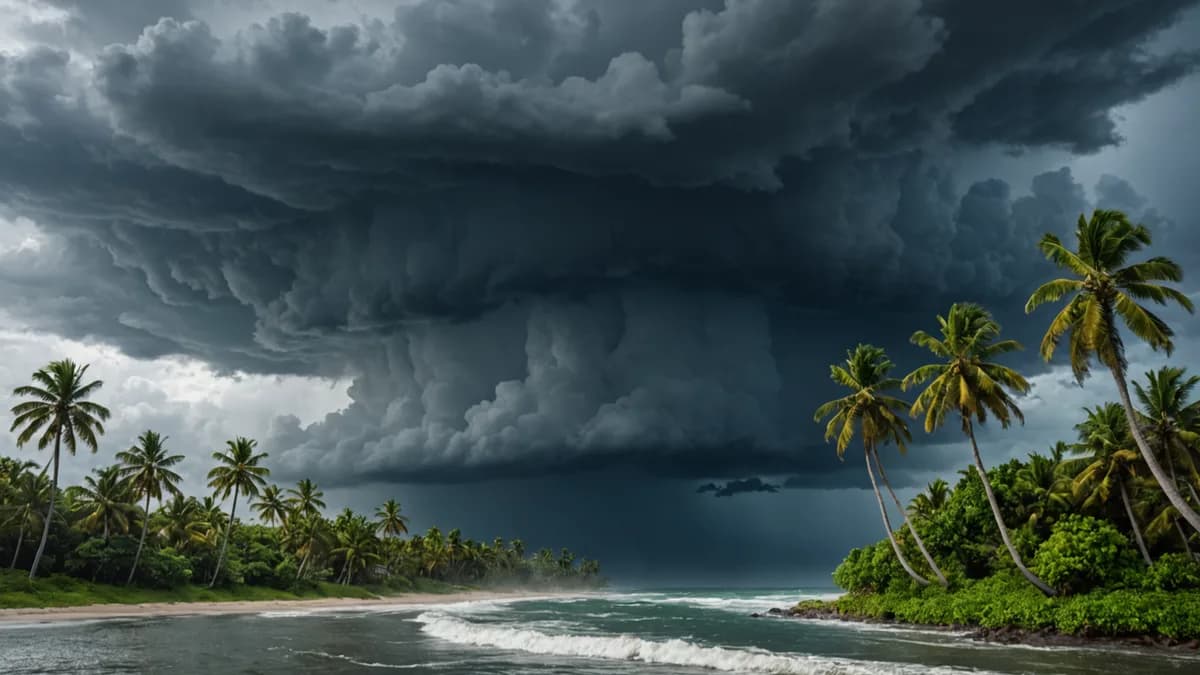
Early Tuesday on Kauai, the power came back on for about 8% of the island. For the other 92%, roughly 30,000 residents served by the Kauai Island Utility Cooperative (KIUC), morning arrived in the dark. The cause was Hurricane Lowell, which, according to Al Jazeera, pelted Hawaii’s western coastline with catastrophic winds and torrential rain without ever making landfall.
XOOMAR Intelligence
Analyst Take
This is not a simple weather report. It is a real-time demonstration of how a major storm’s true impact is measured not in wind speed, but in the silent, cascading failure of the systems modern life depends on. The grid went dark, and with it, the island’s digital tether to the world snapped.
Kauai's Silent Night: A Powerless Island Awakes
The sensory shift is brutal. The overnight roar of 85mph (137km/h) wind gusts and lashing rain gives way to an unnatural quiet, punctuated by the hum of a lucky few generators. For 30,000 people, the routines of a Tuesday morning, lights, coffee makers, news updates, work, simply don’t exist. Emergency officials have one clear instruction: stay off the roads. The isolation is immediate and total, turning neighborhoods into isolated pockets where the only news comes from what you can see out your window or hear from a battery-powered radio.
The premise here is critical. A storm that passes 80 miles offshore can still cripple an island. Resilience isn't just about withstanding a direct hit, it's about the vulnerability of every tree, power pole, and coastal road strung along the path of the wind.
Beyond the Wind Speed: The Mechanics of a Blackout
The National Hurricane Center reported Lowell’s core passed west of the islands overnight as a Category 1 hurricane. The trigger for the mass outage, per the Hawaii County Civil Defense Agency, was straightforward: vicious winds from that distance knocked down trees, power poles and lines.
XOOMAR Interpretation: While the source doesn't detail secondary failures, a near-total grid failure on an island logically triggers a domino effect. Water pumps that rely on electricity stop. Cell towers eventually go silent as backup batteries drain. Food spoils. For the roughly 300 residents who were forced to evacuate due to flooding, the crisis was compounded. The county's plea to conserve water is the first public signal of these cascading strains. The physical damage, flooded coastal roads and dangerous debris, now blocks the very crews needed to fix the problem, creating a recovery bottleneck.
The Immediate Aftermath: Damage Assessment in the Dark
With the hurricane warning lifted by Tuesday morning, the phase shifted from sheltering to reckoning. Mayor Derek Kawakami stated there was “extensive damage” being reported. The county government urged locals to shelter in place to allow crews to assess damage, clear debris, and restore power and services safely.
“Everyone’s participation has gone from preparation to sheltering to staying off roads …. to now gathering data and information,” the mayor stated.
This is the chaotic, slow-motion start to recovery. Crews must first navigate debris-choked roads to even see the full scope of downed lines before repairs can begin. Eric Blake of the National Hurricane Center warned that flooding and mudslides will continue to be a risk through the day, meaning new damage could occur even as they work. The priority becomes a brutal triage: restore critical infrastructure, reach isolated communities, and manage public safety amid a landscape that remains dangerous.
A Comparative Blow: Lowell's Place in Hawaiian Storm History
Hurricane Lowell will inevitably be measured against Hurricane Iniki, the 1992 Category 4 storm that devastated Kauai with direct landfall. The comparison is instructive, but not for the reasons one might think.
Iniki was a catastrophic, direct hit that rewired disaster preparedness for the state. Lowell was a glancing blow, a weakened Category 1 that stayed offshore. Yet, it still stripped power from the vast majority of one island. This underscores a critical, modern vulnerability: today's networked infrastructure can fail systemically without the storm's eye ever passing overhead. The 30,000-person outage figure is a benchmark for what a near-miss can now achieve. It suggests that storm categorization alone is an increasingly poor predictor of societal disruption; the specific combination of wind, rain duration, and infrastructure placement matters more.
As we've seen in other disaster scenarios, like the Himalaya Flash Flood Leaves Hundreds Lost, geographic isolation magnifies the impact of natural events and severely complicates response.
The Stakeholder Standoff in the Dark
In a prolonged blackout, an island fragments into groups with vastly different experiences and resources.
- Utility Crews: Face a logistical nightmare. They are asked to work in still-dangerous conditions to repair damage spread across remote, difficult-to-access terrain. Every decision on which line to fix first carries weight for whose power returns last.
- Local Residents: The scramble is for basics: generators, fuel, food that hasn't spoiled, and information. Community check-ins become vital. The mental strain of instability sets in, especially for vulnerable populations dependent on powered medical devices.
- Tourists: Experiences diverge wildly. Those in large resorts with industrial backup generators may notice little beyond a canceled luau. Those in vacation rentals or smaller hotels are thrust into an uninhabitable situation, with no local knowledge or resources, straining emergency services not designed for them.
This standoff creates implicit tension. Does recovery focus first on population centers to stabilize the most people, or on isolated communities who may be most at risk? There is no perfect answer, only triage.
The Hard Cost of a Dark Island
The economic meter started running the moment the grid failed. While the source does not provide specific figures, the mechanisms are clear and costly.
- Immediate Halt: Every closed business, every spoiled load of agricultural produce, every canceled hotel booking or tour represents direct, lost revenue. The tourism economy, a lifeblood for Hawaii, freezes.
- Repair Bills: Replacing poles, restringing lines, and clearing debris from miles of coastline is a multi-million-dollar undertaking for the utility and county.
- Non-Monetary Toll: The health risks from lack of refrigeration or medical equipment, the disruption to education if schools close, and the accumulated mental fatigue from repeated instability are real costs that don't appear on a balance sheet.
XOOMAR Interpretation: Ultimately, these costs are socialized. They are paid by taxpayers funding emergency response, ratepayers facing future utility bill increases for grid hardening, and everyone through potential rises in insurance premiums. Each major outage is a bill come due for deferred maintenance and resilience investment.
Re-wiring for the Next One: The Resilience Question
Simply repairing the downed poles and lines to the pre-storm standard is a recipe for repeating this scenario. Lowell is a case study prompting harder questions about true resilience.
For an island like Kauai, solutions likely look different than on the mainland:
- Decentralization: Could microgrids powered by solar and battery storage keep critical facilities like hospitals, water stations, and community centers online even when the main grid fails?
- Hardening: Which critical transmission lines can be buried or reinforced to withstand the next bout of 85mph gusts?
- Individual Preparedness: For homeowners and businesses, the lesson is to invest in their own backup power. Solutions are evolving, from traditional generators to new technologies like the liquid-cooled power bank we recently reviewed, which points to innovation in managing the heat and efficiency of stored energy.
Resilience is also social. Formalizing community response networks, identifying vulnerable neighbors, and having shared resource plans can mitigate the chaos of the first 72 hours after a blackout.
Lowell's Forecast: A Preview, Not an Anomaly
The National Hurricane Center noted that dangerous surf from Lowell's remnants will impact the Southern California coast for days due to the storm's intensity. The energy of these systems travels far beyond the eyewall.
XOOMAR Analysis: Lowell’s impact, achieved from a distance, should be read as a preview of a more volatile climate pattern. Warmer oceans provide more fuel for storms. The specific 30,000-person outage threshold may become a more frequent benchmark for Pacific storms that don't look catastrophic on the Saffir-Simpson scale but exploit specific infrastructure vulnerabilities.
The political and financial pressure for radical investment in grid resilience builds with each event. The unresolved tension is whether that investment comes proactively, or reactively after a more costly disaster. For islands like Kauai, the choice is stark: become a laboratory for climate-resilient infrastructure, or remain a recurring case study in cascading failure. The data from this "near-miss" is now being gathered. What Kauai and its utility do with it will write the first chapter of the next storm's story.
Impact Analysis
- The storm shows catastrophic grid failure can occur from a hurricane passing 80 miles offshore, challenging conventional 'direct hit' risk models.
- An outage affecting 30,000 residents serves as a real-time case study in community isolation when digital infrastructure collapses.
- The event underscores the growing need to evaluate resilience beyond wind speed—focusing on infrastructure vulnerability to cascading failures.
Kauai Power Status After Hurricane Lowell
Primary Sources & Disclosures

Written by
XOOMAR Insights Team
Research and Editorial Desk
The XOOMAR Insights Team pairs automated research with human editorial judgment. We track hundreds of sources across technology, fintech, trading, SaaS, and cybersecurity, cross-check the facts, and explain what happened, why it matters, and what to watch next. We do not just rewrite headlines. Every article is fact-checked and scored for reliability before it goes live, and we link back to the original sources so you can verify anything yourself.