
On Tuesday, a US helicopter was downed in an attack blamed on Iran. By Wednesday, US Central Command was striking Iran again, and Tehran was claiming attacks on ships in the Strait of Hormuz.
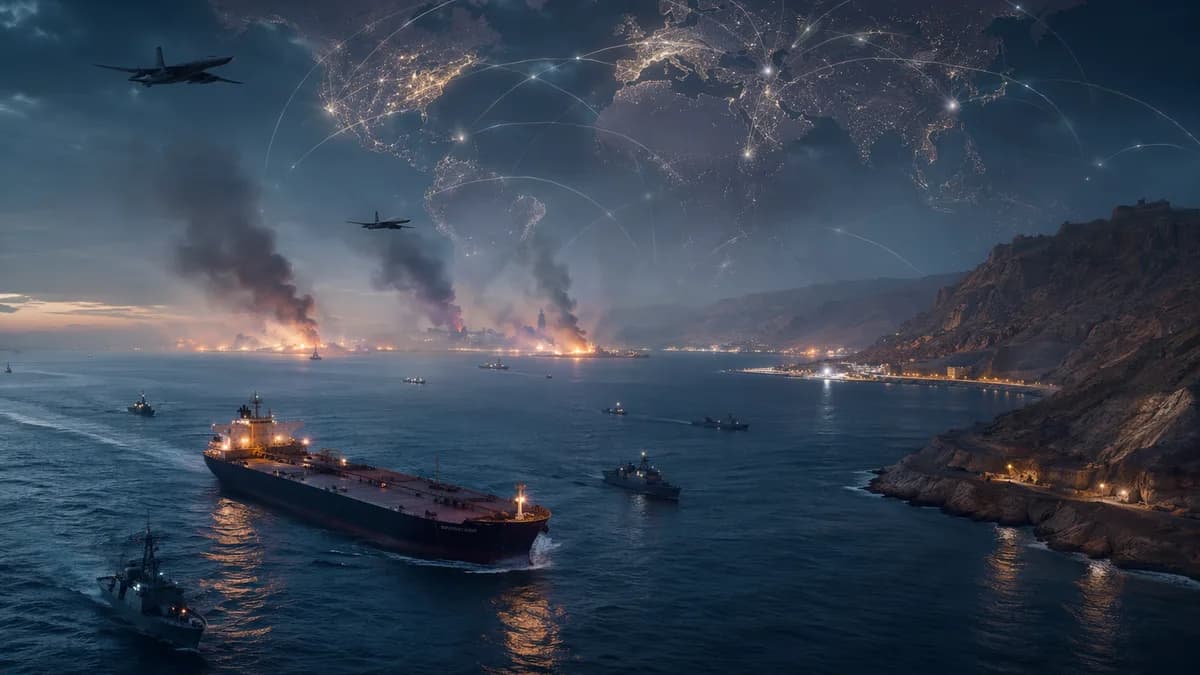
Global TrendsJune 11, 2026· 9 min read· By XOOMAR Insights Team
Iran's Strait of Hormuz Ship Claims Rattle Oil Markets
Updated on June 12, 2026
XOOMAR Intelligence
Analyst Take
58/ 100
4 sources analyzedLow confidenceTrend10Freshness97Source Trust92Factual Grounding88Signal Cluster20
That timing is the story. The fragile April ceasefire is no longer functioning as a real brake on escalation. It is becoming a staging area for controlled violence, with both sides trying to prove they can raise costs without losing control, according to BBC World.
Tuesday's helicopter attack set up Wednesday's wider US strikes
The latest spiral began after a US helicopter was downed on Tuesday in an attack blamed on Iran. The IRGC then targeted US bases across the Middle East, according to the source material. Washington answered with new strikes.
Centcom said it began "self-defense strikes" on Wednesday in "response to Iran's unwarranted and continued aggression". That language matters. The US is framing the strikes as deterrence, not escalation.
Tehran is sending the opposite signal. Iranian state media reported that the Islamic Revolutionary Guards Corps struck two ships in the Strait of Hormuz after the US attack. That claim still leaves major gaps.
The available reporting does not verify:
- Vessels: which ships were hit, if any.
- Damage: whether either vessel suffered serious damage.
- Crew: whether there were injuries or casualties.
- Flags: which countries the ships were registered under.
- Cargo: whether energy cargoes were involved.
That uncertainty is part of the pressure mechanism. A confirmed strike on named commercial ships would be one level of escalation. A claim of ship attacks in Hormuz, paired with warnings about closure, still rattles markets because Hormuz is the chokepoint where military signaling quickly becomes an energy-price event.
This follows the same escalation track we flagged in 21 US Targets Hit as Iran Strikes Gulf Bases Overnight, where retaliation had already spread beyond one battlefield.
Wednesday's Hormuz closure claim collided with Centcom's denial
Iranian state media reported that the Strait of Hormuz was "completely closed to all type of vessel". Centcom rejected that version, saying "commercial ships are continuing to transit in and out of the Strait of Hormuz".
Those two claims cannot both describe the same operational reality. Either Iran is overstating its control of the channel, the US is downplaying the disruption, or traffic is continuing under conditions that are more dangerous than normal.
For markets, including the US dollar amid Hormuz risk, the distinction is crucial.
A legal or military declaration of closure is not the same as an effective closure. The question is whether ships are actually stopping, diverting, delaying transit, or requiring protection. The source material confirms a price reaction, but it does not yet confirm a full operational shutdown.
Brent crude oil climbed above $95 a barrel after rising by about 2% during morning trade in Asia, according to the BBC report. A separate report from The Business Times said oil rose nearly US$3 after Trump’s threat of escalation and cited US$94 per barrel in that context, while also reporting that the war has disrupted roughly one-fifth of the world’s supply of oil and natural gas according to The Business Times.
That is why Hormuz matters even before facts are settled. Markets price the risk of interruption faster than they wait for a full damage assessment.
The market shock is about transit confidence, not just barrels lost
The immediate oil move shows how Hormuz can transmit military risk into financial markets with little delay. The available source material gives enough to say this: traders reacted to the closure claim even while Centcom said ships were still moving.
That gap between physical flow and perceived risk is where costs can build.
XOOMAR analysis: If shipowners, charterers, insurers, and energy buyers treat Hormuz as more dangerous, the economic impact can widen even without a confirmed full closure. The source material does not provide figures for insurance premiums, freight rates, or cargo delays, so those cannot be quantified here. But the channel is clear: higher perceived risk can affect shipping decisions, energy pricing, and contract exposure before supply data catches up.
The claims now in play create three distinct market questions:
| Issue | Source-supported fact | Market relevance |
|---|---|---|
| Oil price reaction | Brent rose above $95 a barrel after gaining about 2% in Asia trade | Traders priced escalation risk quickly |
| Transit status | Iran said Hormuz was closed, Centcom said commercial ships continued to transit | The operational reality remains disputed |
| Conflict tempo | US and Iran have exchanged intermittent fire since the April ceasefire | The ceasefire is no longer preventing repeated attacks |
A true closure would be a different event from harassment, warnings, or selective strikes. The source does not prove closure. It does prove that Hormuz has become the pressure point where each side can test the other’s threshold.
April's ceasefire now looks like a ceiling with holes in it
The US and Iran agreed in April to a ceasefire initially meant to last two weeks. Since then, both sides have exchanged intermittent fire without returning to full-scale hostilities.
That middle state is dangerous because it allows each side to claim restraint while still escalating. Washington can say it is responding to aggression. Tehran can say it is resisting pressure. Both can accuse the other of damaging diplomacy.
Trump said Iran would be hit "hard" and wrote on Truth Social that Iranian leaders have "taken too long to negotiate a deal". Iran’s foreign ministry accused the US of "damaging the diplomatic process through the contradictory messages it sends". Iranian President Masoud Pezeshkian said Iran "will stand firm against any pressure or threat".
US Defence Secretary Pete Hegseth said bombs would be "dropping on key facilities in Iran" and argued that Iran had been given a chance to make a deal but had not taken it.
This is coercive diplomacy under live fire. The problem is that every new strike changes the negotiating table. It creates domestic pressure, military pressure, and market pressure at the same time. That makes compromise harder to sell, even if both sides still want to avoid a wider war.
The dynamic also connects to our earlier analysis in A Near Iran Deal Cracks as Trump Threatens Payback, where threats around diplomacy were already starting to compete with the negotiation track itself.
The Tanker War comparison is tempting, but the current evidence is narrower
The outline of this crisis invites historical comparison to past maritime confrontations. But the supplied reporting does not provide a factual basis for a detailed comparison with the 1980s Tanker War, later mine attacks, tanker seizures, drone strikes, or proxy-linked maritime disruptions.
So the disciplined reading is narrower.
What the source material does show is that Iran is using Hormuz as a signaling venue. It claimed ship strikes after US attacks. It broadcast a closure claim. It paired military response with political messaging. The US then countered with its own operational claim that commercial traffic is still moving.
That means the core contest is not only over territory or facilities. It is over credibility.
Can Iran convince markets and governments that it can impose costs beyond its borders? Can the US convince shipping companies and allies that it can keep the strait usable? Can either side escalate just enough to strengthen its negotiating position without triggering the larger conflict the April ceasefire was meant to avoid?
UN Secretary General António Guterres captured that risk directly:
"We should not minimize the risks of lesser fire becoming full fire. All parties must work towards a diplomatic settlement. No more attacks. No more excuses,"
His phrase that the ceasefire is more like a "lesser-fire" is the cleanest description of the current phase.
Washington, Tehran, and shipowners are solving different problems
Washington’s immediate objective, based on Centcom’s statement, is to answer Iranian aggression and restore deterrence. It also has to defend the claim that Hormuz remains open if it wants to prevent panic around energy flows.
Tehran’s objective is different. Based on its public statements and reported IRGC action, Iran wants to show that US strikes on Iranian targets can carry costs in the Gulf. That does not require a verified full closure. It requires enough uncertainty to force attention.
Shipowners and energy traders are not grading speeches. They care about whether crews are safe, whether cargoes can move, and whether contracts become harder to execute. The available source material does not include industry reaction, so that cannot be treated as confirmed. But as analysis, their likely focus is obvious: operational risk beats political messaging.
The same logic applies to Gulf governments. The supplied reporting does not provide statements from Saudi Arabia, the UAE, Qatar, or Oman, apart from related-source reporting that Qatar has been mediating. So any broader claim about their positions would go beyond the record. What can be said is simpler: the more Hormuz becomes the theater, the more regional states are exposed to decisions made in Washington and Tehran.
Three paths now define the Hormuz risk
The next phase turns on whether the latest exchange stays limited or becomes self-reinforcing.
Scenario one: contained retaliation. The US and Iran trade limited actions, both claim strength, and intermediaries keep channels open. Evidence supporting this would include fewer strikes, clearer transit data, and renewed diplomatic movement.
Scenario two: a grinding maritime campaign. Iran or aligned forces keep pressure on vessels, while the US increases protection and messaging around commercial transit. Evidence supporting this would include more reported ship incidents, repeated closure claims, and continued oil-price jumps without a confirmed full shutdown.
Scenario three: a wider oil shock. A miscalculation causes casualties, a major vessel loss, or attacks that spread across US positions and Iranian facilities. Evidence supporting this would be direct confirmation of severe ship damage, sustained interruption of Hormuz traffic, or further strikes on bases and infrastructure.
The source material does not prove that Hormuz is fully closed. It proves something still serious: the strait has become the main gauge of whether the April ceasefire can survive contact with repeated retaliation. If commercial ships keep moving and diplomacy restarts, the crisis can stay contained. If ship attacks become regular and both sides keep treating bombs as negotiation tools, the market will not wait for a formal declaration of war to reprice the risk.
The Stakes
- The April ceasefire appears to be losing its ability to contain US-Iran escalation.
- Claims of attacks in the Strait of Hormuz can rattle energy markets even before damage is verified.
- Uncertainty over the ships, cargo, and casualties increases the risk of miscalculation.
US and Iran Signals After the Latest Escalation
| Actor | Reported action | Message being sent |
|---|---|---|
| United States | Centcom launched new self-defense strikes after a US helicopter was downed. | Washington is framing its response as deterrence rather than escalation. |
| Iran | Iranian state media claimed the IRGC struck two ships in the Strait of Hormuz. | Tehran is signaling it can threaten a critical energy chokepoint. |
Sources

Written by
XOOMAR Insights Team
Research and Editorial Desk
The XOOMAR Insights Team pairs automated research with human editorial judgment. We track hundreds of sources across technology, fintech, trading, SaaS, and cybersecurity, cross-check the facts, and explain what happened, why it matters, and what to watch next. We do not just rewrite headlines. Every article is fact-checked and scored for reliability before it goes live, and we link back to the original sources so you can verify anything yourself.
Explore More Topics
Related Articles
 Global Trends
Red Sea Tanker Attacks Drag Saudi Oil Into Iran Fight
Two Saudi tankers turned a Houthi claim into a shipping risk, with US strikes on Iran adding pressure on oil routes.
Jul 23, 20267 min
 Global Trends
Iran Vows Eye-for-Eye Strikes if Trump Hits Tehran
Iran says any US strike on its infrastructure will be met in kind, risking a wider energy crisis around the Strait of Hormuz.
Jul 23, 20266 min
 Global Trends
Houthi Attacks Turn Saudi Oil Escape Route Into Trap
Houthi attacks are squeezing Saudi Arabia’s Red Sea oil route just as Hormuz falters, raising the risk of wider supply shocks.
Jul 26, 20268 min
 Global Trends
Houthis Drag Red Sea Tankers Into US-Iran Firestorm
Houthi tanker claims and fresh US strikes on Iran put Red Sea and Hormuz shipping risk back at the heart of the Gulf crisis.
Jul 23, 202610 min
 Global Trends
Houthi Maritime Embargo Throws Saudi Oil Route in Doubt
Houthis say Saudi ships are barred from Bab al-Mandab, putting a key oil route under new strain.
Jul 20, 20266 min
 Trading
WTI Oil Price Sinks 7% as U.S.-Iran Pause Tests Bulls
WTI sank over 7% to $82.50 as traders cut the U.S.-Iran war premium, but Hormuz risk keeps crude on edge.
Jul 27, 20267 min
 Trading
Brent Crude Sinks 7.5% on US-Iran De-Escalation Bet
Brent crude plunged 7.5% as traders priced a US-Iran pause, not peace. Hormuz is still shut, so the relief trade looks fragile.
Jul 27, 20266 min
 Trading
War Pause Sends Bitcoin Back Above $65K as Oil Sinks
Bitcoin reclaimed $65,000 as the U.S. and Iran held fire, sparking a risk rally while oil dropped 5%.
Jul 27, 20266 min
 Global Trends
Double Exit Forces ACTU Test as McManus, O'Neil Quit
McManus and O'Neil are quitting the ACTU, ending a historic duo and forcing a fast succession test for Australia's union movement.
Jul 28, 20268 min
 Fintech
Apple Upgrade Grabs Control of Your Next iPhone Cycle
Apple Upgrade would replace iPhone financing with leases, giving Apple and Klarna more control over when customers swap devices.
Jul 28, 20267 min
Don't miss the signal
Get our weekly roundup of the stories that matter across tech, fintech, and trading. No noise, just signal.
Free forever. No spam. Unsubscribe anytime.