
If “human dignity has no passport,” which European leader wants to explain why deaths at sea have become an acceptable cost of border control?
Global TrendsJune 11, 2026· 8 min read· By XOOMAR Insights Team
Deaths at Sea Haunt Pope Leo’s Canary Islands Visit
Updated on June 12, 2026
XOOMAR Intelligence
Analyst Take
58/ 100
4 sources analyzedLow confidenceTrend20Freshness90Source Trust85Factual Grounding91Signal Cluster20
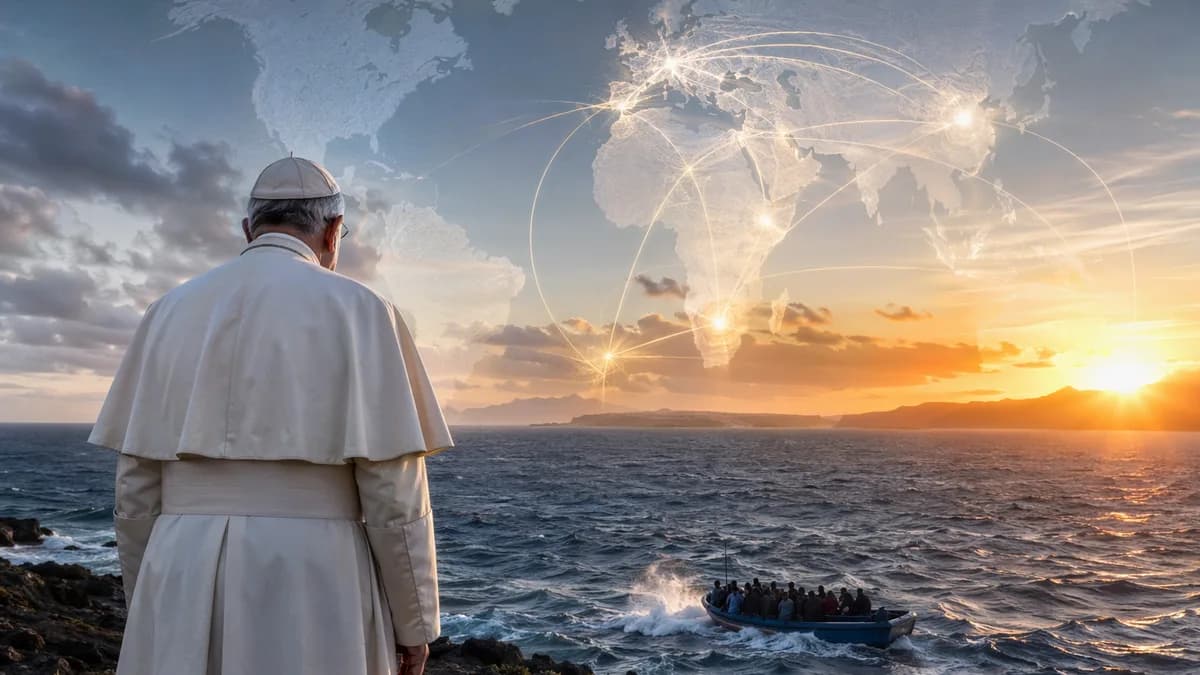
That is the question Pope Leo XIV put in front of Europe on Thursday in Spain’s Canary Islands, where he appealed for more humane treatment of refugees and migrants, according to Al Jazeera. The pope is expected to meet about 1,000 refugees and migrants on Friday, many of whom reached the Spanish archipelago after crossing dangerous Atlantic waters.
His message was not a migration policy blueprint. It was sharper than that. He forced Europe’s leaders to answer for the ethical cost of treating migration mainly as a border-management problem.
How did one papal line turn the Canary Islands into a test of Europe’s conscience?
Pope Leo made the line impossible to miss.
“Human dignity has no passport and does not lose its value when crossing a border.”
He delivered that message at Gran Canaria’s Port of Arguineguin, a site relief groups have called the “Dock of Shame” after about 1,000 people were stranded there in squalid conditions in the early months of the COVID-19 pandemic.
That location matters. A speech in a capital can be filed away as doctrine. A speech at a dock where migrants arrived exhausted, trapped, or dead is harder to neutralize. Leo spoke near a memorial to migrants lost at sea and told the crowd:
“We cannot grow accustomed to counting the dead.”
The deeper signal is that the Vatican wants migration judged through visible human consequences, not just flows, files, returns, and quotas. That doesn’t solve the operational problem. It makes the moral accounting harder to avoid.
Leo’s stop also fits into his broader Spain visit, where he has already warned that escalating conflicts have pushed the world into a profound crisis. His Canary Islands appearance follows other high-profile moments on the trip, including the questions of church symbolism and public authority raised in Tallest Church Tower Puts Pope Leo XIV on Trial in Barcelona.
Why has the Atlantic route become such a brutal front door into Europe?
The Canary Islands are Spanish territory off the western coast of Africa. For many migrants, they function as Europe’s most exposed entry point: close enough to represent hope, dangerous enough to turn the crossing into a gamble with death.
The source material ties the route to people fleeing conflict and poverty, often in packed, unseaworthy boats. Religion News Service adds that arrivals include people from Senegal, Mali, Mauritania, Gambia, and other parts of sub-Saharan Africa, with others arriving by air from Venezuela and Cuba.
The numbers explain why Leo chose this stage:
- Deaths: At least 3,090 people died in 2025 trying to reach the Canary Islands, according to Caminando Fronteras, cited by Al Jazeera.
- Arrivals: In 2024, the Canaries received a record 46,843 migrants, according to Religion News Service.
- This year: Just over 3,000 migrants have arrived in the islands so far, while 1,300 have already died in the first six months of 2026, according to the same NGO cited by Religion News Service.
- Meeting: Leo is due to meet about 1,000 refugees and migrants on Friday.
That ratio is politically explosive. Arrivals can fall while the route becomes proportionally deadlier. If fewer people reach land but more die trying, governments may claim control is working while humanitarian groups point to a worsening death toll.
Leo’s phrase, “counting the dead,” lands precisely there. It attacks the habit of measuring success by reduced arrivals while treating disappearances as background noise.
What pressure is Spain under that Brussels can’t absorb for it?
Spain is in a difficult position because the Canary Islands are both a humanitarian front line and a political pressure point.
Al Jazeera reports that Spain has taken a more open stance than much of Europe, including a programme to grant residency to more than half a million undocumented people. That move has drawn criticism from far-right leaders in Spain and across the continent. The country is also struggling with the slow pace of granting legal status to thousands of people in limbo.
At the same time, the islands face the first shock of arrivals. Juan Carlos Lorenzo, coordinator of the Spanish Commission for Refugees in the Canary Islands, called Leo’s visit a “significant milestone.”
“It will serve as a strong affirmation of the defence of human rights, respect and the dignity that all people deserve, regardless of their origin,” said Lorenzo.
Brussels sits behind this local pressure. Religion News Service reports that the EU Pact on Migration and Asylum, a new legal framework for how European countries manage immigration, takes effect Friday. Human-rights groups warn it could open the door to large deportation efforts to migrant camps in Africa.
There is also a harder enforcement layer. Religion News Service says arrivals have declined after Spain and the European Union struck deals with Mauritania, Senegal and Morocco to intercept departures and increase patrols.
XOOMAR analysis: that creates the central contradiction Leo is pressing on. Europe can fund interception, patrols, and processing rules. But if the political system still produces deaths at sea and legal limbo on land, leaders can’t claim the moral problem has been outsourced.
Why will migrants, church groups, and anti-immigration politicians hear different speeches?
For migrants, Leo’s visit is recognition. He told them directly:
“You are not just numbers or files. You are people who have left behind families and homes. You have dreams that no one has the right to despise.”
That language matters because policy debates often flatten migrants into pressure, capacity, or risk. Leo reversed the frame. He put identity before status.
For Catholic charities and local church networks, the visit strengthens their case for safer routes, humane reception, and less punitive rhetoric. Vatican News reports that Leo denounced traffickers and mafias that profit from despair, while also warning against indifference. That gives church groups language to criticize both criminal exploitation and political neglect.
For border and security officials, the message is more complicated. The pope’s remarks do not erase the operational problems of trafficking networks, documentation gaps, overcrowded reception systems, and legal backlogs. But he is not pretending those problems are simple. He is saying they cannot become excuses for moral numbness.
For nationalist and anti-immigration parties, the visit will be easier to attack. Al Jazeera notes that Spain’s residency initiative has drawn criticism from far-right leaders in Spain and across Europe. Those politicians can frame Leo’s message as detached from public pressure over services and state capacity.
But that attack has a weakness. Leo did not deny that states have obligations. He widened the question: what kind of state treats drowning, trafficking, and prolonged limbo as tolerable side effects?
Is this really a Francis-era migration agenda under a new pope?
Leo’s trip also carries succession weight. Al Jazeera reports that the visit fulfilled a long-held wish of Pope Francis, who died a year ago without making a planned trip to the islands.
That continuity matters. Leo is not improvising a one-off humanitarian gesture. He is placing migration near the center of his public papacy, and doing it at a site that combines grief, rescue work, state failure, and European politics.
Vatican News reports that Leo listened to testimony from a maritime rescuer, a Caritas volunteer, a trafficking survivor, and a migrant entrepreneur. One testimony came from Blessing, a Nigerian woman trafficked for sexual exploitation, whose story was read by another woman to protect her identity.
Leo’s response was direct:
“If others have put a price on your body, know that God has never ceased to recognise your inestimable worth.”
That is the core of the papal intervention. It is not only about entry rules. It is about whether Europe’s language of rights still applies when the person invoking those rights arrives by boat.
What would prove Europe heard the Canary Islands message?
The speech will not stop the boats by itself. No papal address can change the drivers named in the source material: conflict, poverty, criminal exploitation, dangerous crossings, narrow legal pathways, and slow status decisions.
The test is practical. Watch whether European leaders and Spanish authorities respond with:
- Faster processing for people already in legal limbo.
- More support for Canary Islands reception systems.
- Clearer protection for trafficking victims.
- Safer legal pathways that reduce dependence on smugglers.
- Responsibility-sharing that does not leave arrival points carrying the first shock alone.
Evidence that would weaken Leo’s impact is easy to spot: more deaths, slower legal status decisions, tougher rhetoric paired with little local funding, and policies that reduce arrivals while making the route deadlier.
The pope did not rewrite EU migration law in Gran Canaria. He did something narrower and more durable. He made it harder for Europe’s leaders to describe deaths at sea as an administrative detail.
Impact Analysis
- The pope’s remarks put moral pressure on European leaders over deaths linked to migration routes.
- The Canary Islands remain a visible symbol of the human cost of Atlantic crossings.
- Framing dignity as universal challenges policies that treat migration mainly as border control.
Migrant-related figures cited in Canary Islands visit
Refugees and migrants Pope expected to meet
people1,000
People stranded at Port of Arguineguin during early COVID-19
people1,000
Sources

Written by
XOOMAR Insights Team
Research and Editorial Desk
The XOOMAR Insights Team pairs automated research with human editorial judgment. We track hundreds of sources across technology, fintech, trading, SaaS, and cybersecurity, cross-check the facts, and explain what happened, why it matters, and what to watch next. We do not just rewrite headlines. Every article is fact-checked and scored for reliability before it goes live, and we link back to the original sources so you can verify anything yourself.
Explore More Topics
Related Articles
 Global Trends
300,000 Flee as European Wildfire Maps Expose Risk
European wildfire maps show fires outrunning evacuations and response, with 300,000 people displaced across France and Spain.
Jul 27, 20268 min
 Global Trends
Cockroach Protests Crack Modi’s BJP Fortress in Delhi
Cockroach protests forced a minister out and exposed fresh weakness in Modi’s BJP after years of dominance.
Jul 27, 20268 min
 Global Trends
Wildfire Smoke Kills 1.5 Million as Fire Plans Fail
Wildfire smoke kills far more people than flames, and hotter, drier weather is making suppression-only playbooks dangerously obsolete.
Jul 25, 20268 min
 Global Trends
140,000 Flee as Madrid Wildfires Outrun Fire Crews
Madrid wildfires merged into a major emergency as France and Spain evacuated 140,000 people and crews struggled to hold the line.
Jul 24, 20268 min
 Global Trends
€2bn Europe Heatwave Shreds Grain Harvest Forecast
June’s heatwave cost Europe’s grain farmers €2bn and erased up to 10m tonnes of crops, turning harvest risk into a food-price warning.
Jul 22, 20268 min
 Technology
RT6 Fleet Storms London Robotaxi Race for Lyft, Baidu
Baidu's RT6 test cars put Lyft into London's robotaxi fight, turning a 2027 launch plan into a regulatory and trust test.
Jul 28, 202611 min
 Trading
Gold Price Risks $4,000 Breakdown Before Fed Decision
Gold is slipping near $4,000 as traders wait for the Fed's rate signal, with yields and dollar strength threatening support.
Jul 29, 20268 min
 Technology
Fast Metals Mines Toxic Red Mud for Critical Minerals
Fast Metals raised $4.3M to mine critical minerals from red mud. Now it has to prove the leftover waste is safer.
Jul 29, 202612 min
 SaaS & Tools
Nearly 60 Webinar Tools Expose the Best Webinar Software
Webinar platforms are now judged by pipeline, not polish. Zapier’s 2026 picks show marketers which tools turn attendance into action.
Jul 29, 20268 min
 Trading
$83 Oil Traps USD/CAD Before Pivotal Fed Rate Call
USD/CAD is boxed near 1.4093 as oil supports the loonie, but Fed risk keeps traders from calling a breakout.
Jul 29, 20265 min
Don't miss the signal
Get our weekly roundup of the stories that matter across tech, fintech, and trading. No noise, just signal.
Free forever. No spam. Unsubscribe anytime.