
Can Pope Leo XIV's inauguration of the world's tallest church tower turn a packed Barcelona spectacle into lasting Catholic credibility once the fireworks fade?
Global TrendsJune 10, 2026· 8 min read· By XOOMAR Insights Team
World’s Tallest Church Tower Puts Pope Leo XIV on Trial
Updated on June 11, 2026
XOOMAR Intelligence
Analyst Take
57/ 100
4 sources analyzedLow confidenceTrend10Freshness95Source Trust92Factual Grounding90Signal Cluster20
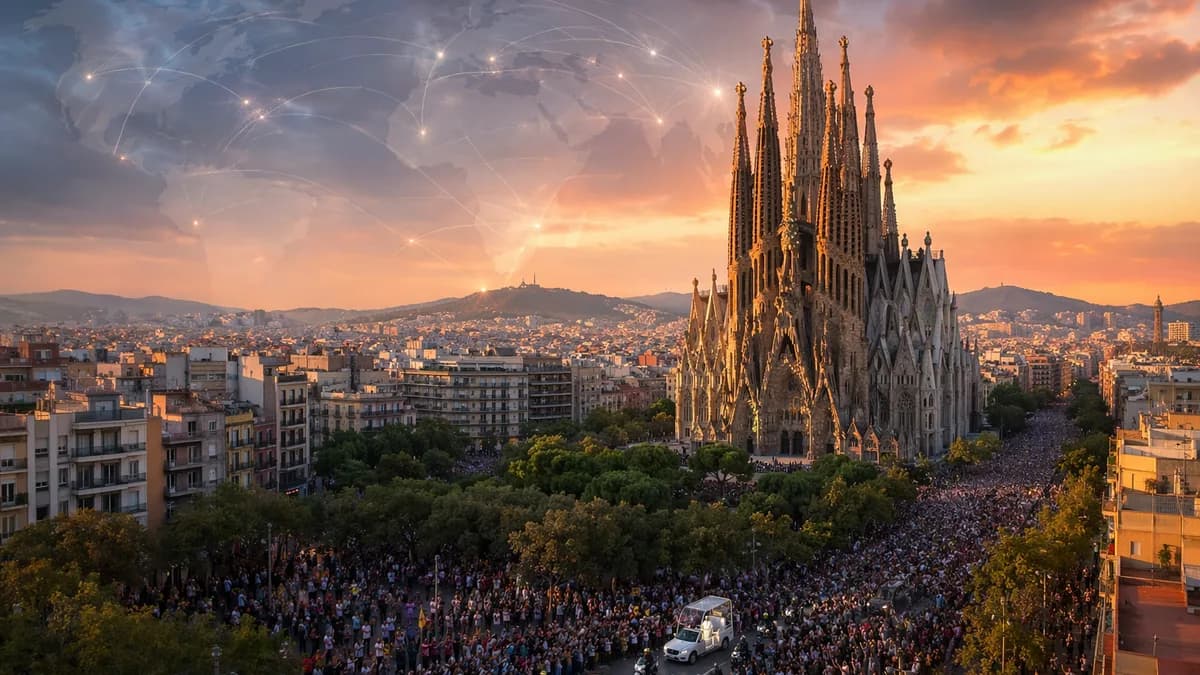
That is the real question beneath the images from Barcelona, where thousands filled the streets as the pope visited Sagrada Família, according to BBC World. The visit gave the Church a rare public stage: a new pope, a global architectural icon, Spanish royalty, the prime minister, and a basilica now standing at 172.5m (566ft) after the completion of the Tower of Jesus Christ.
Can a basilica tower carry more weight than a papal motorcade?
Yes, for one day. Maybe longer.
Pope Leo XIV did not just visit Sagrada Família. He inaugurated its newest and tallest tower, completed in February, and described the basilica as a masterpiece of:
"stones, colours and light"
That phrase matters because it frames the visit as more than ceremony. Sagrada Família lets the Church speak through architecture before it asks anyone to listen to doctrine. The basilica is a working Catholic site, a monument to Antoni Gaudí, and one of Barcelona's most recognizable public symbols. The BBC reports that this visit also marks 100 years since Gaudí's death, which gave the event a second layer: papal authority standing inside a centenary tribute to sacred design.
The optics were unusually dense.
King Felipe VI, Queen Letizia, and Prime Minister Pedro Sánchez attended the service. Fireworks lit the basilica. The new tower pushed the church to a height the BBC says cements it as the tallest church in the world. And the pope's trip, which began on Saturday, is the first by a pope to Spain in some 15 years.
That combination made the event difficult to read as a simple religious visit. It was also a civic performance, a national moment, and a Barcelona branding event. XOOMAR analysis: the Church's strongest card here was not argument. It was visibility.
Do thousands in the street prove Catholic strength, or just papal spectacle?
They prove mobilizing power. They don't prove institutional renewal.
The BBC's video headline says thousands filled Barcelona's streets for the Pope Leo visit. Vatican News, reporting from the city before his arrival, described Barcelona as "literally buzzing with activity," with authorities cleaning streets, fixing walkways, and a visible security presence. It also noted flyers carrying "Benvingut!", Catalan for "Welcome," and "PAU", Catalan for peace.
Those details show preparation at city scale. They don't tell us who the crowd was.
The available sources do not provide a breakdown of attendees by religious practice, age, nationality, parish affiliation, or motivation. That matters. A papal visit can draw practicing Catholics, occasional Catholics, architecture lovers, residents who want to witness a rare event, and visitors already near Sagrada Família. Treating all of them as one religious bloc would overstate what the evidence supports.
A cleaner reading looks like this:
| Signal from Barcelona | What it supports | What it does not prove |
|---|---|---|
| Thousands in the streets | Pope Leo XIV can still draw a major public crowd | A sustained rise in Mass attendance |
| Royal and prime ministerial attendance | The visit carried national institutional weight | Political consensus on Church influence |
| Sagrada Família tower inauguration | Catholic symbolism still commands visual attention | Renewed trust in Church leadership |
| Security and city preparation | Barcelona treated the visit as a major public event | Long-term local approval |
This distinction is the article's spine. A packed street is powerful. A fuller pew is a different test.
XOOMAR has seen the same conversion problem in a very different sector: attention is not the same as commitment, as explored in 365 Equity Crowdfunding Platforms Force a Costly Bet. Institutions can gather audiences. The harder task is turning that audience into durable participation.
Why did Barcelona give Pope Leo XIV a sharper stage than another Spanish city?
Because Sagrada Família concentrates several messages in one place.
Vatican News called it the "Masterpiece of Barcelona" and noted that the city has been designated World Capital of Architecture for 2026. It also said Barcelona is celebrating the Year of Gaudí and the centenary of his death. That makes the basilica a religious site, an architectural claim, and a civic emblem at the same time.
The pope's presence also arrived during a broader week-long visit to Spain. Vatican News described Barcelona as the second leg of his Apostolic Journey to Spain. The BBC says the trip is the first by a pope to the country in some 15 years. Those facts make the stop more than a local event.
The Church also used the visit to touch a pastoral theme beyond architecture. Vatican News reported that Pope Leo XIV was expected to visit a parish run by a small Augustinian community of four pastors in Barcelona: two priests from Tanzania and two from the Philippines. The report said they maintain a strong ministry among migrants.
That detail gives the visit a second register. The global Church was not only presenting its grandest stone-and-light image at Sagrada Família. It was also showing a smaller parish model shaped by migration and international clergy.
XOOMAR analysis: that contrast is the most useful way to understand the trip. Sagrada Família gave Pope Leo XIV altitude. The parish visit, as described by Vatican News, gave him ground contact.
What did the different audiences actually see?
The sources show the event's participants and setting. They don't show crowd psychology.
We know Spanish royals attended. We know Prime Minister Pedro Sánchez attended. We know the pope inaugurated the Tower of Jesus Christ. We know thousands gathered. We know Barcelona prepared streets and walkways, and that security was visible but the city was generally calm, according to Vatican News.
From that, we can responsibly infer the visit operated on several levels:
- Religious: Pope Leo XIV presided over a Catholic ceremony at one of the Church's most visible modern basilicas.
- Civic: Barcelona authorities prepared for a major public event with security, street work, and crowd management.
- Cultural: The Gaudí centenary tied the papal visit to architecture and memory, not only worship.
- Diplomatic: The presence of the king, queen, and prime minister put the visit inside Spain's national public life.
The risk is over-reading the crowd. The BBC does not report interviews from attendees. The Vatican News piece gives street atmosphere, not opinion polling. So the honest conclusion is narrower but still significant: Pope Leo XIV achieved public concentration. He drew attention across religious, civic, and cultural channels at once.
That is not nothing. In media terms, Sagrada Família gave the Vatican a highly efficient image: one tower, one pope, one city, one centenary.
Can Pope Leo XIV turn architectural awe into pastoral traction?
That is the harder problem.
The pope's language at Sagrada Família leaned into beauty. "Stones, colours and light" is not a policy message. It is a claim about how sacred art can still speak in public. Vatican News also framed the visit as "profoundly spiritual and pastoral," and emphasized the word peace through the Catalan PAU signs seen in the city.
But pastoral traction requires follow-through. The sources point to one concrete place where that follow-through may be tested: the Augustinian-run parish serving migrants. If the visit is remembered only for fireworks and the 172.5m tower, it will remain a spectacle. If local Church structures use the attention to deepen parish engagement, especially among communities already served by those priests, the trip could have a more durable effect.
That distinction matters for any institution trying to convert a one-day surge into repeat trust. As XOOMAR argued in 365 Equity Crowdfunding Platforms Force a Costly Bet, scale and visibility can create pressure as well as opportunity. The same logic applies here, though the stakes are religious and civic rather than financial.
The evidence needed is practical, not poetic: parish attendance, youth participation, migrant ministry activity, volunteer sign-ups, and local Church engagement after the trip. None of those figures appear in the supplied reporting, so they can't be claimed now.
After the fireworks, what evidence will show whether Barcelona mattered?
Barcelona gave Pope Leo XIV the kind of image every institution wants: crowded streets, a landmark stage, elite attendance, and a clear visual marker in the Tower of Jesus Christ. It also gave him a built-in story: Gaudí's centenary, Barcelona's architectural status, and a Church trying to speak through beauty, peace, and pastoral presence.
The trip's legacy will not be settled by crowd shots.
The confirming evidence would come later: stronger local participation around parishes, clearer engagement with migrant communities, and signs that people who showed up for the pope stayed connected after the barriers came down. The weakening evidence would be just as clear: the visit lives on as a beautiful video clip, while local Church life returns unchanged.
For now, the safest judgment is also the sharpest one. Pope Leo XIV won visibility in Barcelona. Credibility is the next test.
Impact Analysis
- Pope Leo XIV’s visit turned Sagrada Família into a global stage for the Catholic Church.
- The new 172.5m Tower of Jesus Christ reinforces the basilica’s status as the world’s tallest church.
- The presence of Spanish royalty and the prime minister made the event both religious and civic.
Sources

Written by
XOOMAR Insights Team
Research and Editorial Desk
The XOOMAR Insights Team pairs automated research with human editorial judgment. We track hundreds of sources across technology, fintech, trading, SaaS, and cybersecurity, cross-check the facts, and explain what happened, why it matters, and what to watch next. We do not just rewrite headlines. Every article is fact-checked and scored for reliability before it goes live, and we link back to the original sources so you can verify anything yourself.
Explore More Topics
Related Articles
 Global Trends
300,000 Flee as European Wildfire Maps Expose Risk
European wildfire maps show fires outrunning evacuations and response, with 300,000 people displaced across France and Spain.
Jul 27, 20268 min
 Global Trends
Cockroach Protests Crack Modi’s BJP Fortress in Delhi
Cockroach protests forced a minister out and exposed fresh weakness in Modi’s BJP after years of dominance.
Jul 27, 20268 min
 Global Trends
140,000 Flee as Madrid Wildfires Outrun Fire Crews
Madrid wildfires merged into a major emergency as France and Spain evacuated 140,000 people and crews struggled to hold the line.
Jul 24, 20268 min
 Global Trends
Christian Brothers Abuse Survivors Win Full Payout
EREA's backdown lets Christian Brothers abuse survivors seek full compensation after a $217m property sale plan left claims badly underfunded.
Jul 24, 20266 min
 Global Trends
Manchin Puts Independent Leadership Council on Trial
Joe Manchin is turning voter frustration into a midterm test for independent candidates. Viability will take more than protest votes.
Jul 25, 20267 min
 Trading
Gold Price Risks $4,000 Breakdown Before Fed Decision
Gold is slipping near $4,000 as traders wait for the Fed's rate signal, with yields and dollar strength threatening support.
Jul 29, 20268 min
 Technology
Fast Metals Mines Toxic Red Mud for Critical Minerals
Fast Metals raised $4.3M to mine critical minerals from red mud. Now it has to prove the leftover waste is safer.
Jul 29, 202612 min
 SaaS & Tools
Nearly 60 Webinar Tools Expose the Best Webinar Software
Webinar platforms are now judged by pipeline, not polish. Zapier’s 2026 picks show marketers which tools turn attendance into action.
Jul 29, 20268 min
 Trading
$83 Oil Traps USD/CAD Before Pivotal Fed Rate Call
USD/CAD is boxed near 1.4093 as oil supports the loonie, but Fed risk keeps traders from calling a breakout.
Jul 29, 20265 min
 Technology
DoorDash Drone Delivery Seizes FAA Clearance to Fly
DoorDash won FAA clearance for DoorDash Air, signaling a bigger bet on owning delivery from couriers to bots to drones.
Jul 29, 20269 min
Don't miss the signal
Get our weekly roundup of the stories that matter across tech, fintech, and trading. No noise, just signal.
Free forever. No spam. Unsubscribe anytime.