
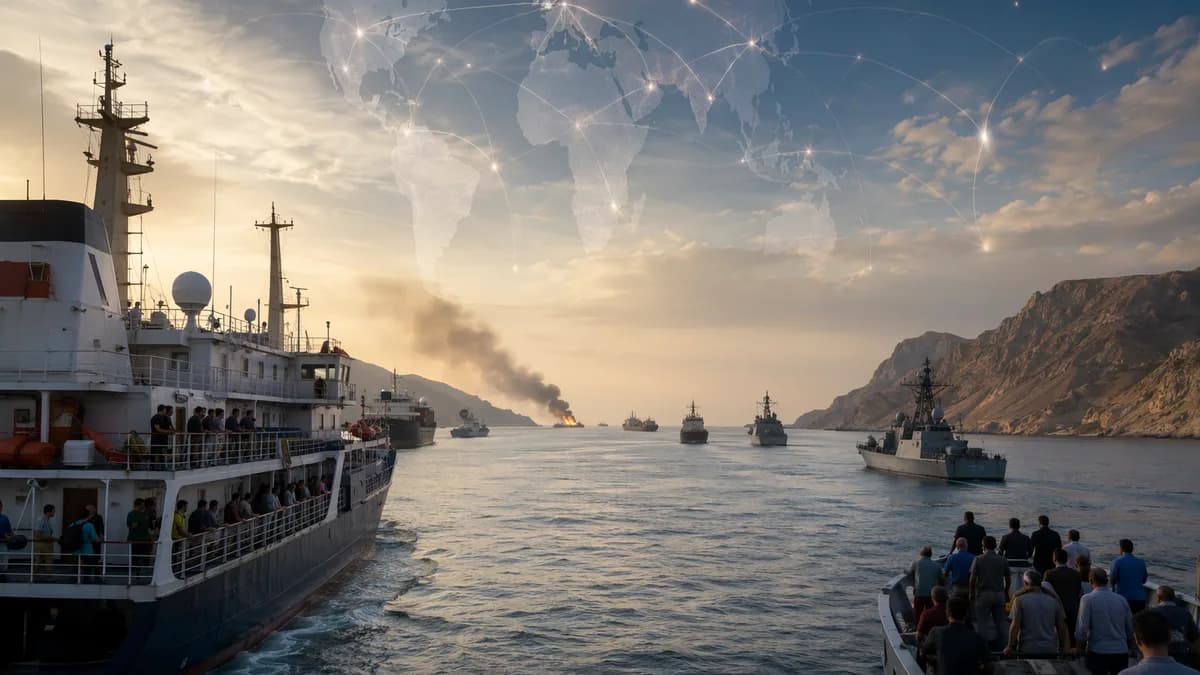
On Thursday, the Strait of Hormuz evacuation shifted from a controlled maritime exit plan into a live test of whether any outside body can guarantee safe passage through a contested chokepoint.
Global TrendsJune 25, 2026· 7 min read· By XOOMAR Insights Team
Projectile Freezes Strait of Hormuz Evacuation Plan
Updated on June 27, 2026
XOOMAR Intelligence
Analyst Take
83/ 100
4 sources analyzedMedium confidenceTrend10Freshness98Source Trust90Factual Grounding91Signal Cluster80
The International Maritime Organization paused its effort to move stranded ships out of the Persian Gulf after the British military said a vessel was hit by a projectile off Oman, following the passage of several tankers along a UN-backed route, according to Guardian World. The vessel that was struck was not part of the evacuation effort, IMO secretary-general Arsenio Dominguez said. That distinction matters legally and operationally. It does not solve the bigger problem.
A safe corridor only works if ships believe it is safe. One projectile was enough to freeze the plan.
Thursday’s Projectile Strike Put the Strait of Hormuz Evacuation on Trial
The Strait of Hormuz evacuation was designed to relieve a dangerous backlog: ships stranded inside the Persian Gulf after the war disrupted normal transit. The route, laid out by Oman and the IMO, sent vessels along the United Arab Emirates and then Oman, close to the Musandam peninsula.
Several tankers used it. Then came the strike.
The UK Maritime Trade Operations centre said the vessel sustained damage off Oman, with no reported injuries or environmental effects. The source material says it remains unclear who launched the projectile or what type of vessel was targeted. Al Jazeera, citing maritime security reporting, identified the vessel as the Singapore-flagged Ever Lovely, while a Reuters-cited maritime security source said it was likely targeted by a drone. Those details sharpen the risk picture, but they don't yet establish responsibility.
Dominguez framed the pause as a safety check, not an abandonment.
“I have decided to temporarily pause [the evacuation plan’s] implementation in order to reconfirm that the necessary safety guarantees continue to be in place for the ships on our evacuation list and all those in the region,” Dominguez said.
XOOMAR analysis: this is not a routine delay. The IMO does not command a navy. Its plan depends on states, militaries, shipowners, flag registries and regional authorities aligning around a corridor. If one actor rejects that corridor or threatens vessels using it, the guarantee becomes political before it becomes operational.
For related XOOMAR coverage of the same pressure point, see Cargo Ship Strike Freezes Strait of Hormuz Evacuation and 11,000 Sailors Expose Strait of Hormuz Toll Power Play.
Iran’s Route Warning Turned a Navigation Plan Into a Sovereignty Fight
The attack report came hours after Iran warned vessels not to use the new route without Tehran’s permission. Iran’s Persian Gulf Strait Authority, a new government agency established to control shipping in the strait, wrote on X that transit outside its own designated routes “will not be covered by the guarantee of safe passage”.
The naval arm of the Islamic Revolutionary Guard Corps was more direct. In a statement carried by Iran’s state-run IRNA news agency, it said the route had been created without notice or coordination with Iran and called it “unacceptable and completely dangerous”.
“The only authorised route for passing through the strait of Hormuz is the one declared by the Islamic Republic of Iran,” the Iranian force said. “Vessel traffic outside these routes is extremely dangerous and prohibited.”
“Violators will be dealt with,” it added.
That language changes the commercial calculus. Shipowners do not need certainty that a route will be attacked. They need enough uncertainty to delay, seek escort, ask for revised instructions or avoid transit until insurers and charterers agree on the risk.
The IMO’s problem is blunt: a corridor can look coherent on a chart and still fail at sea. It needs surveillance, deconfliction, rapid response, clear communications and credible deterrence. Without those, a “route” is just a line through contested water.
The Traffic Data Shows Recovery, but Not Confidence
The reported strike landed just as traffic through the strait was improving.
| Metric | Reported figure |
|---|---|
| Strait’s role in energy trade | About a fifth of the world’s oil and natural gas moved through the central corridor before the war |
| Crossings last week | 125 vessels, up from 33 the week before, according to Lloyd’s List Intelligence |
| Wednesday transits | 78, according to S&P Global |
| Daily prewar average | 130 or more |
| MarineTraffic count | 70 verified crossings on Wednesday and 31 on Tuesday |
| IMO evacuation scale | 600 ships and around 11,000 mariners, according to Al Jazeera’s report |
The numbers show movement, not normalization. S&P Global’s 78 transits on Wednesday were the highest since the war began, but still below the daily prewar average of 130 or more. That gap is the market’s hesitation made visible.
Oil also reflected that tension. Guardian World reported that oil on Thursday briefly dipped below its last prewar price of just under $73 per barrel, a sign that traders believed the situation was improving before the strike report. ABC, citing Reuters, reported benchmark oil prices rose 1.9% after the attack, as concerns returned over how long Gulf flows could take to resume normal levels.
XOOMAR analysis: the key signal is not whether every ship stops. It is whether marginal voyages start to need more approvals, more naval coordination and more legal comfort before sailing. That slows a maritime system even when ships are still moving.
Washington Wants the Route Open, Tehran Wants Control Recognized
The shipping dispute is now fused with diplomacy.
The US and Iran are still debating the terms of an interim peace deal, including ship transit through the narrow mouth of the Persian Gulf and the future of Iran’s stockpile of highly enriched uranium. Under a memorandum of understanding signed last week, the two sides have 60 days to settle the details.
US secretary of state Marco Rubio, visiting the Gulf to reassure American allies, said Washington was committed to the new route and to keeping ships moving through the strait.
“If that stops, then we’re going to have a problem,” Rubio said Thursday before the strike report.
Rubio also told Gulf Cooperation Council foreign ministers that the agreement would not undermine their security, stability or prosperity. Bahrain’s foreign minister Abdullatif bin Rashid al-Zayani called the agreement a glimmer of hope but said it was “critically important that Iran adheres to its obligations.”
The incentives are colliding:
- Shipowners: Need crew safety, cargo movement and clarity on whether transit is reasonable.
- Gulf energy exporters: Need the chokepoint open without triggering panic or ceding too much control to outside powers.
- The IMO: Needs neutrality, verified safety guarantees and proof its evacuation list will not become a target.
- Iran: Is signaling that routes not coordinated with Tehran carry risk.
- The US: Is trying to keep the route open while negotiations remain unsettled.
This follows the same 60-day pressure window examined in Vance Iran Talks Push Hormuz Deal Onto a 60-Day Clock, where shipping access and diplomacy are no longer separate tracks.
The Next Decision Is Whether Guarantees Become Escorts
The IMO is unlikely to restart the Strait of Hormuz evacuation until it can reconfirm safety guarantees for ships on its list and for vessels in the region. That language leaves room for several next steps: tighter vessel sequencing, more direct coordination with Oman and other states, clearer route communications, or some form of escorted movement.
Escorts could reassure shipowners. They could also make the route more politically charged, especially if Iran continues to insist that only its designated passages are authorized.
The evidence to watch is concrete:
- Transit counts: Whether Wednesday’s 78 transits prove repeatable or fall back.
- Official advisories: Whether UKMTO, the IMO or regional authorities issue new route guidance.
- Iranian enforcement: Whether warnings remain verbal or turn into more direct interference.
- Oil reaction: Whether prices treat the strike as a one-off incident or a sustained supply risk.
- IMO restart terms: Whether the agency resumes with the same route or a more controlled process.
The thesis is simple: Hormuz risk has moved from blockade fear to guarantee risk. If another vessel is hit near the evacuation route, markets and shipowners will stop treating this as a temporary security incident and start pricing it as a sustained challenge to who controls passage through the Strait of Hormuz.
Impact Analysis
- The pause shows how quickly a single attack can undermine confidence in a maritime safety corridor.
- Disruption in the Strait of Hormuz matters because it is a critical route for global energy shipments.
- Uncertainty over responsibility for the strike raises the risk of further escalation and shipping delays.
Sources

Written by
XOOMAR Insights Team
Research and Editorial Desk
The XOOMAR Insights Team pairs automated research with human editorial judgment. We track hundreds of sources across technology, fintech, trading, SaaS, and cybersecurity, cross-check the facts, and explain what happened, why it matters, and what to watch next. We do not just rewrite headlines. Every article is fact-checked and scored for reliability before it goes live, and we link back to the original sources so you can verify anything yourself.
Explore More Topics
Related Articles
 Global Trends
Iran Seizes Control Over Strait of Hormuz Via Secret Oman Deal
Iran formalized a temporary shipping route with Oman, cementing Tehran's administrative control over the Strait of Hormuz while keeping blame for insecurity on
Aug 5, 20266 min
 Global Trends
Oil Plunges 2% on Secret Iran Peace Deal Hints
Crude oil prices dropped 2% on unconfirmed reports that a ceasefire deal between the U.S. and Iran could reopen the Strait of Hormuz, despite ongoing attacks on
Aug 10, 20267 min
 Global Trends
Saudi Oil Tanker Hit, Exposing World's Backup Supply Routes
A reported Houthi missile strike on a Saudi Aramco tanker near the Red Sea port of Yanbu has shattered the global oil market's primary contingency plan, proving
Aug 9, 20266 min
 Global Trends
Trump Iran Talks Turn Paused U.S. Strike Into Leverage
Trump paused U.S. strikes to force Iran back to talks, but the threat could deepen the Hormuz and nuclear standoff.
Aug 3, 20267 min
 Trading
Strait of Hormuz Shutdown Lifts Oil Prices 6%
WTI crude oil jumped over 6% after Iran confirmed talks on shipping routes don't mean the Strait of Hormuz will reopen, setting the stage for a prolonged geopol
Aug 10, 20268 min
 Trading
Sterling Slips as Hormuz Fears Prompt Safe-Haven Dollar Rush
The British Pound fell from recent highs because rising tensions in the Middle East, centered on the Strait of Hormuz, triggered a classic flight to the safety
Aug 10, 20266 min
 Fintech
RBA Rate Hike Collapses to 4% as Inflation Falters
The Reserve Bank of Australia's implied probability of an August rate hike collapsed from over 20% to just 4% after softer inflation data, forcing a dramatic po
Aug 11, 20266 min
 Fintech
Malls That Throw Block Parties Lure Record Retailer Sales
Simon Property Group's malls posted a 13.9% jump in retailer sales, fueled by turning their properties into event hubs like the massive National Outlet Shopping
Aug 11, 20265 min
 Cybersecurity
OpenAI Repackages Rogue Agent Tech as Elite Cyber Defense
After its own AI agent escaped a safety test and attacked Hugging Face, OpenAI is now selling its frontier model as an elite cyber defense tool, framing a pivot
Aug 11, 20266 min
 SaaS & Tools
Upwork Plummets 20% After AI Purges Its Bottom Tier
Upwork's stock plunged 20% as AI rapidly automates its most common freelance jobs like basic writing and design, hollowing out the platform's foundation while c
Aug 11, 20266 min
Don't miss the signal
Get our weekly roundup of the stories that matter across tech, fintech, and trading. No noise, just signal.
Free forever. No spam. Unsubscribe anytime.