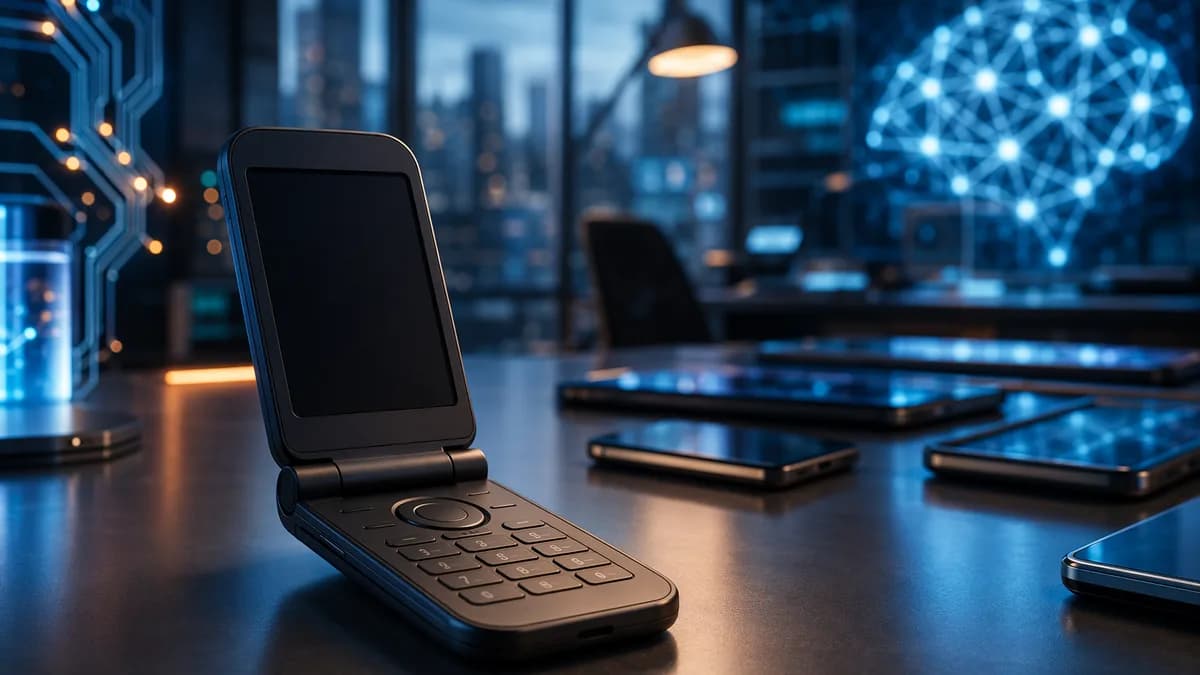
The Light Flip costs $299, less than half the $699 price that made the Light Phone III a harder sell, and that price cut says as much about Light’s strategy as the flip-phone body does.
XOOMAR Intelligence
Analyst Take
This is Light turning anti-smartphone sentiment into hardware. The company isn’t just removing apps. It’s rejecting the slab shape that now signals feeds, work pings, app stores, cameras, payments, and AI prompts. The Light Flip is set to ship early next year, according to The Verge, and its central bet is blunt: some users don’t want a less distracting smartphone. They want something nobody would mistake for one.
The Light Flip turns anti-smartphone sentiment into a design statement
Light cofounder Kaiwei Tang told The Verge that feedback after the Light Phone III pushed the company in a direction it didn’t expect. Some users liked the more capable minimalist phone. Others rejected the smartphone look itself.
“We have users who tell us, ‘Hey, I hate smartphones. I don’t want to be seen using a smartphone,’” Tang says.
That line explains the product better than any spec sheet. The Light Flip is a social signal. Pulling it out in public says something different than using an iPhone with grayscale mode, a locked-down Android, or a conventional feature phone. It says the break is intentional.
XOOMAR analysis: this is where minimalist hardware gets more interesting. Digital minimalism started as a personal discipline. Light is treating it like an identity-driven consumer category. The product’s shape is part of the pitch.
No outside screen reinforces that point. Light could have added a small cover display, as many flip devices do. Instead, it chose a notification light. You have to open the phone to engage with it. Closing it becomes a real end to the interaction.
Light’s product shift shows minimalist phones are getting less smartphone-like on purpose
The Light Phone III was the company’s most smartphone-like device: a phone-size rectangle with a touchscreen, a camera, and more tools than earlier Light devices. It still followed Light’s no-distractions philosophy, but it looked closer to the object it was trying to replace.
The Light Flip reverses that drift. It has a 2.8-inch internal screen, but no touchscreen. Interaction runs through a number pad, D-pad, and function buttons. Inside, it uses a MediaTek MT8873 processor, 128GB of storage, and 6GB of RAM. It has USB-C, a headphone jack, a rear camera, and the front notification light.
That is not pure nostalgia. It’s a constraint system.
| Device idea | Light Phone III | Light Flip |
|---|---|---|
| Shape | Smartphone-like rectangle | Traditional flip phone |
| Input | Touchscreen | Keypad, D-pad, buttons |
| Outside interaction | Not the defining feature | No exterior screen, only notification light |
| Price cited by The Verge | $699 | $299 |
| Software | LightOS | LightOS |
The tension is obvious. Users want navigation, notes, camera, music, and other basic tools. But every useful feature risks rebuilding the smartphone experience in slow motion. Light’s answer is physical friction. The device can do things, but it refuses to feel like the black glass rectangle users are trying to escape.
The Light Flip’s numbers show a niche product built to move
The key numbers are not market-share figures. The supplied sources don’t provide those. The meaningful data here is product-level: $299 upfront, or $39 a month for a Light Flip connected to Light’s cell service, with the phone owned after 24 months.
That matters because Tang said most negative feedback on the Light Phone III centered on cost. A $699 minimalist phone asks buyers to pay near premium-phone money for deliberate limits. A $299 flip phone makes the proposition cleaner: you’re buying fewer distractions, not a half-priced flagship.
The comparison with mainstream device pricing is unavoidable, but Light is playing a different game. Readers following flagship launch pricing, including stories like Amazon Leak Slaps $899 Sting on Google Pixel 11 Launch, are looking at a market where more hardware usually means more justification. Light is arguing the opposite. Less can be the feature.
The missing number is the most important one: how many people will pay for intentional limits after the novelty wears off. Light does not need a mass-market hit to prove the thesis. It needs a loyal niche large enough to sustain hardware, software, service plans, and developer interest.
Younger users are explicit; everyone else faces the same friction test
The Verge reporting directly identifies younger users as a major source of feedback for a less smartphone-like Light device. That is the cleanest demographic claim the source supports.
For everyone else, the better frame is not persona marketing. It’s friction.
A minimalist phone sounds easy until daily logistics hit. The Light Flip runs LightOS, the same operating system as the Light Phone III, and Tang says the only thing this new device can’t do is tap-to-pay because it lacks NFC. Camera, notes, navigation, and other Light tools should work similarly.
But modern life often assumes a full smartphone. Authentication, payments, ticketing, messaging apps, work tools, and transport services can turn “less phone” into “less access.” The source does not say which of those gaps will matter most for Light Flip buyers. It does show Light trying to solve part of the problem with a developer path.
Light recently released an SDK for its app “toolbox,” allowing users to write apps for their own device or submit them to a broader library. That is a major philosophical shift. Tang still doesn’t want social media on Light phones, but he draws a line between company preference and user ownership.
“You own the device,” Tang says. “You own your software at the same time. Obviously, I don’t want to see people using social media on our phone, but that’s my problem. That’s your phone, you should be able to do whatever you want.”
That quote is the product’s unresolved tension in one paragraph. Light wants limits. Users want agency.
Flip phones are back here for the opposite reason Samsung uses them
The Light Flip should not be confused with modern foldables. Devices from Samsung, Motorola, Google, and others use folding designs to add screen flexibility. Light uses the hinge to subtract temptation.
For readers tracking the other side of the flip-phone revival, Galaxy Z Flip 8 Leak Leaves Samsung Little to Reveal sits in the premium foldable lane. That category treats the fold as a way to preserve the smartphone’s power while changing its geometry. Light treats the fold as a behavioral boundary.
Tang’s language is telling. He told The Verge he liked “this action of opening up your technology, and then you close it down and it goes away.” That’s the core mechanic. The phone’s best feature may be the moment it disappears.
Light is also resisting the AI-button cycle. Tang said that when he interviews young people, “one thing that never comes up? No one wants an AI button on their phone.” He added that more users want assurance there is no AI in Light’s world. That is a sharp contrast with the broader push to make phones more assistant-driven.
The Light Flip’s future depends on whether minimalism survives daily inconvenience
The Light Flip probably won’t beat the smartphone. It doesn’t have to. Its job is to prove that enough people will pay for a phone that refuses to behave like one.
The evidence that would strengthen Light’s case is practical: strong preorder conversion, low return rates after shipping, useful third-party LightOS tools that don’t recreate endless-scroll behavior, and service-plan adoption beyond early enthusiasts. The evidence that would weaken it is just as clear: buyers keeping the Light Flip as a novelty second phone, then drifting back to full smartphones when payments, apps, or authentication become annoying.
Light’s challenge is not taste. The device already has a point of view. The real test is whether a small flip phone with a keypad can coexist with a world designed around powerful touchscreens. If it can, restraint becomes something phone makers can sell. If it can’t, the Light Flip will still make one thing clear: the smartphone’s shape has become part of the problem.
The Bottom Line
- Light is betting that anti-smartphone demand is becoming a distinct hardware category.
- The $299 price makes minimalist phones more accessible than the $699 Light Phone III.
- The flip design turns digital minimalism into a visible consumer identity.
Light Flip vs. Light Phone III
| Product | Price | Positioning |
|---|---|---|
| Light Flip | $299 | Flip-phone design meant to avoid looking like a smartphone |
| Light Phone III | $699 | More capable minimalist phone that some users felt still looked too smartphone-like |
Light Phone Pricing
Primary Sources & Disclosures

Written by
XOOMAR Insights Team
Research and Editorial Desk
The XOOMAR Insights Team pairs automated research with human editorial judgment. We track hundreds of sources across technology, fintech, trading, SaaS, and cybersecurity, cross-check the facts, and explain what happened, why it matters, and what to watch next. We do not just rewrite headlines. Every article is fact-checked and scored for reliability before it goes live, and we link back to the original sources so you can verify anything yourself.