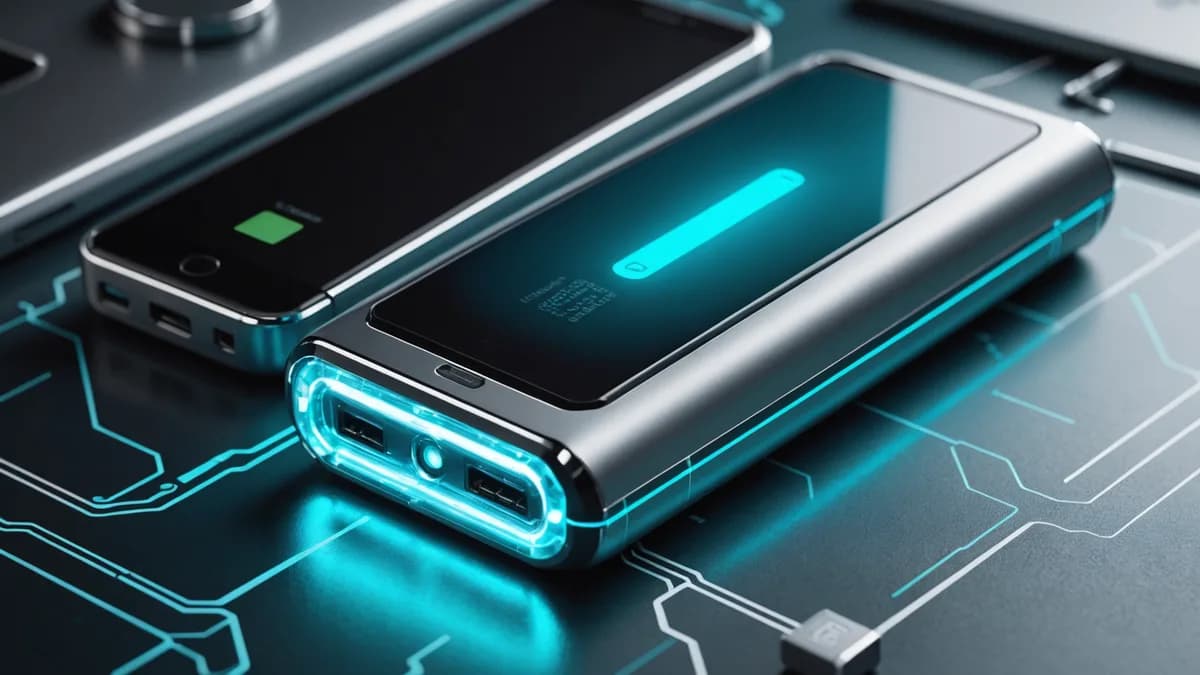
Ugreen is selling a $150 power bank with a miniature liquid cooling system you can watch work through a "Cyber Window." This isn't an incremental upgrade, it's a radical, almost absurd engineering flex aimed directly at users whose high-performance phones overheat and throttle. According to The Verge, the MagFlow Pro Magnetic Power Bank claims to be the world's first power bank with wireless charging to use such a system. For a gadget category defined by boring black bricks, this is either a brilliant solution to a real thermal crisis or a spectacularly expensive piece of tech theater.
XOOMAR Intelligence
Analyst Take
The primary search keyword for this story is liquid-cooled power bank.
Ugreen's Performance Play: Solving a Problem Most Power Banks Ignore
The core of the MagFlow Pro is a gamble that users care about thermal performance, not just capacity. It positions the accessory not as a simple battery but as a performance-enhancing component. The thinking is clear: modern smartphones, especially during intensive tasks like gaming or video processing, hit thermal limits and slow down. Plugging into a traditional high-speed power bank adds another heat source right against the phone, often making the throttling worse.
Ugreen’s answer is an integrated cooling loop. Inside is a micro-pump that circulates coolant to pull heat away from key components, including the Qi2.2-compatible wireless charging coil. The system works alongside copper foil and a component layout designed to manage heat. The stated goals are to prolong the life of both the power bank's battery and your phone's battery, maintain consistent charging speeds up to 25W wirelessly, and leave the device cooler to the touch after a long session.
"It’s available starting today for $149.99, which puts it on the really expensive end of power banks with only a 10,000mAh battery."
The most telling feature is the "Cyber Window." It lets you watch the coolant flow. In an industry of sealed units, this is a deliberate "show, don't tell" move. It makes the engineering, the solution to an invisible problem, tangible. For a certain type of user, that visibility builds trust and turns a utility into a conversation piece.
The Specs Behind the Spectacle: What $150 Actually Buys
Let's break down what you're paying for, because the price is the biggest hurdle. At $149.99 for a 10,000mAh battery, the MagFlow Pro commands a massive premium.
- Capacity: 10,000mAh. Standard for mid-tier power banks that typically cost $25-$50.
- Cooling System: "CryoPulse" liquid cooling with micro-pump and visible "Cyber Window."
- Wireless Charging: Qi2.2 standard, up to 25W.
- Wired Charging: A built-in USB-C cable lanyard and a separate USB-C port, each capable of up to 45W.
- Critical Limitation: The total maximum output is 45W. Connecting multiple devices will split and reduce that power.
You are not paying for unprecedented capacity or unmatched peak output. You are paying for thermal consistency and a unique form factor. The lanyard-as-cable is a clever space-saving design, but the real cost is in the cooling assembly. The question becomes whether the benefit of sustained, cooler charging is worth triple the price of a conventional high-capacity bank.
This move mirrors a broader industry push to manage heat in compact devices, a challenge we've seen in segments from electric mowers packing car-sized powerplants to the computational cores of autonomous vehicles.
The Mobile Power User's Dilemma: Who Really Needs This?
The market for this product splits into three distinct camps.
The Performance-Critical User This is Ugreen's target. Think mobile gamers playing graphics-intensive titles for hours, on-location content creators using their phone as a 4K video editing station, or early adopters of power-hungry AR/VR glasses. For them, thermal throttling isn't an annoyance; it's a workflow breaker. A power bank that mitigates heat buildup could meaningfully extend peak performance during a travel day or a long session away from an outlet. The premium is justifiable as professional-grade insurance.
The Pragmatic Charger For this group, the MagFlow Pro is a solution in search of a problem. Most users need a power bank to top up a phone and maybe wireless earbuds during a day out. Heat is rarely a noticeable issue, and a standard 10,000mAh bank does the job for a fraction of the price. The liquid cooling and its window are seen as pure gimmicks, complexity where none is needed. The high cost seems disconnected from the core utility of simply storing power.
The Industry Watcher This perspective sees the MagFlow Pro not as a mass-market product, but as a strategic R&D test balloon and a marketing tool. It's a proof-of-concept for integrated thermal management in ultra-portable electronics. The real goal may be to elevate Ugreen's brand from "reliable accessory maker" to "portable power innovator," carving out a high-performance niche. Success is measured less in unit sales and more in buzz, reviews, and laying groundwork for future, perhaps more essential, applications of the tech.
The Ripple Effect: What a Liquid-Cooled Power Bank Signals to the Market
Ugreen's move, whether it succeeds or fails commercially, sends a clear signal to the accessories industry: the competition is shifting beyond mAh counts and port quantities.
From Capacity to Capability The next battleground may be "performance assurance." Brands could start competing on guarantees of sustained output, lower operating temperatures, or extended battery lifespan for both the power bank and the connected device. Thermal management becomes a spec alongside wattage.
The Risk of Spectacle The danger for Ugreen is if the cooling benefit proves marginal in real-world use. If reviews find it only shaves off a few degrees compared to a well-ventilated traditional design, the product could be branded as over-engineered and out of touch. The "Cyber Window" would then highlight a solution with little tangible effect, damaging credibility rather than building it.
Visible Engineering as a Brand Tool The visual coolant loop taps into a powerful trend: transparency as a trust signal. In an era of glued-shut devices, showing the complex workings inside can foster a community of tech enthusiasts and early adopters who appreciate the engineering. It turns a commodity into a coveted object. This strategy relies entirely on that engineering being genuinely effective.
The Thermal Frontier: Where Portable Power Goes From Here
The MagFlow Pro is a fascinating prototype for the future, whether it becomes a mainstream product or a curious footnote.
Short-Term Implications We should expect imitators and refinements. Could the next iteration use its cooling system to directly chill the phone it's attached to, not just its own internals? Will we see smaller, more efficient micro-pumps become commonplace in high-wattage accessories? The success of this product will determine how quickly others follow.
Long-Term Necessity Look beyond the gimmick, and the underlying problem is real and growing. As smartphones and tablets take on more local AI processing, faster wireless data standards, and higher-wattage charging, they will generate more heat in slim form factors. Accessories that supply power will need to become smarter partners in thermal management. Ugreen's approach may be a first, clumsy step toward a necessary portable power ecosystem where heat is a primary design constraint.
XOOMAR Analysis: A Practical Verdict Is the MagFlow Pro the future? For most people, no. The price is prohibitive for the capacity offered. But is it a dead end? Also no. It identifies and aggressively attacks a legitimate, growing pain point for a specific, high-value user segment. It makes the invisible problem of heat into a visible, marketable feature.
Watch for third-party thermal testing. The verdict on this product won't come from its spec sheet, but from independent measurements showing how much cooler it keeps a phone under sustained load compared to a standard power bank. If the delta is significant, Ugreen has defined a new category. If it's minor, the coolant flow will be just a pretty light show in an overpriced brick. Your need for it depends entirely on whether your mobile device has ever felt too hot to hold or suddenly too slow when you needed it most.
Key Takeaways
- It directly addresses a major pain point for power users whose high-performance phones overheat and throttle during heavy use.
- As a first-of-its-kind product, it signals a shift in accessory design from simple capacity to active thermal management, potentially setting a new industry standard.
- Its premium price and novel technology force consumers to evaluate whether superior thermal performance justifies a significant cost premium over traditional power banks.
Primary Sources & Disclosures

Written by
XOOMAR Insights Team
Research and Editorial Desk
The XOOMAR Insights Team pairs automated research with human editorial judgment. We track hundreds of sources across technology, fintech, trading, SaaS, and cybersecurity, cross-check the facts, and explain what happened, why it matters, and what to watch next. We do not just rewrite headlines. Every article is fact-checked and scored for reliability before it goes live, and we link back to the original sources so you can verify anything yourself.