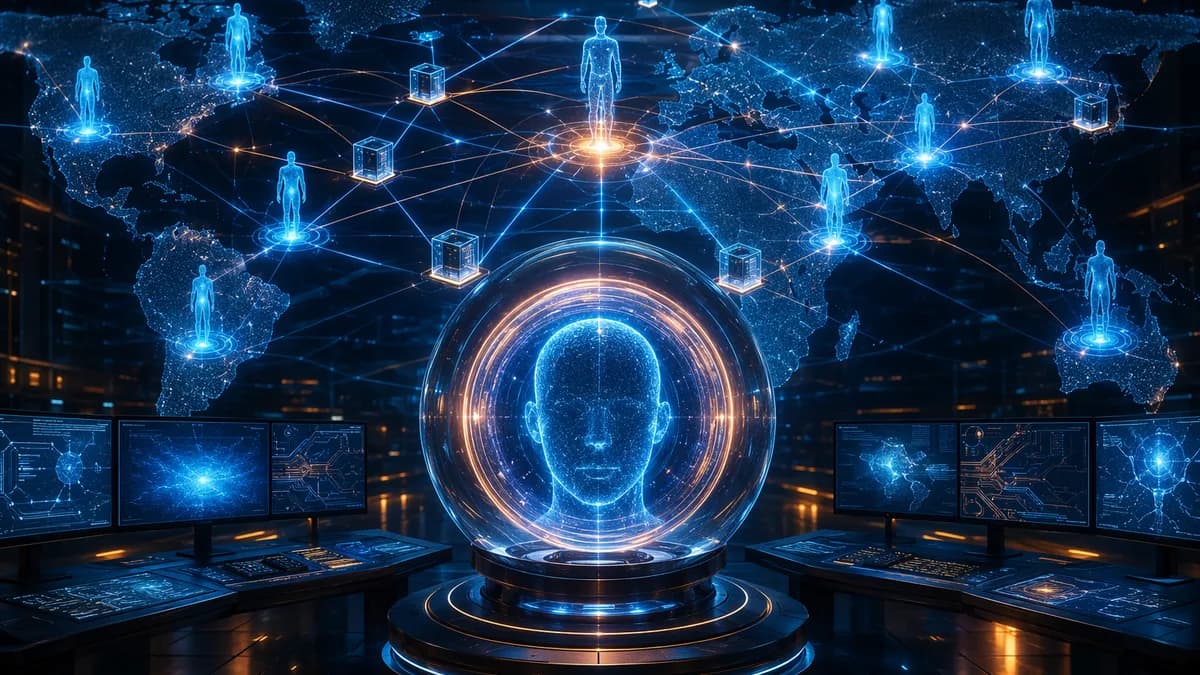
World ID just moved from crypto curiosity to AI-era infrastructure bet, and World Foundation’s $52.5 million raise shows investors are willing to fund that shift before the trust problem is solved. The core wager is simple: as AI agents, synthetic accounts, and machine-generated activity spread across digital channels, platforms will pay for proof that a user, or an agent acting for a user, traces back to a real human.
XOOMAR Intelligence
Analyst Take
World Foundation raised $52.5 million by selling WLD tokens to strategic investors, with the tokens subject to a one-year lockup, according to PYMNTS. The stated goal is to bring World ID technology to organizations, consumers, and AI agents. That last category is the tell. World is no longer pitching identity only as a human onboarding tool. It’s trying to become a verification layer for software that acts on behalf of people.
The funding validates demand for AI identity solutions. It also raises the harder question: who gets to control the proof-of-human layer if it becomes part of payments, messaging, dating, authentication, and agentic commerce?
World ID demand is rising because AI agents blur the line between user and software
World Foundation says the need for World ID infrastructure is accelerating as AI expands. That’s the thesis behind this raise, and it’s stronger than the old crypto-native pitch. A person proving they are unique online was once a niche problem for token distributions, spam control, or account abuse. AI agents turn it into a commercial operating issue for any platform that needs to know whether an action came from a human, a delegated agent, or an automated actor with no accountable user behind it.
The organization’s own language is pointed:
“World has built the only technology that enables individuals to prove they are unique humans without revealing their identity,” the organization said in the release.
That claim is ambitious. It’s also the pressure point. If World ID can prove uniqueness without exposing identity across every interaction, it has a plausible role in AI-mediated digital activity. If users or regulators decide the biometric tradeoff is too opaque, the product’s technical promise won’t be enough.
The early evidence is scale. World Foundation says more than 18 million humans have been verified, more than 475 million World ID proofs have been used, and World ID is being integrated with communications platforms, identity, authentication, and dating platforms. Those numbers don’t prove mainstream trust. They do show World has moved beyond a white paper.
For readers tracking the crypto-financing side of the same story, XOOMAR’s related piece, Iris Scan Crypto Bet Banks $52M as Altman’s World Sells WLD, goes deeper on why the token structure matters.
Locked WLD tokens make this a financing round and a network bet
The mechanics matter. World Foundation didn’t announce a traditional equity round. It sold WLD tokens to strategic investors, and those tokens are locked for one year. The first close was led by Pantera Capital.
That structure gives World Foundation capital without the same form as a startup equity raise. It also aligns the investors with the future utility and adoption of the World network. A lockup forces patience, at least for the first year. It doesn’t remove token risk, but it signals that the buyers are not entering for immediate liquidity.
Cosmo Jiang, general partner at Pantera Capital, framed the investment around AI pressure rather than crypto speculation:
“The need for Proof of Human is becoming acutely clear with the acceleration of AI development, and we see this in the influx of enterprise traction. We’re excited to continue supporting World’s mission at this inflection point in its growth.”
The phrase “strategic investors” deserves attention. XOOMAR analysis: this kind of raise is likely about more than balance-sheet funding. For an identity network, distribution matters. Integrations matter. Developer trust matters. A proof layer gets more valuable if it appears inside the workflows where fraud, impersonation, and bot activity already create costs.
| Reported fact | What it signals | Main risk |
|---|---|---|
| $52.5 million raised | Fresh capital for World ID expansion | Funding does not equal adoption |
| WLD tokens sold | Token-linked financing, not conventional equity | Investor incentives depend on network confidence |
| One-year lockup | Longer-term positioning by buyers | Liquidity returns as a question later |
| Focus on organizations, consumers, and AI agents | World is aiming beyond human signups | Enterprise buyers may demand stricter controls |
The Orb story is becoming an enterprise identity pitch
World’s identity model remains tied to biometric verification. PYMNTS notes that Tools for Humanity uses a device called an Orb to take pictures of a person’s face and eyes, converts those images into a string of numbers stored on the person’s device, and enables the person to use that World ID to prove they are human.
The product narrative has changed. Earlier, the public story around World was dominated by crypto, token incentives, and iris scanning. Now the Foundation is framing World ID as infrastructure for businesses, apps, and AI-driven systems. That’s a cleaner commercial pitch because the problem is clearer: platforms increasingly need a privacy-preserving way to separate real users from automated noise.
World Foundation also describes itself as the independent nonprofit steward of the World protocol. Its stated aims include transitioning the protocol to an open, decentralized protocol, expanding community participation, and making it economically self-sustaining through protocol fees paid by applications. That matters because the business model, governance path, and technical architecture are all part of the same trust question.
The strongest counterpoint is obvious. Any biometric-linked identity system starts with a trust deficit. Users must believe the system won’t become a permanent tracking handle. Enterprises must believe adoption won’t create reputational or compliance risk. Developers must believe the integration won’t lock them into an identity gate they can’t audit or exit.
AI agents give World ID a sharper use case than human login alone
The most concrete AI angle in the source is World’s March collaboration with Coinbase. The companies introduced a solution for the agentic web that provides proof that agents have a human behind them. The AgentKit beta developer toolkit lets verified humans delegate their World ID to AI agents, giving those agents an added trust layer for interactions and transactions.
That is the more interesting product than a simple “verified human” badge. If AI agents begin shopping, posting, booking, applying, or transacting for people, platforms will need to know whether the agent is authorized by a verified human. A bot filter is defensive. Delegated identity is transactional.
For fintechs, marketplaces, gaming platforms, social apps, and AI developers, the practical use cases are straightforward:
- Fraud control: Reduce fake-account creation and promotion abuse.
- Agent authorization: Confirm that an AI agent is acting for a verified human.
- Marketplace trust: Add a signal that a counterparty is not just a synthetic account.
- Account recovery: Give platforms another route to distinguish humans from automated attacks.
- Authentication workflows: Pair proof-of-human checks with existing login and identity systems.
There’s a cost. Businesses that plug in World ID inherit questions about privacy, consent, biometric processing, and dependence on a crypto-linked network. That tradeoff may be acceptable in high-abuse environments. It may be harder in mainstream consumer workflows.
For a wider view of how AI is forcing consumer platforms to rethink product trust and accountability, see XOOMAR’s 200M Viewers Put Prime Video AI on Bezos’s Hot Seat.
World ID has to avoid becoming the very gatekeeper it wants to replace
The product challenge is not just technical. World ID has to be easy for platforms to add, difficult for bots to spoof, useful for AI agents, and credible to users who don’t want a biometric credential to follow them everywhere.
Verification and identity ownership are different things. A winning proof-of-human model must let people prove personhood without handing every app a durable universal tracking signal. World’s claim that people can prove they are unique humans without revealing identity goes directly at that problem. The market will test whether the implementation feels as private as the pitch.
XOOMAR analysis: the danger is concentration. If a small group of proof-of-personhood providers becomes default infrastructure, they could influence access to payments, marketplaces, communications, and AI services. That doesn’t mean World ID will become a gatekeeper. It means the governance model has to convince platforms and users that it won’t.
Adoption friction is real. Orb-based enrollment requires physical access. Trust depends on how users understand the biometric process. Enterprise buyers will ask whether the system fits their compliance posture. Local rules may vary. These are not side issues. They are the path from funding headline to deployment.
The next year tests whether World ID becomes trusted AI infrastructure
Three scenarios now matter.
First, World Foundation is likely to push World ID where the pain is clearest: AI agent workflows, authentication, dating platforms, communications tools, and other online environments where fake users or impersonation can damage trust. That inference is grounded in the Foundation’s stated targets and the integrations named in the source.
Second, scrutiny will rise if World ID moves from niche integrations into mainstream consumer workflows. Biometric-linked identity needs extraordinary transparency because user trust can collapse fast if people believe the tradeoff is unfair.
Third, the category may split. Some buyers will want privacy-first proof-of-personhood. Others may prefer broader enterprise identity and fraud tools. World’s advantage is a large verified base and a timely AI problem. Its burden is proving that its model can scale without turning human verification into a new control point.
The watch item is clear: over the next year, evidence that would strengthen World’s thesis includes more named enterprise integrations, heavier use of World ID proofs, and practical AI-agent deployments through tools like AgentKit. Evidence that would weaken it includes slow partner adoption, user resistance to Orb verification, or enterprise hesitation around biometric and token-linked risk. Fresh capital gives World Foundation time. It doesn’t settle the trust question.
The Bottom Line
- World Foundation’s $52.5 million raise signals investor confidence that AI will increase demand for digital identity verification.
- AI agents make it harder for platforms to distinguish real users from delegated software or synthetic activity.
- If World ID becomes core infrastructure, control over proof-of-human systems could affect payments, messaging, authentication, and online commerce.
World ID Positioning Shift
| Earlier Crypto-Native Pitch | AI-Era Infrastructure Pitch |
|---|---|
| Proving unique humans for token distributions, spam control, and account abuse | Verifying whether actions come from humans, delegated AI agents, or unaccountable automation |
| Niche identity use case tied to crypto ecosystems | Broader verification layer for payments, messaging, dating, authentication, and agentic commerce |
World Foundation Funding Raise
Primary Sources & Disclosures
- [1]PYMNTS
- [2]Sam Altman's World raises $52.5 million selling iris-scan tokens as AI deepfakes rewrite the identity problem - Startup Fortune
- [3]World Foundation Raises $52.5M to Scale World ID as AI Drives Demand for Proof of Human
- [4]World Foundation raises $52 million in token sale to scale proof-of-human infrastructure

Written by
XOOMAR Insights Team
Research and Editorial Desk
The XOOMAR Insights Team pairs automated research with human editorial judgment. We track hundreds of sources across technology, fintech, trading, SaaS, and cybersecurity, cross-check the facts, and explain what happened, why it matters, and what to watch next. We do not just rewrite headlines. Every article is fact-checked and scored for reliability before it goes live, and we link back to the original sources so you can verify anything yourself.