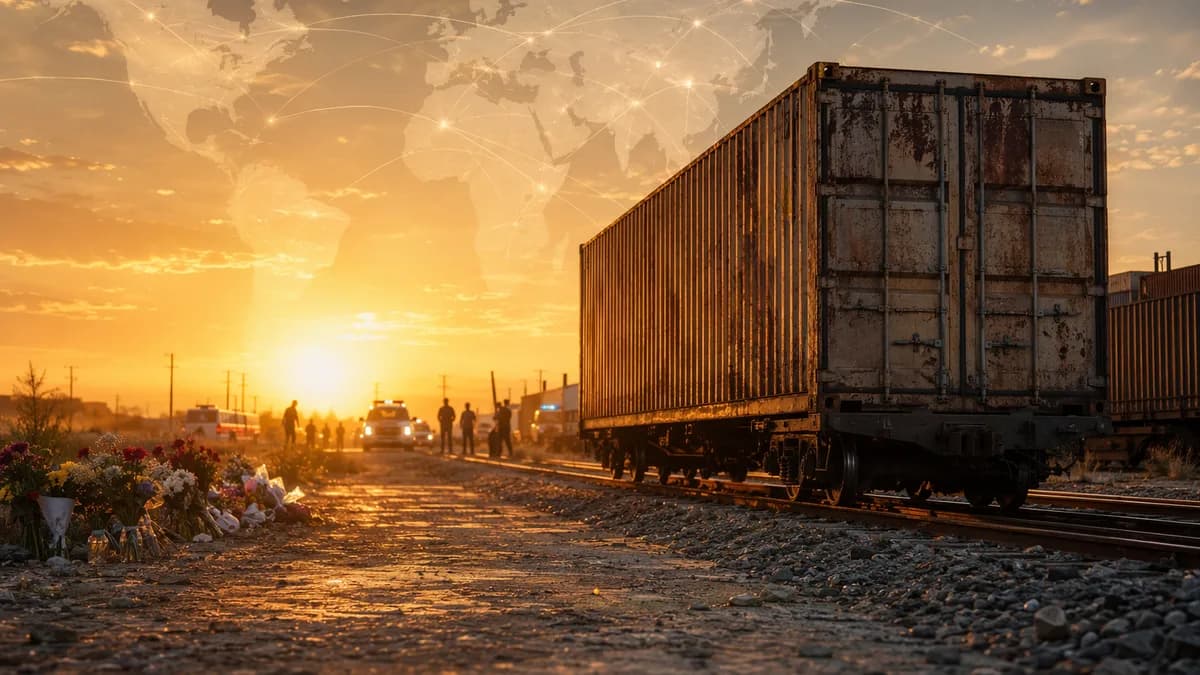
The Texas migrant deaths indictment points to a brutal failure mode in border smuggling: people were allegedly treated as cargo, locked inside a sealed rail container, then abandoned when the trip turned lethal.
XOOMAR Intelligence
Analyst Take
A federal indictment announced Friday charges 11 people over a smuggling operation tied to the deaths of migrants found in and around a rail shipping container in Texas, according to Guardian World. Six bodies were discovered in May at a Union Pacific rail yard in Laredo, on the US-Mexico border. Prosecutors, in related federal filings described by the Justice Department, allege seven migrants died in total, including one person left near railroad tracks in San Antonio.
That distinction matters. This was not just a grim discovery in one container. It was, according to prosecutors, a multi-city smuggling route that ran through Del Rio, San Antonio, and Laredo, using freight infrastructure as cover.
The Laredo rail container deaths expose a smuggling business built on disposable lives
The core allegation is simple and horrifying: migrants were placed in a Conex shipping container that had no ventilation or cooling system, could not be opened from the inside, and sat in Texas heat.
The victims were from Mexico and Honduras. One was a 14-year-old child. The oldest victim identified in the Guardian report was 56.
Federal prosecutors say the migrants were part of a human-smuggling effort using a freight train. The indictment, as described by the Justice Department, alleges the defendants and others operated a smuggling organization from at least April 2023 through May 12, 2026, using cargo trains after migrants had crossed illegally from Mexico.
This is where the case moves beyond a single criminal docket.
XOOMAR analysis: The indictment shows how smuggling networks can mimic logistics operations without any of logistics’ safety systems. Rail corridors, containers, timing, and handoffs become part of the business model. The migrants carry the risk. The network collects the fee.
“It’s very hard to survive in an un-air-conditioned, sealed container with … the temperature being what it was on that day,” the US attorney for the western district of Texas, Justin Simmons, said on Friday.
Inside the May cargo container case: who died, where they were found, and what prosecutors allege
The bodies of six migrants were found in a rail yard shipping container in Laredo, Texas, in May. A Union Pacific employee discovered them, according to the Guardian report. The Webb county medical examiner suspected the deaths were caused by hyperthermia, or heatstroke.
The Justice Department’s account adds a fuller route. Prosecutors allege that toward the end of April 2026, the organization began moving at least seven migrants from Acuña, Mexico, into Del Rio. On or about May 9, smugglers allegedly brought them to Union Pacific train tracks in Del Rio. Between approximately 1:18 p.m. and 1:25 p.m., while the train was stationary, smugglers allegedly used red bolt cutters to cut the lock off the container, loaded the migrants inside, and shut the door.
The train then traveled east along U.S. highway 90 to San Antonio. Prosecutors say smugglers opened the container there, found the migrants in peril, fled, and left one deceased person near the tracks. The remaining migrants stayed in the container, which later went to Laredo.
The defendants are charged with:
- Conspiracy: conspiracy to transport illegal aliens resulting in death.
- Aiding and abetting: aiding and abetting transport of illegal aliens resulting in death.
- Maximum penalty: up to life in prison if convicted.
An indictment is not a conviction. The accused remain defendants unless prosecutors prove the charges in court.
The numbers behind the Texas migrant deaths indictment
The case turns on a small set of hard numbers.
| Case detail | Source-supported figure |
|---|---|
| People indicted | 11 |
| Migrants found dead in Laredo container | 6 |
| Total deaths alleged by prosecutors | 7 |
| Child victim | 14-year-old boy |
| Outside temperature that day | 88 to 92 degrees Fahrenheit |
| Alleged smuggling payments | $1,500 to $10,000 |
| Defendants still at large | 2 |
The Justice Department says each smuggled person, or their families and friends, paid smugglers in Honduras, Mexico, the United States, and elsewhere between $1,500 and $10,000.
That payment range is the economic core of the indictment. It shows why such routes exist even when they are visibly dangerous. For the smuggling organization alleged by prosecutors, every person in the container represented revenue. For the migrants, the same container became a sealed space with no safe exit.
AP’s related reporting also cites two prior Texas cases: in 2023, two people were found dead among 17 people in two rail cars near Knippa, Texas; and last year, two smugglers were sentenced to life in prison over the deaths of 53 migrants inside a sweltering tractor-trailer in Texas in 2022.
That comparison is limited but useful. The recurring feature is not the vehicle type. It is confinement in overheated, enclosed transport.
Why Laredo keeps surfacing in border smuggling investigations
Laredo sits at a busy land port with heavy US-Mexico trade activity. The Guardian notes that this made investigators suspect early on that the deaths were connected to smuggling.
Freight volume creates cover. Trains headed to the US often slow or stop in Mexico before crossing the border, which creates opportunities for smugglers or migrants to climb aboard or hide drugs or other contraband, according to the Guardian. AP adds that trains can be used to move people beyond the reach of officers patrolling the border.
That does not mean freight operators caused this case. The indictment targets alleged smugglers. But it does show why freight corridors matter in smuggling investigations.
XOOMAR analysis: The same features that make Laredo valuable for commerce also make it attractive for illicit movement: cross-border flow, rail access, and scale. The more cargo moves through a node, the harder it becomes to see every hidden human risk in real time.
For readers tracking how public agencies respond after preventable deaths, XOOMAR’s recent reporting on Five Deaths Jolt NYC Legionnaires' Outbreak Tower Hunt offers a separate example of how investigations often begin only after fatalities reveal a system’s weak points. In a very different domain, Tesla Robotaxi Miles Crash 36% as Expansion Backfires shows how operational data can expose risks that headlines alone miss.
The same Laredo tragedy looks different to prosecutors, families, and humanitarian workers
Law enforcement sees an organized smuggling case. The indictment names 11 defendants, says nine have been arrested, and says Karina Garcia and Seferino Huerta-Casillas remain at large. Prosecutors are using charges that carry a possible life sentence.
Families see something colder. At least one migrant messaged a loved one, pleading for help, according to the Justice Department.
Humanitarian workers see desperation feeding the smuggling market. The Guardian quoted Paul Nixon, a retired teacher and volunteer with the Arizona-based Green Valley-Sahuarita Samaritans, who said he understood why people might risk hiding on a train after dangerous travel and cartel abuse.
“But people will get into a boxcar and somebody will close the door and just forget that they’re there,” he said. “I mean, that’s a death sentence right there,” he said.
XOOMAR analysis: Prosecution can punish the alleged network in this case. It cannot, by itself, explain why migrants paid thousands of dollars to enter a sealed container. That gap is where enforcement, migration pressure, and criminal opportunity keep colliding.
The next signal is whether scrutiny reaches the route before the next container is opened
The Texas migrant deaths indictment gives federal prosecutors a case against named defendants. It also gives border agencies a map of alleged vulnerabilities: Del Rio staging, rail-yard access, container locks, San Antonio handoffs, and Laredo discovery.
The strongest evidence that authorities are learning from this case would be practical and measurable: arrests of the two defendants still at large, clearer proof in court of how the alleged network operated, and detection methods that identify people trapped in containers before workers find bodies.
The weaker scenario is familiar. Smuggling networks shift routes, change recruiters, and alter transport methods while prosecutions chase the last disaster.
The indictment may bring accountability. Prevention will require something harder: seeing migrants as people in danger before a sealed freight container turns into evidence.
Impact Analysis
- The indictment highlights the deadly risks migrants face inside organized smuggling networks.
- Prosecutors allege freight infrastructure was used to conceal a multi-city smuggling route.
- The case may intensify scrutiny of border enforcement, rail security, and human-smuggling prosecutions.
Key figures in the Texas migrant deaths case
Primary Sources & Disclosures
- [1]Guardian World
- [2]11 indicted in smuggling deaths of 7 migrants in rail cargo container in Texas
- [3]Eleven indicted in alleged Texas smuggling scheme that left 7 migrants dead in shipping container
- [4]11 Charged in Homeland Security Task Force Investigation Relating to Aliens Found Dead in a Boxcar Earlier This Year

Written by
XOOMAR Insights Team
Research and Editorial Desk
The XOOMAR Insights Team pairs automated research with human editorial judgment. We track hundreds of sources across technology, fintech, trading, SaaS, and cybersecurity, cross-check the facts, and explain what happened, why it matters, and what to watch next. We do not just rewrite headlines. Every article is fact-checked and scored for reliability before it goes live, and we link back to the original sources so you can verify anything yourself.