Two days after The Odyssey moved into its July 2026 release week, Christopher Nolan turned the film’s central deception into a blunt Christopher Nolan AI warning: the danger isn’t hidden, because “everybody knows the Greeks are inside.”
XOOMAR Intelligence
Analyst Take
July 19: Nolan turns the Trojan horse into an AI warning
Nolan made the remark in an interview with Hugo Travers, who publishes on YouTube as HugoDécrypte, after Travers connected AI to the Trojan horse in Nolan’s film. The question was simple: could a technology welcomed into daily life later reveal itself as “something else and something darker”? Nolan laughed, then sharpened the metaphor, according to TechCrunch.
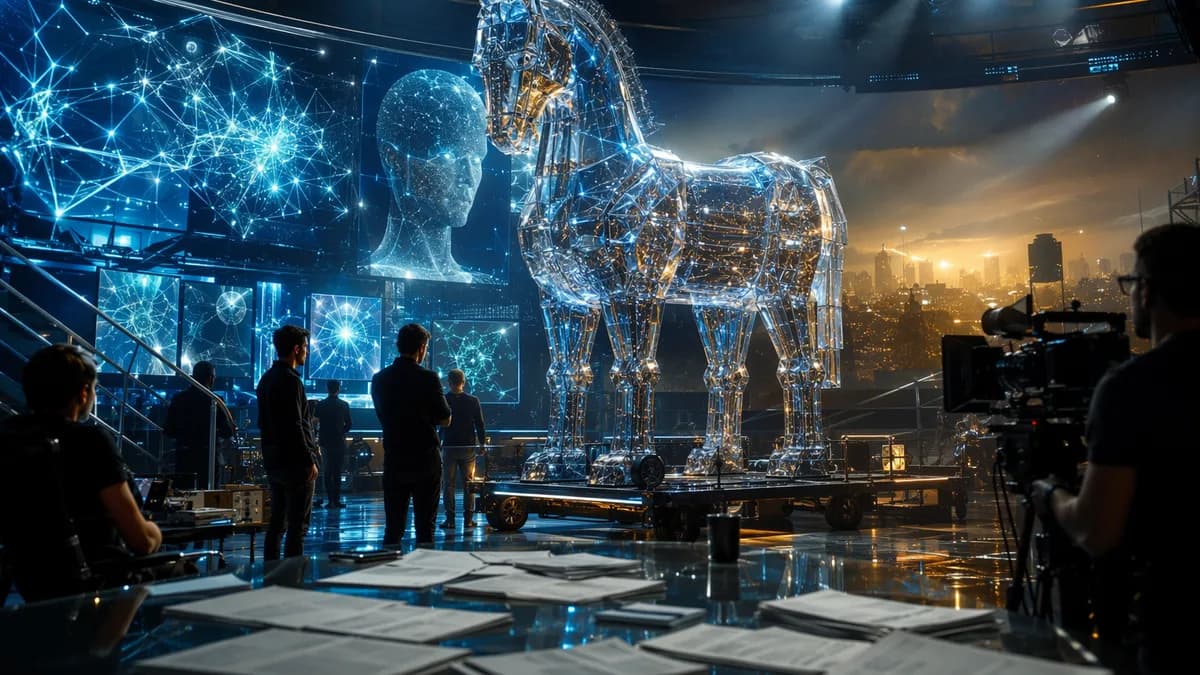
“I think AI is a Trojan horse that everybody knows the Greeks are inside.”
That line lands because Nolan isn’t describing an unknown future risk. He’s saying the public already sees the bargain. AI is being sold as useful, but many people suspect the people selling it have motives worth questioning.
He pushed the image further:
“I’ve never seen a technology advancing so rapidly [that’s been] so completely rejected by the public.”
Nolan later called AI “a transparent horse, it’s made of glass.” That’s the core of his argument. The threat, in his view, is not that AI hides perfectly. It’s that its risks are visible and still being invited through the gate.
After the 2023 strikes: AI moved from side issue to contract language
The Hollywood context matters. TechCrunch notes that AI was a major focus during the writers’ and actors’ strikes of 2023, and that the Directors Guild of America won some generative AI protections in its most recent contract.
That doesn’t tell us the exact scope of those protections. The source does not spell out the clauses. But it does show the direction of travel: AI is no longer a speculative panel topic for entertainment executives amid Netflix’s AI film deal. It has entered labor negotiations, echoing broader AI workplace disputes.
Nolan did not specify the precise AI threat he worries about in the TechCrunch interview. That restraint is important. The supplied material supports a narrower claim than the broadest anti-AI arguments: Hollywood’s concern is tied to whether AI changes the relationship between studios, guild labor, and creative work.
The Guardian’s related AFP-based report adds that Nolan expects AI may produce useful “imaging tools,” including the kind debated around Adobe Project Indigo’s AI playground, but rejects the claim that it can replace human creativity wholesale.
“But I think the idea that it replaces human beings wholesale and human creativity, to me it’s a nonsense,” Nolan said, according to The Guardian.
So the Christopher Nolan AI position is not blanket refusal. It’s conditional acceptance. Tools are fine. Blind faith is not.
This warning carries weight because Nolan is a techno-skeptic, not a technophobe
Nolan’s criticism has more force because it fits his career. He has long favored film, theatrical presentation, practical-scale filmmaking, and director-led control. TechCrunch notes that The Odyssey became the first feature film to be shot entirely on Imax film and Imax cameras.
That matters. Nolan is not a filmmaker whose brand is nostalgia alone. He uses advanced formats and large-scale production technology, but he tends to defend older systems when he believes they still produce better results.
In a recent New York Times interview cited by TechCrunch, Nolan rejected the technophobe label.
“I think of myself as a techno-skeptic,” Nolan said.
He added that film is “better in terms of representing the way the eye sees the world than any digital imaging system I’ve seen.”
That distinction is the article’s hinge. Nolan isn’t warning that new technology is bad because it’s new. He’s warning that the sales pitch around new technology can erase systems that remain “valid and viable.” His phrase from the Times interview is sharper: “We almost lost film!”
July release week: The Odyssey becomes the perfect AI metaphor
The timing gives Nolan’s comment extra bite. He is promoting The Odyssey, a film built around one of mythology’s great acts of deception, while making an argument that AI’s risks are unusually visible.
The Odyssey itself has become a counterexample to the idea that large-scale human-led spectacle is obsolete. The Guardian and Straits Times report that the film has a reported budget of US$250 million, with locations throughout the Mediterranean and a cast including Matt Damon, Zendaya, Tom Holland, Robert Pattinson, Anne Hathaway, and Lupita Nyong’o.
IGN’s related coverage adds another practical-production detail: star Matt Damon described a 60-foot Cyclops puppet, with filming tied to Psychro Cave, described there as Zeus’ believed birthplace.
| Nolan’s stated position | What the sources support |
|---|---|
| AI can be useful | He expects some useful “imaging tools.” |
| AI should be distrusted as a sales pitch | He says technology and “the motives of the people giving it to us” must be viewed with skepticism. |
| AI replacement claims are overstated | He calls wholesale replacement of human creativity “nonsense.” |
| Audience rejection matters | He says young people are calling AI content “AI slop.” |
The strongest XOOMAR reading: Nolan is defending authorship as a production discipline, not as a slogan. He is saying the value of a film is partly in how it is made, who makes it, and whether the work still carries human judgment at scale.
Young audiences are not reacting the way AI boosters expected
Nolan’s most interesting claim is about younger viewers. He told Travers that people his children’s age quickly label AI videos as “AI slop” and put them “in a box.”
IGN’s Telegraph-based report quotes him in similar terms:
“Their judgment of AI slop has been immediate and harsh.”
That matters because it complicates a common entertainment assumption that younger audiences automatically prefer faster, synthetic, digitally native content. Nolan argues the opposite: because younger viewers grew up online, they may identify AI-generated material faster and dismiss it harder.
The Guardian report says “AI slop” refers to the flood of AI-generated text, video, and audio content that has inundated social media in recent years. That phrase has become useful because it compresses an aesthetic judgment into two words. It says the content feels cheap, mass-produced, and low-trust.
Nolan’s point is not that audiences reject every AI tool. He explicitly leaves room for useful uses. The sharper claim is that visible synthetic output can damage credibility, especially when the audience senses it was used to replace human craft rather than support it.
The next decision point: contracts, credits, and audience trust
The immediate industry question is practical. If AI is already important enough to appear in guild negotiations and contract protections, studios and creators will need clearer rules around when it can be used, who consents, and how that use is disclosed.
The sources don’t provide pending deadlines, specific legal cases, or detailed contract language. So the watch item is narrower: whether future Hollywood deals treat generative AI as a standard production tool with negotiated limits, or as an exceptional risk requiring case-by-case consent.
For filmmakers, Nolan’s warning sets a high bar. If AI becomes part of the production process, the creative team will need to show that human authorship still drives the final work. For moviegoers, trust may become part of the product. A film’s making-of story could matter more if audiences believe synthetic shortcuts weaken the work.
The Christopher Nolan AI line will stick because it turns a messy technical fight into a clean warning. Hollywood has already opened the gate to AI in some form. The question now is whether contracts, credits, and audiences make clear who is still holding the reins.
Impact Analysis
- Nolan’s comments amplify public skepticism about AI from one of Hollywood’s most influential filmmakers.
- The remarks connect AI concerns to ongoing labor protections after the 2023 writers’ and actors’ strikes.
- Hollywood’s handling of generative AI could shape how creative industries define authorship, consent, and job security.
Primary Sources & Disclosures
- [1]TechCrunch
- [2]Christopher Nolan says people ‘disdain’ AI and the idea it will replace humans is ‘nonsense’
- [3]People ‘disdain’ AI, says The Odyssey director Christopher Nolan
- [4]'We're Seeing a Renewed Interest in More Tactile, More Real Forms of Storytelling' — The Odyssey Director Christopher Nolan on the 'Immediate and Harsh' Response to 'AI Slop'

Written by
XOOMAR Insights Team
Research and Editorial Desk
The XOOMAR Insights Team pairs automated research with human editorial judgment. We track hundreds of sources across technology, fintech, trading, SaaS, and cybersecurity, cross-check the facts, and explain what happened, why it matters, and what to watch next. We do not just rewrite headlines. Every article is fact-checked and scored for reliability before it goes live, and we link back to the original sources so you can verify anything yourself.