
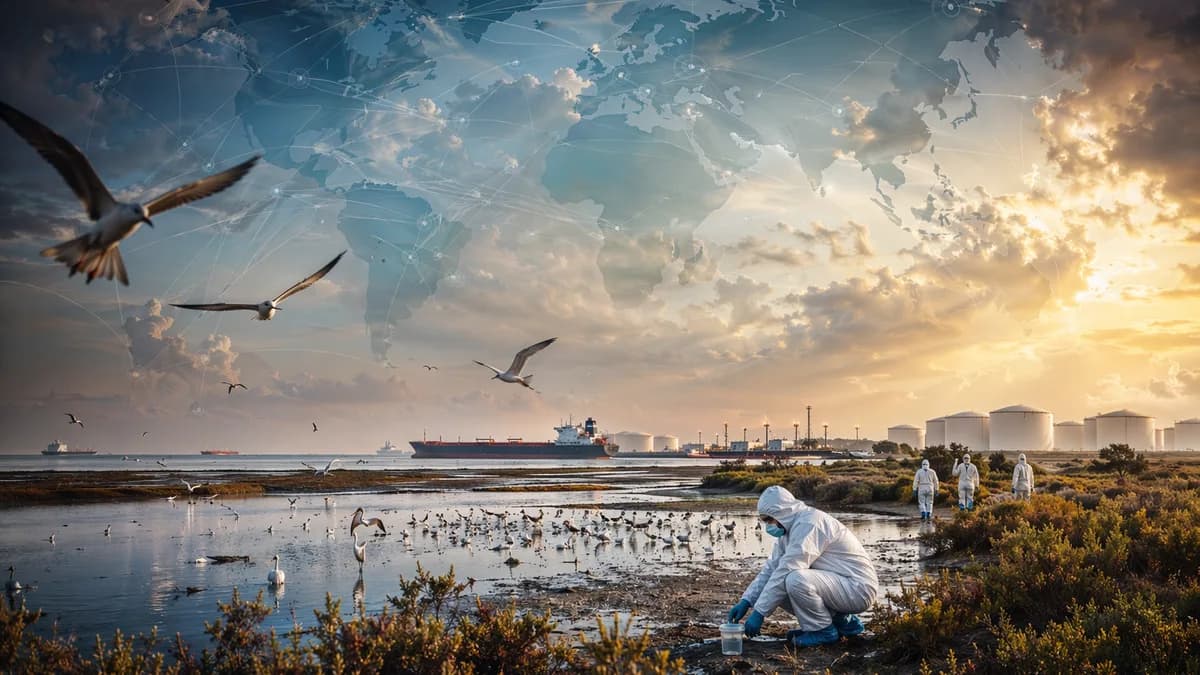
On Saturday, June 20, Australia’s first confirmed mainland case of H5N1 bird flu turned a long-feared biosecurity scenario into a live wildlife emergency, just as politics shifted back to fuel costs and the Strait of Hormuz.
Global TrendsJune 21, 2026· 7 min read· By XOOMAR Insights Team
H5N1 Bird Flu Breaches Australia as Fuel Fight Looms
Updated on June 22, 2026
XOOMAR Intelligence
Analyst Take
71/ 100
4 sources analyzedMedium confidenceTrend10Freshness96Source Trust90Factual Grounding91Signal Cluster40
The connecting thread is exposure. Australia is dealing with pressures that don’t start in Canberra: migratory disease routes, global oil chokepoints, overseas diplomatic deals, and political churn abroad. The updates were tracked by Guardian World, with related reporting from ABC confirming the bird flu detection near Esperance.
| Pressure point | Trigger in the source material | Domestic channel |
|---|---|---|
| H5N1 bird flu Australia | First confirmed mainland detection in Western Australia | Wildlife, poultry risk, biosecurity response |
| Fuel excise rebate | Extended at a reduced rate, according to the Guardian live headline | Cost-of-living politics |
| Strait of Hormuz | Concern over an ongoing toll after a 60-day US-Iran memorandum | Petrol prices, shipping costs, foreign policy |
| Leadership stability | Albanese contrasts continuity with leadership churn | Crisis management message |
June 20 H5N1 confirmation turns Australia’s isolation into a stress test
The most concrete shock is biological. A brown skua found at Cape Le Grand National Park near Esperance tested positive for the deadly H5 bird flu variant, according to ABC. The bird was found on a remote beach and died that night.
ABC reported that Australia had been the last continent where the disease had not spread. That status is now gone.
Federal Agriculture Minister Julie Collins said there was still no evidence of poultry infection or mass wildlife deaths.
“I can confirm that there's still no evidence of any mass mortalities at this time, nor is there any evidence of infection in any poultry,” Collins said.
That sentence matters because it separates detection from spread. One confirmed case is not the same as an entrenched outbreak. But it also narrows the window for action.
The immediate test is surveillance. Authorities are checking whether H5N1 bird flu Australia has established itself in animal populations, while officials have urged people not to touch sick or dead birds and to report sightings to the Emergency Animal Disease Hotline. WA Agriculture Minister Jackie Jarvis also warned that pets should be kept away from wildlife, including cats not roaming and dogs being kept on leads in wildlife areas.
Wildlife emergency fears now sit beside poultry and public health risks
The strongest warning in the source material came from wildlife specialists concerned about native species. Wayne Boardman, a wildlife veterinarian and associate professor at Adelaide University, said the virus could hit Australia’s wildlife hard if confirmed.
“This strain of bird flu has caused huge die-offs of birds and sea mammals,” Boardman said.
He pointed to risks for endangered shorebirds, coastal raptors, and Australian sea lions, whose population he described as “precarious.” That is why experts are framing the arrival of H5N1 bird flu Australia as more than an agricultural problem.
The public health risk remains limited in the supplied material. CBC noted that human infections remain rare. The larger immediate risk is institutional: conservation agencies, wildlife carers, agriculture departments, and emergency managers all need clean reporting lines before scattered detections become a wider animal disease event.
Australia had prepared for this. ABC reported $95 million in biosecurity, environmental, and public health funding last October, plus a further $11.2 million less than 24 hours before the infected bird was announced. The question now is whether preparation built enough speed.
Fuel excise rebate extension keeps cost-of-living politics at the pump
The Guardian live headline also flagged that the fuel excise rebate had been extended at a reduced rate. The supplied source material does not include the new rate, duration, eligibility settings, or fiscal cost, so those details remain unclear from the available record.
What can be said is narrower, and still important. A reduced extension signals the government is trying to keep some pump relief in place without maintaining the previous level of support.
That creates a familiar political squeeze. Voters feel petrol prices immediately. Budget restraint is less visible. Climate goals are even more abstract when households are looking at the bowser.
The practical significance depends on details not provided in the source: how much relief remains, how long it lasts, and whether the reduced rate changes consumer behavior in any measurable way. Without those numbers, the rebate is best read as a political marker rather than a fully assessable policy shift.
Hormuz toll fears put petrol prices back inside foreign policy
Shadow foreign affairs minister Ted O’Brien tied the cost-of-living debate directly to the Strait of Hormuz, warning on ABC’s Insiders about the risk of an ongoing toll after a 60-day memorandum of understanding between the United States and Iran.
“From Australia’s perspective, I think that’s the main thing that we should be concerned about, because that has a direct impact on the prices we pay here in Australia.”
O’Brien’s argument was not just about price. It was about precedent.
“A permanent toll would be bad in practice, wrong in principle, and set a dangerous precedent for how otherwise waterways should be managed internationally.”
That is the bridge between foreign policy and domestic inflation pressure. A toll or restriction in a strategic waterway does not need to happen in Australia’s region to matter to Australian drivers. It can travel through oil pricing, shipping risk, and freight costs.
For related XOOMAR coverage on how Gulf tension turns into pump politics, see Gas Prices Expose America's Iran War Weak Spot at Pump. For the diplomacy track behind the current risk, see Scrapped US-Iran Talks Trap Trump Between Iran, Israel.
The 60-day US-Iran memorandum leaves Canberra watching a temporary fix
The 60-day US-Iran memorandum matters because temporary arrangements can calm nerves without settling the rule at stake. The source material does not say what the memorandum contains, only that O’Brien linked it to concern about an ongoing toll for Hormuz.
That uncertainty is the point. If a temporary arrangement leaves the toll question unresolved, Australia remains exposed through global price channels it cannot directly control.
Canberra’s leverage over such a dispute is limited. Its interest is clear: stable maritime rules, predictable shipping, and no normalization of permanent charges on international waterways outside accepted frameworks.
This is where the story connects back to the fuel excise rebate. Domestic relief can soften pain at the pump, but it cannot remove the external source of the shock.
Albanese turns leadership churn into a stability argument
Prime Minister Anthony Albanese used global and domestic leadership churn to make a quieter political case: stability has value when shocks keep arriving.
“But I must say that the history of just changing leaders is not a positive one.”
He added:
“I’ve dealt with already four British prime ministers since I’ve been elected as prime minister, and so I think stability is a good thing, and I’m on my fourth Liberal party leader as well.”
The message is obvious, but not trivial. Biosecurity, energy relief, Gulf diplomacy, and budget trade-offs all reward governments that can coordinate across agencies and sustain decisions beyond a single news cycle.
The risk for Albanese is also clear. Stability only works as a selling point if voters see competent delivery. Continuity without visible relief can read as drift.
The bigger picture: Australia’s cost-of-living debate is now global
These stories point in the same direction. Australia’s domestic pressures are increasingly shaped by systems that cross borders before they hit households, farms, beaches, and petrol stations.
H5N1 bird flu Australia shows how wildlife disease can breach geographic isolation. The fuel excise rebate shows how quickly global and domestic cost pressures become political. The Hormuz debate shows that shipping rules and diplomatic bargains can end up inside the weekly household budget.
The next decision points are practical: confirm whether bird flu has spread beyond isolated cases, clarify the reduced fuel rebate settings, and watch whether the US-Iran arrangement prevents tolls from becoming a standing feature of Gulf shipping.
Australians may experience these shocks as higher bills or threats to wildlife. The causes sit in a world that is more unstable, and more connected, than political messaging often admits.
Impact Analysis
- Australia’s first confirmed mainland H5N1 case removes a key biosecurity advantage and raises risks for wildlife and poultry.
- Fuel excise changes keep cost-of-living pressure high as global oil and shipping risks remain uncertain.
- The story links domestic politics to external shocks that Australia cannot fully control, from disease migration to energy chokepoints.
Australia's Main Exposure Points
| Pressure point | Trigger | Domestic channel |
|---|---|---|
| H5N1 bird flu | First confirmed mainland detection in Western Australia | Wildlife, poultry risk, biosecurity response |
| Fuel excise rebate | Extended at a reduced rate | Cost-of-living politics |
| Strait of Hormuz | Concern after a 60-day US-Iran memorandum | Petrol prices, shipping costs, foreign policy |
| Leadership stability | Albanese contrasts continuity with leadership churn | Crisis management message |
Sources

Written by
XOOMAR Insights Team
Research and Editorial Desk
The XOOMAR Insights Team pairs automated research with human editorial judgment. We track hundreds of sources across technology, fintech, trading, SaaS, and cybersecurity, cross-check the facts, and explain what happened, why it matters, and what to watch next. We do not just rewrite headlines. Every article is fact-checked and scored for reliability before it goes live, and we link back to the original sources so you can verify anything yourself.
Explore More Topics
Related Articles
 Global Trends
Iran Seizes Control Over Strait of Hormuz Via Secret Oman Deal
Iran formalized a temporary shipping route with Oman, cementing Tehran's administrative control over the Strait of Hormuz while keeping blame for insecurity on
Aug 5, 20266 min
 Global Trends
Trump Iran Talks Turn Paused U.S. Strike Into Leverage
Trump paused U.S. strikes to force Iran back to talks, but the threat could deepen the Hormuz and nuclear standoff.
Aug 3, 20267 min
 Global Trends
Trump Shelves Iran Strikes Unless a Deal Lands Fast
Trump says Iran strikes are shelved only if a rapid deal opens Hormuz and ends the nuclear threat. The pressure hasn't vanished.
Aug 2, 20265 min
 Global Trends
US-Escorted Tankers Hit as Strait of Hormuz Shuts Down
Iran says it struck two US-escorted tankers, nearly closing Hormuz and forcing Trump to weigh war strategy as energy prices jump.
Jul 31, 20267 min
 Global Trends
Oil Shock Exposes Germany Energy Drag Behind Ifo Jump
Germany’s Ifo jump may be stale. Commerzbank sees oil costs capping 2026 growth at just 0.6%.
Jul 28, 20267 min
 Trading
Gold's Lockstep Surge Hints at Dollar Replay
Gold is rallying alongside oil, breaking its traditional inverse relationship. This reveals a market shift—bullion is pricing a tangible inflation premium from
Aug 6, 20266 min
 Trading
Iran Demands Shipping Toll To Reopen Oil Chokepoint
Global markets rallied on news of the Strait of Hormuz reopening, but the deal would grant Iran unprecedented control to collect transit tolls.
Aug 6, 20266 min
 Trading
WTI Crude Paralyzed at $74 Amid Hormuz Showdown
WTI crude prices are stuck near three-week lows, not due to calm but to paralysis as traders await a binary outcome for the Strait of Hormuz that could detonate
Aug 6, 20267 min
 Trading
Pound Defies Rate Reality on Political Relief Rally
The British pound is holding steady despite unfavorable rate spreads, as positive political sentiment under new PM Andy Burnham battles massive financial headwi
Aug 7, 20266 min
 Technology
Nike and Adidas Lose Their Grip on Running Shoes
Established running shoe giants are losing ground to five emerging brands that are winning over testers with better value, durability, and innovative tech.
Aug 7, 20268 min
Don't miss the signal
Get our weekly roundup of the stories that matter across tech, fintech, and trading. No noise, just signal.
Free forever. No spam. Unsubscribe anytime.