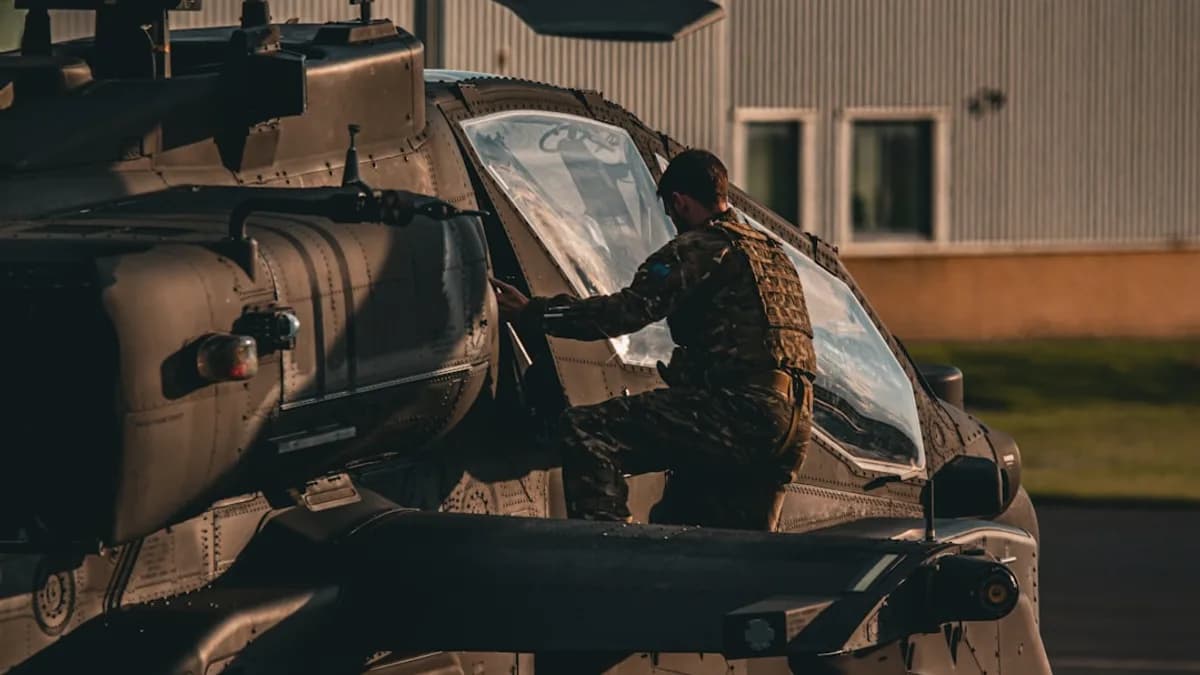
Two US Army soldiers were rescued within approximately two hours after their AH-64 Apache helicopter went down near the Strait of Hormuz, with US officials saying an American sea drone picked them up in what they described as the first operation of its kind for US forces.
XOOMAR Intelligence
Analyst Take
The uncrewed vessel was operated by Task Force 59, military officials told CBS News, according to BBC World. US Central Command said the helicopter crashed Monday “near the coast of Oman while patrolling regional waters,” and that both soldiers were in stable condition after being recovered at 19:33 EDT on Monday, or 23:33 GMT.
2 soldiers recovered after Apache goes down near Oman
CENTCOM said the two soldiers were “safely rescued within approximately two hours” after the Apache went down. The command did not initially say the rescue was carried out by an unmanned vessel, but officials later told CBS News the crew was picked up by an uncrewed surface drone.
“Rescue efforts were led by US Naval Forces Central Command and the 82nd Airborne Division, with support from US Air Force and Navy units including US 5th Fleet's Task Force 59,” CENTCOM said, according to the BBC.
The aircraft was an AH-64 Apache, an American-made twin-turboshaft attack helicopter. CENTCOM said it had been patrolling regional waters. Officials have not released coordinates for the crash site, and the available statements describe the location only as near Oman and near the Strait of Hormuz.
The cause remains under investigation. The BBC reported that it was not immediately clear whether the helicopter had a mechanical or other technical problem, or whether it had been downed by Iranian fire.
President Donald Trump told reporters earlier that the two crew members were “fine,” and said a report into the incident would be issued later.
| Confirmed by officials | Not yet confirmed |
|---|---|
| Two soldiers were rescued | Exact crash coordinates |
| Rescue happened within approximately two hours | The specific drone model used |
| The helicopter was an AH-64 Apache | Whether the cause was mechanical, technical, or hostile action |
| The aircraft was patrolling regional waters near Oman | Whether the mission was routine patrol beyond what CENTCOM described |
| Task Force 59 operated the sea drone, according to officials speaking to CBS News | Full rescue sequence and command timeline |
Strait of Hormuz crash site makes a routine mishap harder to read
The geography is doing a lot of work here. The Strait of Hormuz is one of the world’s most sensitive maritime corridors, and any US military incident near it carries more weight than the same crash in a lower-pressure operating area.
That does not mean hostile action occurred. Officials have not confirmed that. CENTCOM has said only that the Apache went down while patrolling regional waters, and that the cause is being investigated.
The sensitivity comes from the combination of aircraft type, location, and timing. An Apache is an attack helicopter, not a transport aircraft. The crash happened near Oman, close to a waterway that sits at the center of recurring US-Iran military tension.
Iranian fire is one of the possibilities the BBC said had not been ruled in or out. That wording matters. It leaves the question open, but it does not establish Iranian involvement.
For now, the strongest confirmed fact is narrower and still significant: a US Army attack helicopter crashed during a patrol near a strategic maritime chokepoint, and its two crew members survived.
First US sea drone rescue pushes Task Force 59 into view
The rescue method is the most novel part of the incident. Officials told CBS News the soldiers were recovered by an uncrewed surface drone, making it the first such rescue operation carried out by US forces.
Task Force 59, based with the US 5th Fleet, has been the Navy’s main unit for unmanned maritime systems in the region. The BBC reported that in 2024, Task Force 59 launched a new unit focused on “the operational deployment of unmanned systems teamed with manned operators to bolster maritime security across the Middle East region.”
That phrasing is important. These systems are not being presented as fully independent machines acting alone. The military description points to unmanned platforms paired with human operators.
A US official told ABC News, according to the BBC, that the vessel used in the rescue had a speed boat-like design. Officials have not said which drone model was involved, how it located the soldiers, or how the handoff to medical care was carried out.
XOOMAR analysis: The operational significance is specific, not abstract. A drone boat that can reach downed crew at sea gives commanders another rescue option without immediately putting more personnel into the water or air. That matters most in areas where a crash site could be dangerous, politically sensitive, or hard to access quickly.
Still, the available record does not support sweeping claims about a new rescue doctrine. This is one incident, and officials have released only the outline of the operation.
Investigation now turns on cause, drone type, and official timeline
The next phase will be less dramatic but more important. Investigators need to determine why the Apache went down, whether a mechanical or other technical issue was involved, and whether any hostile action played a role.
CENTCOM has said the incident is under investigation. The BBC said it has approached CENTCOM for comment. Trump also said a report would come later.
The technical details of the sea drone will draw scrutiny too. Officials have confirmed the use of an uncrewed surface vessel, but not the model, sensor package, control method, or recovery procedure.
Those details will show whether this was an improvised use of a nearby unmanned vessel or a planned capability that commanders expected to be available during patrols.
The practical watch item is clear: the next official statements need to answer three questions, what brought the Apache down, how the crew was located and recovered, and whether US forces change anything about patrols near the Strait of Hormuz after the first confirmed sea drone rescue of American service members.
Impact Analysis
- The rescue marks a reported first for US forces using an uncrewed sea drone in a recovery operation.
- The crash occurred near the Strait of Hormuz, a strategically vital and often tense maritime corridor.
- The cause remains under investigation, leaving open questions about mechanical failure, technical issues, or hostile action.
Primary Sources & Disclosures

Written by
XOOMAR
Data desk
XOOMAR is a capital markets software and data company. Every brief on this site starts from a dataset the company collects itself from primary sources (CFTC, SEC EDGAR, FINRA, the Federal Reserve, exchange APIs) and names the numbers it is built on, with a link to the data page so you can check them. Briefs are reviewed before they go out and corrected in place when the data is revised.