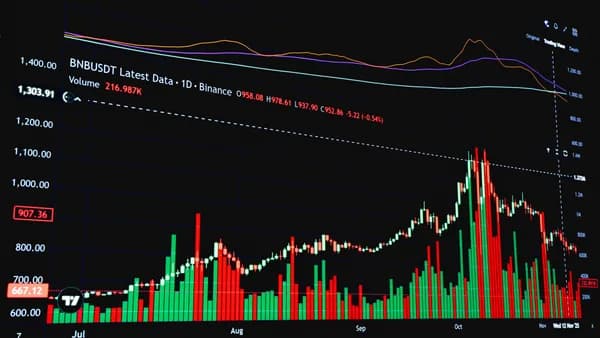
Bitcoin and ether failed their first risk-on test under Kevin Warsh’s Fed: stocks rallied on a signed Iran deal, while crypto sold off on the message that inflation still has the central bank’s full attention.
XOOMAR Intelligence
Analyst Take
That split is the story. Bitcoin traded around $63,900, down 3% over 24 hours, while ether fell 3.4% to $1,733, according to CoinDesk. S&P 500 futures rose as much as 0.9% and Nasdaq futures gained 1.5% after President Donald Trump signed an interim Iran deal to end the war and reopen the Strait of Hormuz.
The market message is blunt. The Bitcoin ether Fed trade is still a liquidity trade. Crypto did not behave like a clean hedge against policy shocks or geopolitical stress. It behaved like a high-duration risk asset that needs easier financial conditions to move higher.
Bitcoin and ether failed the risk-on test after Warsh’s hawkish Fed debut
The trigger was not the rate decision itself. The Federal Reserve left rates unchanged at 3.5% to 3.75%, which matched expectations. The problem was the guidance around it.
CoinDesk reported that the Fed’s updated projections pointed to higher inflation and a slower pace of future rate cuts, while some officials floated the possibility that rates may still need to rise. That was enough to push crypto lower even as equities caught a relief bid from the Iran deal.
This was Kevin Warsh’s first decision as Fed chair. He said there had been rigorous debate before the vote and pledged that the central bank would deliver price stability. XOOMAR analysis: that language matters because it sets the early tone for the Warsh Fed. Investors heard an inflation-first reaction function, not a growth-protection pivot.
The result was a clean cross-asset split:
| Asset or market | Move reported |
|---|---|
| Bitcoin | Around $63,900, down 3% over 24 hours |
| Ether | Down 3.4% to $1,733 |
| XRP | Down 3.9% to $1.17 |
| Solana | Down 3.6% to $71 |
| HYPE | Down 7.2% to $69, still up about 28% over seven days |
| Tron | Up 0.9% |
| S&P 500 futures | Up as much as 0.9% |
| Nasdaq futures | Up 1.5% |
| Brent crude | Fell toward $78 a barrel |
That table captures the core issue. The Iran deal helped stocks. It did not give crypto the liquidity bid it needed.
Warsh held rates, but his inflation-first message still tightened conditions
A central bank can tighten without hiking. It can do it through projections, tone, and by reducing market confidence in near-term cuts. That is what happened here.
The Fed’s rate hold at 3.5% to 3.75% looked neutral on the surface. The surrounding message was not neutral. Higher inflation projections, slower expected cuts, and open discussion of possible future hikes all point in the same direction: borrowing costs may stay higher for longer.
That matters for bitcoin and ether because neither asset pays a conventional yield. When the market hears that the Fed may keep policy restrictive, the opportunity cost of holding crypto rises. Speculative positioning also gets less forgiving. Traders have less room to bet on future liquidity when the central bank is warning that inflation remains the larger threat.
This follows the same Fed pressure point discussed in XOOMAR’s related analysis, Warsh Fed Rips Up Rate Map After Federal Reserve Rate Hold, and the broader setup around Warsh Era Opens as Federal Reserve Freezes Interest Rates. The useful point for crypto investors is not that rates stayed put. It is that the market’s expected path for policy became less friendly.
XOOMAR analysis: Warsh’s first meeting looks like a credibility exercise. By stressing price stability at the start of his tenure, he gave investors fewer reasons to front-run cuts. That hits crypto harder than equities when another headline, in this case Iran, gives stocks a separate reason to rally.
The data shows crypto ignored the stock-market relief trade
The Bitcoin ether Fed reaction was broad, not isolated to one token. XRP, solana, and HYPE all sold off. Even HYPE, described by CoinDesk as the standout gainer all week, fell the hardest among the named majors at 7.2%, though it remained up about 28% over seven days.
Tron was the exception, up 0.9%. The source material does not explain why Tron diverged, so the clean read is limited: it was the lone major in the green during an otherwise broad crypto decline.
The outline for this analysis calls for dollar strength, Treasury yields, fed funds futures pricing, liquidations, options positioning, exchange flows, ETF flows, and funding rates. The supplied source does not provide those figures. That absence matters. Without those datapoints, it is not possible to say from the verified material whether the selloff was spot-led or leverage-driven.
What can be said: the visible market split was between geopolitical relief and monetary restraint. Stocks responded to the signed Iran agreement. Crypto responded to the Fed.
"We expect bitcoin to continue to trade in the $60,000 to $70,000 range in the coming weeks absent any major catalyst," said Gerry O’Shea, head of global market insights at Hashdex.
O’Shea named two possible catalysts: the signing of the CLARITY Act, a crypto market-structure bill, into law, or further U.S.-Iran de-escalation.
Iran relief helped equities, but crypto needed a Fed signal
The Iran deal gave equities a clear reason to rally. Trump signed an interim agreement to end the war with Iran and reopen the Strait of Hormuz, putting it into effect. Brent crude fell toward $78 a barrel.
For stocks, that was enough to lift futures. For crypto, it was not.
XOOMAR analysis: the difference is that the Iran headline reduced one kind of risk, while the Fed increased another. Equities could trade the geopolitical relief directly. Bitcoin and ether needed confirmation that liquidity conditions were improving. They did not get it.
There is a possible inflation channel here. If energy pressure eases, that could help the inflation picture over time. But the Fed’s current posture, as described by CoinDesk, says officials are not ready to treat inflation as beaten. That is why the Bitcoin ether Fed setup remains capped even when oil-related stress cools.
The political backdrop also connects to XOOMAR’s related coverage, Trump Iran Deal Exposes the Fantasy Behind His War. For markets, the important point is narrower: de-escalation lifted stock futures, but the crypto market cared more about the Fed’s price-stability signal.
Different investors will read this split in opposite ways
Crypto bulls can frame the move as consolidation, not capitulation. CoinDesk made that point directly: bitcoin holding in the low $64,000s suggests the worst of the selling pressure may be easing, even as buyers remain cautious.
Macro traders will read the same tape differently. To them, the failure to rally on an Iran deal confirms that bitcoin remains tied to rate expectations. That is the cleaner interpretation from the verified data. The Fed moved the crypto market more than diplomacy did.
ETF issuers, exchanges, miners, and validators are not all exposed in the same way, but the pressure point is shared: lower token prices and weaker sentiment can reduce appetite for crypto risk. CoinDesk reported O’Shea’s view that sentiment has been weak as IPOs and AI stocks pulled attention away from crypto, though he expects capital to rotate back as institutional interest grows and regulation formalizes.
That is an analyst view, not a guarantee. The near-term market still needs a catalyst.
Bitcoin’s range is now the market’s report card on Warsh
The working range is clear because Hashdex put numbers on it: $60,000 to $70,000. A break above that range would likely require a stronger catalyst than generic risk appetite. O’Shea cited the CLARITY Act becoming law or further U.S.-Iran de-escalation as examples.
A move toward the lower end would say the Fed’s inflation-first tone is still dominating. A hold near the low $64,000s would support the consolidation view. A failure there would weaken it.
For ether, the immediate verified story is simpler: it dropped 3.4% to $1,733 alongside the broader market. The supplied source does not provide network revenue, staking, layer-2, or flows data, so any deeper ether-specific valuation claim would go beyond the record.
The practical read for the next quarter is disciplined: watch rate-cut expectations, oil, bitcoin’s $60,000 to $70,000 range, and whether crypto can respond to positive non-Fed headlines. If softer inflation evidence changes the Fed tone, bitcoin and ether could regain momentum quickly. If inflation keeps Warsh sounding restrictive, diplomatic optimism alone probably will not power the next crypto rally.
Disclaimer: This XOOMAR analysis is for informational and educational purposes only. It is not financial, investment, legal, tax, or professional advice. It does not provide buy, sell, hold, price-target, portfolio, or personalized recommendations. Verify information independently and consult qualified professionals before making decisions.
The Bottom Line
- Crypto’s selloff suggests bitcoin and ether remain sensitive to Fed liquidity expectations.
- Stocks benefited from geopolitical relief while crypto focused on tighter-for-longer policy risk.
- Kevin Warsh’s first Fed decision signaled an inflation-first stance that could pressure high-duration assets.
Crypto vs. equity reaction to Fed guidance and Iran deal
| Asset or market | Move reported | Driver |
|---|---|---|
| Bitcoin | Down 3% to about $63,900 | Hawkish Fed guidance |
| Ether | Down 3.4% to $1,733 | Hawkish Fed guidance |
| S&P 500 futures | Up as much as 0.9% | Iran deal relief rally |
| Nasdaq futures | Up 1.5% | Iran deal relief rally |
Reported market moves
Primary Sources & Disclosures
Disclaimer: Content on XOOMAR is produced using AI-assisted research, drafting, and verification workflows and is intended for informational and educational purposes only. It does not constitute financial, investment, legal, tax, medical, or professional advice of any kind. All analysis reflects available information at the time of publication and may not be current. Verify information independently and consult qualified professionals before making decisions. Editorial policy

Written by
XOOMAR
Data desk
XOOMAR is a capital markets software and data company. Every brief on this site starts from a dataset the company collects itself from primary sources (CFTC, SEC EDGAR, FINRA, the Federal Reserve, exchange APIs) and names the numbers it is built on, with a link to the data page so you can check them. Briefs are reviewed before they go out and corrected in place when the data is revised.