
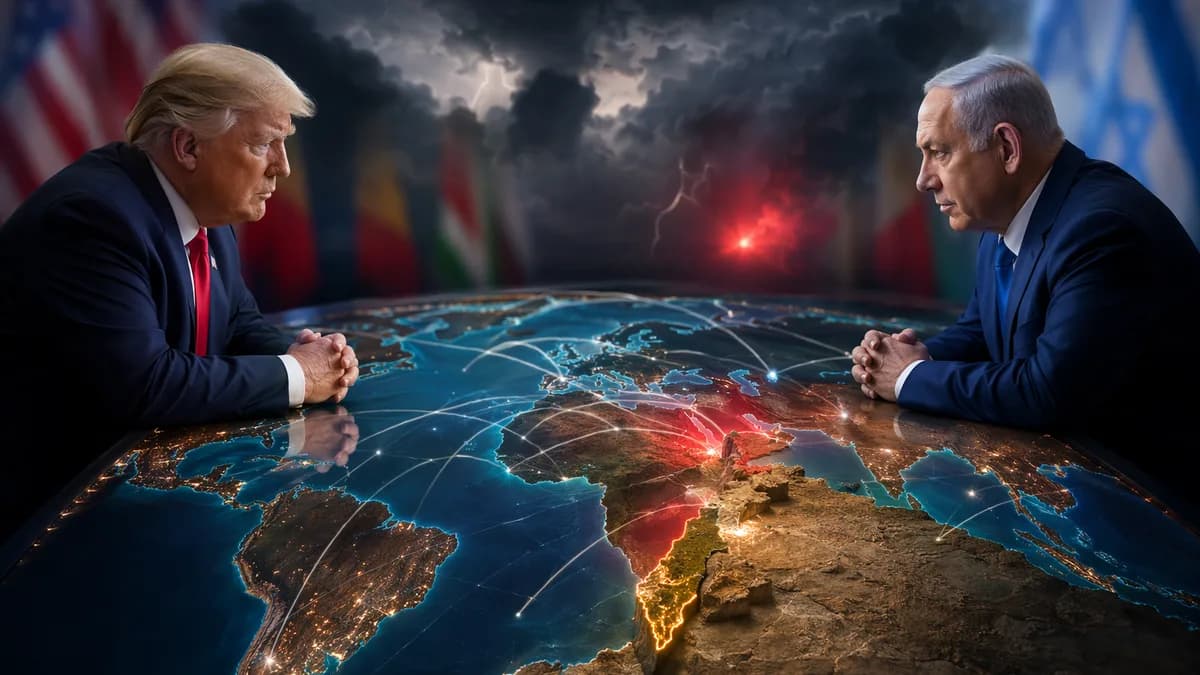
Trump Netanyahu Lebanon tensions are now a live risk to the U.S.-Iran talks, after President Donald Trump publicly told Prime Minister Benjamin Netanyahu to be “more responsible with respect to Lebanon.”
Global TrendsJune 20, 2026· 9 min read· By XOOMAR Insights Team
Trump Corners Netanyahu as Lebanon Threatens Iran Deal
Updated on June 22, 2026
XOOMAR Intelligence
Analyst Take
73/ 100
4 sources analyzedMedium confidenceTrend10Freshness96Source Trust88Factual Grounding92Signal Cluster40
Trump made the remarks Tuesday at the G7 summit in France, saying he was “not happy with the way Israel has handled themselves with Lebanon and with Hezbollah,” according to Time. The rebuke landed as Washington tries to preserve a U.S.-Iran agreement that Trump says has moved into its “second stage,” even though the permanent truce remains unresolved.
“It just goes on forever,” Trump said of the Israel-Hezbollah fighting. “When that happens, it throws a negative light on the big deal, the deal with Iran.”
XOOMAR analysis: The point is not that Trump has broken with Israel. He repeatedly stressed his relationship with Netanyahu. The point is that he has now framed Israel’s Lebanon campaign as a complication for his Iran diplomacy. That turns a private allied disagreement into a public pressure campaign.
Trump Netanyahu Lebanon Warning Turns an Ally’s War Into a U.S. Diplomatic Problem
Trump’s wording matters because it narrows the room for ambiguity. Saying Netanyahu has to be “more responsible with respect to Lebanon” is not a routine call for restraint. It assigns responsibility.
CBS reported that Trump also said he “didn’t like” an Israeli attack in Beirut “two hours” before the signing of the agreement with Iran, describing the attack as “vicious” and “too much.” Time separately reported Trump’s complaint that Israel “should have been able to do the job faster.”
That is the core tension. Trump wants the U.S.-Iran peace deal to project control. Israel’s continued strikes in Lebanon make that harder, especially when Iran says Israeli actions could complicate the deal.
The President is trying to hold two positions at once:
- Support Israel: Trump said he has an “unbelievable relationship” with Netanyahu.
- Protect the Iran deal: He warned that the Lebanon fighting casts “a negative light” on the agreement.
- Avoid looking constrained: He claimed “Israel would have been blown up a long time ago, had I not gotten involved.”
This follows the pressure pattern we tracked in Trump's Iran Peace Deal Erases US Red Lines at Versailles, where the deal’s political value depends heavily on whether Trump can show that regional actors are moving in line with Washington’s timetable.
Lebanon and Hezbollah Are Becoming the Weak Link in Trump’s Iran Strategy
The Israel-Hezbollah front is dangerous for Trump because it sits beside, not inside, the Iran deal. That makes it harder to control.
Trump called the Lebanon war “minor” compared with Iran.
“I consider that the minor war. Iran’s the big one, but we have that little pinprick out there that constantly rears its head and that’s Hezbollah,” he said.
That framing reveals Washington’s sequencing problem. Trump wants to lock in the Iran agreement first. Israel, based on Netanyahu’s Monday night address, is not ready to withdraw from Lebanon. Netanyahu said Israel had established deep security zones in Gaza, Lebanon, and Syria, and vowed: “We will remain in the security zones for as long as it is required to defend our country.”
Those positions don’t easily fit together. A deal with Iran may require enough calm in Lebanon to avoid giving Tehran a reason to slow or challenge implementation. Israel’s current position points the other way: security zones remain until Israel judges the threat reduced.
Some Israeli officials have already signaled resistance to U.S. constraints. Time cites Israeli officials reacting negatively to the U.S.-Iran agreement, including the line that “Israel is not subject to the United States.” CBS reported Israeli officials said troops are expected to stay in Lebanon because “Trump's agreement does not bind us.”
That is the weak link. A bilateral U.S.-Iran document can be signed. It cannot, by itself, force Israel’s Lebanon calculus to change.
The Numbers Behind Washington’s Anxiety Are Small Only If Iran Stays Out
The human cost in Lebanon is already severe. Since the Israel-Hezbollah fighting reignited in March, at least 3,783 people have been killed in Lebanon and 11,699 wounded, according to Lebanon’s Health Ministry, as cited by Time.
Trump still described the conflict as secondary to Iran. That does not make it strategically harmless.
| Issue | Source-backed fact | Why it matters |
|---|---|---|
| Lebanon casualties | 3,783 killed, 11,699 wounded | The “minor war” label clashes with the scale of civilian harm reported by Lebanon’s Health Ministry |
| Iran deal status | Digitally signed, in “second stage” | The deal exists, but a permanent truce has not been negotiated |
| Deal text | Vance called the memorandum “a very general” document, around “a page and a half” long | The framework appears thin, leaving room for disputes |
| Formal signing | Expected Friday in Geneva | Near-term timing raises the cost of disruptive military action |
| Strait of Hormuz | Around a fifth of global oil production flows through it | Any failure around Iran talks can hit energy and shipping assumptions fast |
The Strait of Hormuz is the direct market channel in the source material. Trump says the agreement assures the passage will fully reopen Friday with no tolls. Time also cites experts saying it could take weeks or months for traffic through the Strait to return to its pre-war state.
XOOMAR analysis: That is why Lebanon matters to markets even if traders do not price every border clash. The market risk does not come only from Lebanon. It comes from Lebanon knocking the Iran deal off schedule, especially when Hormuz reopening is part of the diplomatic package.
Netanyahu, Trump, Hezbollah, Iran, and Lebanon Are Not Aiming at the Same Finish Line
Netanyahu’s stated objective is security. His Monday address emphasized security zones and the need to defend Israel. He did not offer an immediate withdrawal timeline.
Trump’s stated objective is the Iran deal. He said the agreement contains guarantees that prevent Iran from developing or purchasing a nuclear weapon.
“They're not going to acquire a nuclear weapon. If they do, all hell will rain down on them, and they're not going to do that,” Trump told reporters.
Iran’s position, as reflected in the supplied reporting, is more conditional. The U.S. and Iran say a permanent truce has yet to be negotiated. Officials have indicated that Iran’s nuclear program and broader regional security arrangements will be deferred to later talks.
Lebanon’s position is visible mostly through the damage. The Health Ministry casualty figures show the country bears the cost of the Israel-Hezbollah conflict. The supplied material does not establish how much control Beirut has over Hezbollah, so that should not be overstated. What is clear is that Lebanon is central to the fallout while the key bargaining is happening elsewhere.
That mismatch mirrors the breakdown we covered in New Strikes Shake Israel Hezbollah Ceasefire Claim, where battlefield activity kept undermining diplomatic claims of containment.
The 2006 Comparison Is Less Useful Than the Current Constraint
The outline of this crisis invites a comparison to past Israel-Hezbollah wars, but the supplied source material does not provide enough verified historical detail to build that comparison responsibly.
The current facts are enough. Netanyahu says Israel will remain in security zones as long as required. Trump says Israel’s handling of Lebanon and Hezbollah is damaging the optics of the Iran deal. Iran and the U.S. have not yet negotiated a permanent truce. Vance has described the memorandum as “a very general” document, around “a page and a half” long.
That creates a fragile diplomatic structure. The Lebanon front does not need to become a full regional war to create trouble. It only needs to generate enough violence, timing conflict, or political pressure to slow the next phase of talks.
Markets Should Watch Hormuz, Not Just Beirut
For market readers, the immediate source-backed channel is energy and shipping risk tied to Hormuz. Trump says the Strait will reopen fully on Friday with no tolls. Experts cited by Time say traffic may take weeks or months to return to its pre-war state.
That gap matters. Political announcements can move faster than vessels, insurers, and counterparties.
Defense, cybersecurity, and regional asset pricing may react if the conflict escalates, but the supplied sources do not provide company-level or sector-level evidence. The stronger read is narrower: if Lebanon disrupts the Iran process, Hormuz becomes the market transmission point.
XOOMAR analysis: Investors should treat Trump’s warning as a signal that Washington sees Lebanon as a risk variable in the Iran trade, not as a separate humanitarian or military file. If Beirut strikes continue around signing milestones, the market story shifts from “Iran deal implementation” to “Iran deal stress test.”
Three Paths After Trump’s Public Pressure on Netanyahu
The next phase turns on whether Trump’s warning changes behavior.
- Managed de-escalation: Israel reduces the tempo or visibility of Lebanon operations, Iran keeps the agreement moving, and the Friday Geneva signing proceeds without a Lebanon-triggered rupture.
- Controlled escalation: Israel keeps striking Hezbollah, Hezbollah responds, and the conflict remains bloody but contained while U.S.-Iran diplomacy limps forward.
- Deal-breaking shock: A major strike, mass casualty event, or dispute over Israeli forces in Lebanon gives Iran reason to slow or challenge the process.
The evidence that would support Trump’s preferred path is concrete: fewer Lebanon strikes near diplomatic deadlines, clearer public alignment from Israel, and progress from the “second stage” toward a permanent truce.
The evidence that would weaken it is just as concrete: Netanyahu standing firm on open-ended security zones, Israeli officials insisting the Trump agreement does not bind them, and Iran tying implementation to Israel’s conduct in Lebanon. That is the pressure point now. The Trump Netanyahu Lebanon clash is no longer a side issue. It is becoming a test of whether Trump can make his Iran deal survive contact with Israel’s war next door.
Impact Analysis
- Trump’s public rebuke signals rare open pressure on Netanyahu over Israel’s Lebanon campaign.
- The fighting risks undermining the U.S.-Iran agreement before a permanent truce is secured.
- Lebanon has become a key flashpoint linking Israel-Hezbollah conflict to broader regional diplomacy.
Diplomatic Tension Over Lebanon
| Actor | Position | Why It Matters |
|---|---|---|
| Trump / U.S. | Wants Israel to be “more responsible” in Lebanon while preserving the U.S.-Iran peace process. | Frames Israeli strikes as a risk to Washington’s Iran diplomacy. |
| Netanyahu / Israel | Continues military action against Hezbollah in Lebanon. | Keeps pressure on Hezbollah but complicates U.S. efforts to stabilize the region. |
| Iran | Warns Israeli actions could complicate the deal. | Uses the Lebanon conflict as leverage in negotiations. |
Sources

Written by
XOOMAR Insights Team
Research and Editorial Desk
The XOOMAR Insights Team pairs automated research with human editorial judgment. We track hundreds of sources across technology, fintech, trading, SaaS, and cybersecurity, cross-check the facts, and explain what happened, why it matters, and what to watch next. We do not just rewrite headlines. Every article is fact-checked and scored for reliability before it goes live, and we link back to the original sources so you can verify anything yourself.
Explore More Topics
Related Articles
 Global Trends
Trump Shelves Iran Strikes Unless a Deal Lands Fast
Trump says Iran strikes are shelved only if a rapid deal opens Hormuz and ends the nuclear threat. The pressure hasn't vanished.
Aug 2, 20265 min
 Global Trends
Israeli Strikes Rattle Hamas Disarmament Deal as 8 Die
Israeli strikes killed at least eight in Gaza, putting Hamas’s new disarmament pledge under immediate pressure.
Aug 2, 20268 min
 Global Trends
Salman Rushdie Attacker Faces Life After Terror Conviction
Hadi Matar’s attack on Salman Rushdie is now a federal terrorism conviction, with a possible life sentence beyond his 25-year term.
Jul 29, 20267 min
 Global Trends
Bill Shock Sends Great Britain Solar Installations Flying
Great Britain’s solar rush hit a 15-year high as fossil fuel costs scared households into putting energy security on their roofs.
Jul 31, 20268 min
 Global Trends
Bread and Fear Push Iran Internal Crises to the Brink
Iran’s war narrative is cracking as inflation, executions and public defiance turn daily life into Tehran’s most dangerous front.
Jul 30, 202611 min
 Trading
Iran Demands Shipping Toll To Reopen Oil Chokepoint
Global markets rallied on news of the Strait of Hormuz reopening, but the deal would grant Iran unprecedented control to collect transit tolls.
Aug 6, 20266 min
 Technology
Trump AI Framework Excludes Open Models in Cybersecurity Blind Spot
The Trump administration's AI testing framework excludes open models, creating a two-tier system that favors corporate labs and leaves a critical cybersecurity
Aug 5, 20267 min
 Trading
Gold's Lockstep Surge Hints at Dollar Replay
Gold is rallying alongside oil, breaking its traditional inverse relationship. This reveals a market shift—bullion is pricing a tangible inflation premium from
Aug 6, 20266 min
 Technology
How Her's AI Dream Stalled in Consumer Apathy
Despite billions in investment and inspiration from the movie 'Her,' mainstream consumers aren't adopting AI agents, viewing them as unreliable solutions to pro
Aug 6, 20267 min
 Technology
AirPods Pro Plunge to $189 in Rare $60 Sale
The AirPods Pro have dropped to $189.99, their lowest price since June, in a coordinated sale across Amazon, Walmart, and Best Buy signaling a final pre-holiday
Aug 6, 20266 min
Don't miss the signal
Get our weekly roundup of the stories that matter across tech, fintech, and trading. No noise, just signal.
Free forever. No spam. Unsubscribe anytime.